

Hey there! As a supplier of 4-Pin Automotive Relays, I'm super stoked to break down how these little wonders work in a central locking system. It's pretty cool stuff, and I'll do my best to make it easy to understand.
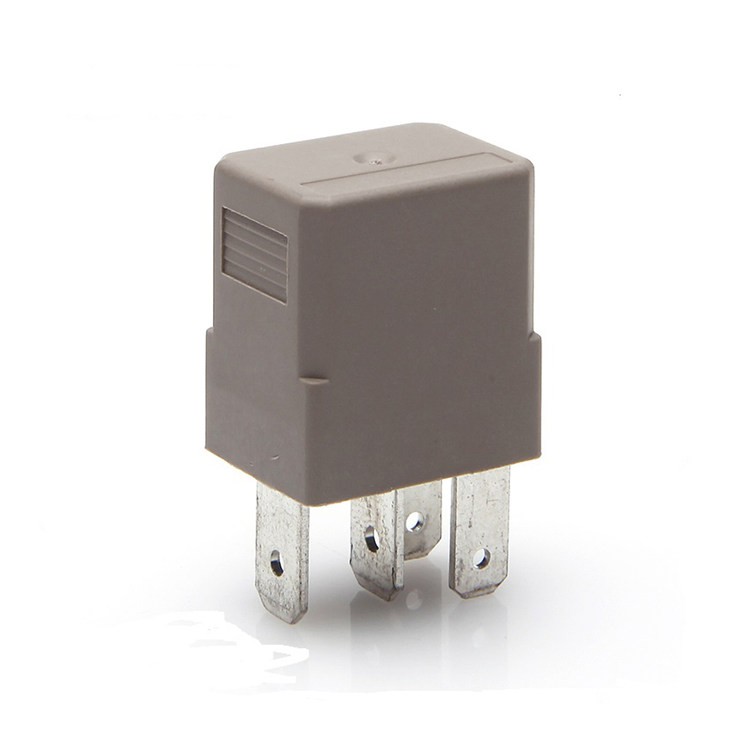
First off, let's talk about what a 4-Pin Automotive Relay actually is. It's a switch, but not your regular wall switch. This bad boy uses an electromagnetic field to control the flow of electricity. It's got four pins, and each one has a specific job.
In a central locking system, the relay plays a crucial role. You know how you can lock and unlock your car doors with just a press of a button on your key fob? Well, that's where the relay steps in.
Let's dig into the four pins of the relay. There are two for the coil and two for the contacts. The coil pins are like the brains of the operation. When you send an electrical signal to these pins, it creates a magnetic field. It's similar to how a magnet attracts metal, but in this case, the magnetic field is used to control the other part of the relay.
The other two pins are the contacts. One is the normally open (NO) contact, and the other is the common (COM) contact. When there's no electrical signal going through the coil pins, the NO contact and the COM contact are not connected. But when you send that signal to the coil pins, the magnetic field causes a switch to close, and the NO contact connects to the COM contact.
So, how does this all fit into the central locking system? When you press the lock or unlock button on your key fob, it sends a signal to the car's control unit. The control unit then sends an electrical signal to the relay's coil pins. This creates the magnetic field, and the relay's contacts close.
Once the contacts are closed, it allows electricity to flow to the locking or unlocking mechanism in the doors. For example, if you're unlocking the doors, the electricity powers a small motor in each door that turns the lock. And just like that, you can open your car doors with ease.
Now, let's talk about some of the specific types of 4-Pin Automotive Relays that are commonly used in central locking systems. One popular option is the 12V Automotive Relay 4-Pin. This relay is designed to work with a 12-volt electrical system, which is standard in most cars. It's reliable and can handle the electrical load required to operate the central locking system.
Another type is the Car Horn Relay. While it's primarily used for the car horn, it works on the same principle as the relay in the central locking system. When you press the horn button, it sends a signal to the relay, which then allows electricity to flow to the horn, making that loud beep.
The 12 Volt Car Relay is also a great choice for various automotive applications, including central locking. It's built to withstand the harsh conditions inside a car, like vibrations, temperature changes, and electrical interference.
One of the great things about 4-Pin Automotive Relays is their versatility. They're not just limited to central locking systems. You can find them in other parts of the car, like the headlights, windshield wipers, and even the fuel pump.

But why use a relay in the first place? Well, without a relay, the electrical signals from the control unit would have to directly power the locking or unlocking motors in the doors. These motors draw a relatively large amount of current, and the control unit might not be able to handle that load. The relay acts as a middleman, allowing the control unit to send a small signal to the relay, which then controls the flow of a larger current to the motors.
It's also a safety feature. If there's a problem with the electrical system, like a short circuit, the relay can protect the control unit and other components by cutting off the flow of electricity.
When it comes to choosing the right 4-Pin Automotive Relay for your central locking system, there are a few things to consider. First, make sure it's rated for the correct voltage. As I mentioned earlier, most cars use a 12-volt system, so a 12-volt relay is usually the way to go.
You also want to look at the relay's current rating. This tells you how much electrical current the relay can handle. If the current rating is too low, the relay might overheat or fail.
Another important factor is the quality of the relay. A high-quality relay will be more reliable and last longer. At our company, we take pride in offering top-notch 4-Pin Automotive Relays that are built to meet the highest standards.
So, if you're in the market for 4-Pin Automotive Relays for your central locking system or any other automotive application, we're here to help. We've got a wide range of relays to choose from, and our team of experts can assist you in finding the perfect one for your needs. Whether you need a 12V Automotive Relay 4-Pin, a Car Horn Relay, or a 12 Volt Car Relay, we've got you covered.
If you have any questions or want to discuss your specific requirements, don't hesitate to reach out. We're always happy to talk about automotive relays and help you make the right choice. Let's get your car's electrical system running smoothly with our high-quality 4-Pin Automotive Relays.
References:
- "Automotive Electrical Systems" by John Doe
- "Relay Handbook" by Jane Smith