

Definition of PCB Relay
Relays soldered onto printed circuit boards through technology are essentially miniaturized electronic control devices, where the circuit board makes the circuit miniaturized and intuitive, playing an important role in the mass production of fixed circuits and optimizing the layout of electrical appliances. Relays have control systems (also known as input circuits) and controlled systems (also known as output circuits), and are commonly used in automatic control circuits. They are actually a type of "automatic switch" that uses smaller currents to control larger currents. Therefore, it plays a role in automatic regulation, safety protection, and circuit conversion in the circuit.
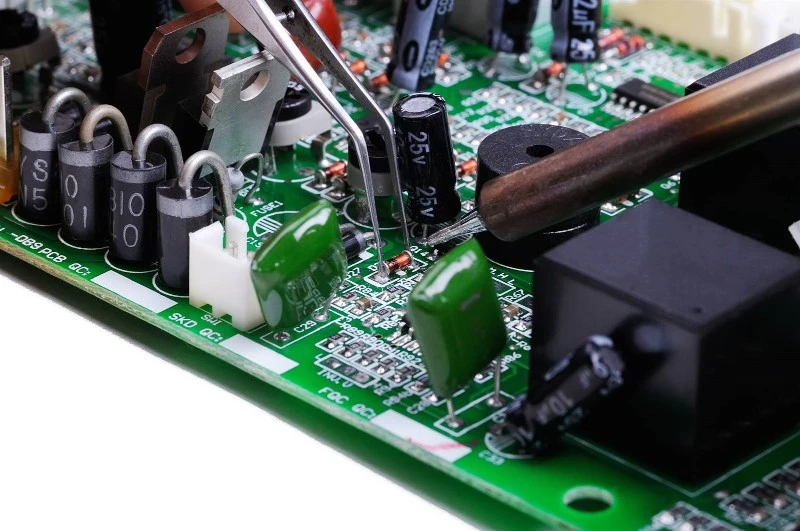
How PCB relays work
Here, I will divide the operation of relays into two systems to introduce how they work.
Working principle of electromagnetic system
When a certain voltage (or current) is applied to the coil of a PCB relay, a magnetic field is generated in the coil.
The magnetic field magnetizes the iron core, thereby generating attraction to the armature.
Working principle of contact system
The armature moves under the attraction of the magnetic field, causing the moving contact to move.
When the magnetic induction torque between the magnetic gaps exceeds the recoil torque, the armature is attracted to the guide magnet, and at the same time, the armature presses the contact spring, causing the normally closed contact to open and the normally open contact to close, thus completing the relay operation and achieving the connection operation of the external circuit.
When the coil is powered off, the magnetic field disappears, and the armature returns to its initial position under the reaction force of the spring or other reset device. The moving and stationary contacts also return to their original state, that is, the normally open contact opens, the normally closed contact closes, and the external circuit is cut off.

Relay structure diagram
Structure of PCB Relay
Coil: Usually made of enameled wire, it generates a magnetic field when current passes through the coil.
Core: Generally made of ferromagnetic material, it can enhance the magnetic field generated by the coil.
Armature: It is attracted by the magnetic field generated by the coil, thereby achieving the action of the relay.
Moving contact: It is linked with the armature, and when the armature moves, the moving contact will move
accordingly.
Static contact: fixed on the base of the relay, it cooperates with the moving contact to achieve the on/off of the circuit.
Base: used to fix and support various components of electromagnetic systems and contact systems, while also serving as insulation and isolation. It is usually made of insulating materials to ensure the electrical safety of the relay during operation.
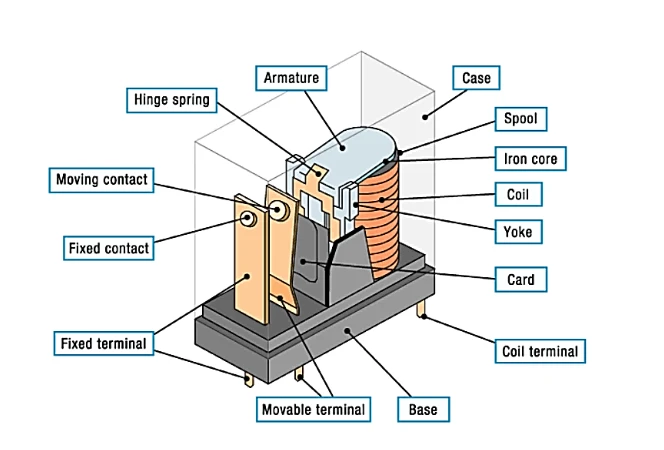
3D view of internal components of relay
PCB relays have three working modes
Normally Open
Normally open means that if the relay loses power, whether by applying a small control voltage or current, the normally open contacts will open. In this case, current cannot flow through the contact in the circuit. When the coil of the relay is energized by the control signal, it will close these contacts and allow current to flow through the connected circuit.

PCB relay normally open mode
Normally Closed
Unlike normally open mode, normally open mode allows the circuit to conduct when the relay is activated, while normally closed contacts close when the relay is not activated. If sufficient control signals are applied to the relay, the normally closed contacts will open to cut off the circuit.

Normally closed mode of PCB relay
Conversion mode
Conversion mode: The conversion mode, also known as SPDT mode, can support normally open and normally closed contacts on a single relay. If the relay coil is not energized, the normally closed contacts close and the normally open contacts open. When the coil is energized, the normally closed contacts open, and vice versa. This mode has been widely used and applied to switch between two circuits, such as selecting heating and cooling systems in a thermostat system.
Principle division of PCB relay types
Electromagnetic relay
Electromagnetic relay utilizes the principle of electromagnetic induction to generate a magnetic field when electricity is passed through the coil. The magnetic field causes the armature to move, driving the contacts to open and close, thereby achieving circuit on/off control. The coil generates magnetic force to attract the armature, causing the normally open contact to close and the normally closed contact to open; After the coil is powered off, the magnetic force disappears, and the armature resets under the action of the spring, restoring the contact state to its original state.
Solid state relay
Solid state relay is a type of relay without mechanical contacts, which uses solid-state electronic components such as thyristors, diodes, etc. to achieve on/off control of circuits. The input signal is applied to the control terminal to turn on or off the solid-state electronic components, thereby controlling the on/off of the output circuit.
Thermal relay
Thermal relay is a relay that uses the thermal effect generated when current passes through a conductor to open and close contacts, achieving circuit protection. When the current in the circuit exceeds the set value, the thermal element heats up, causing the bimetallic strip to bend and deform, thereby pushing the contacts to move and cutting off the circuit.
Optocoupler relay
Optocoupler relays use optoelectronic devices to isolate and convert input and output signals. It is usually composed of light emitting diodes (LEDs) and phototransistors. The input signal causes the LED to emit light, which illuminates the phototransistor and turns it on or off, thereby controlling the on/off of the output circuit.
Precautions for PCB relay installation
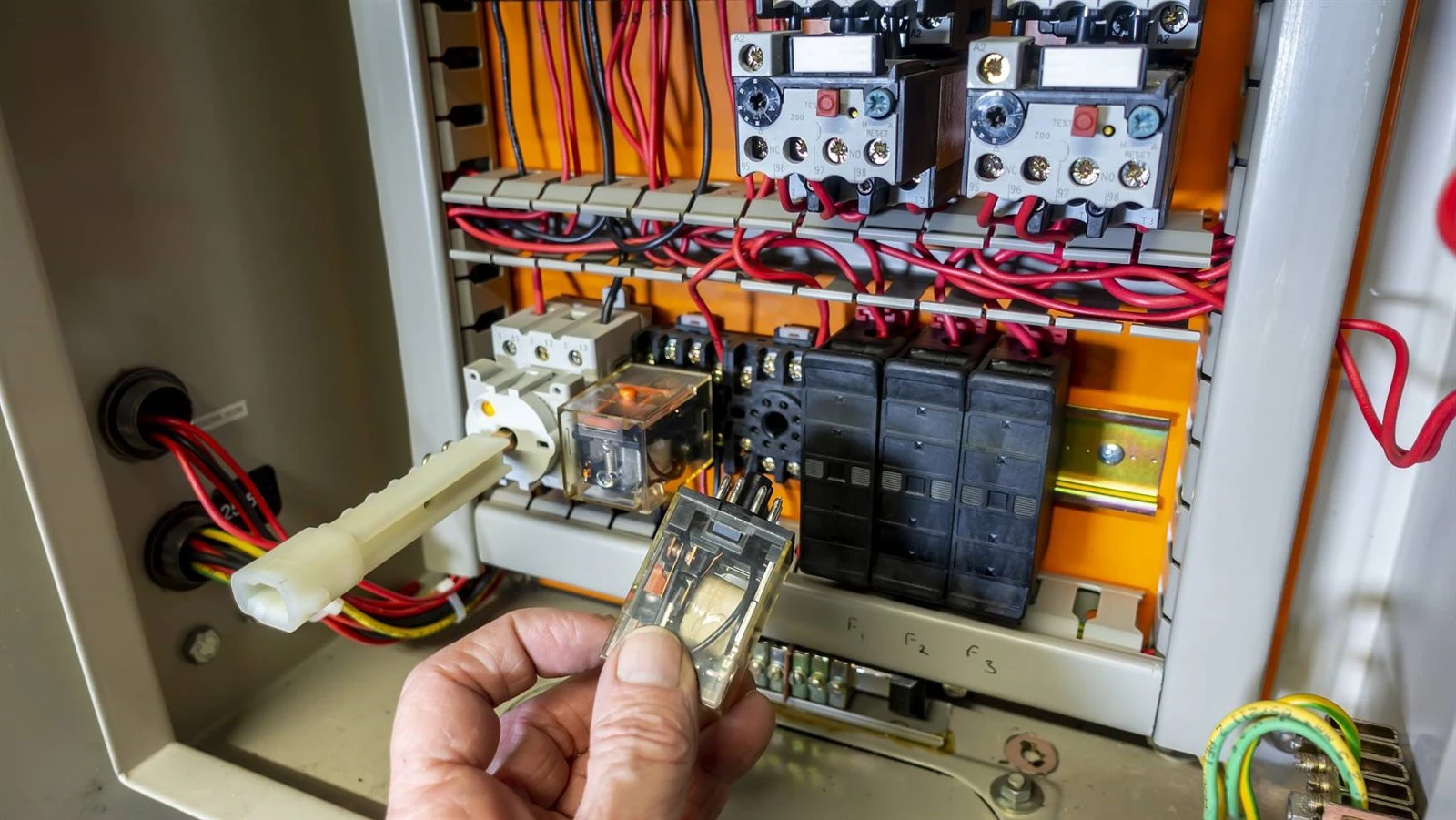
Preparation before Installing PCB Relays
Before installing PCB relays, carefully check their specifications and models, inspect their appearance, and prepare suitable tools and materials. When installing, if welding is used, it is necessary to control the welding temperature and time, pay attention to the welding sequence, and prevent static electricity; If it is a plug-in installation, ensure that the pins are accurately aligned with the socket and avoid excessive force. After insertion, firmly fix it. After installation, conduct a visual inspection to check for any new damage, use an electric soldering iron to check for correct electrical connections, and perform functional testing and compatibility checks with other components.
Application fields of PCB relays
1, Industrial automation
Motor control
In industrial environments, it is used to control the start, stop, forward and reverse rotation of various motors (such as AC motors and DC motors).
Logic control of industrial equipment
As a logical control component, participate in the control system of industrial automation equipment.
2.Communication equipment
Signal switching and routing
In communication base stations, PCB relays are used for signal switching and routing selection.
Equipment protection and energy conservation
PCB relays in communication devices can be used for power management and protection of the equipment. When the device is started, the relay can connect various circuit modules in a certain order to avoid the impact of instantaneous high current on the device.
3, Automotive Electronics
Automotive electrical system control
In the starting system of a car, PCB relays are used to control the circuit connection between the starter motor and the battery. In automotive lighting systems, relays are used to control the on/off of headlights, fog lights, turn signals, etc.
Integration and protection of automotive functional modules
There are multiple functional modules inside the car, such as engine control module, airbag module, in car entertainment module, etc. PCB relays play an integrated and protective role between these modules.
4, Smart Home
Smart home appliance control
In smart home systems, PCB relays can be used to control the power on/off of smart appliances. Taking the intelligent washing machine as an example, PCB relays can switch between different motor speeds, as well as the opening and closing of inlet and outlet valves, according to the washing program settings, to achieve different washing modes.
Integration of Home Automation Systems
In home automation systems, PCB relays serve as intermediate control components to connect different smart devices together.
Advantages of PCB relays
Miniaturization and thinning
Compact design can effectively save circuit board space, allowing electronic products to integrate more functions in limited space, especially suitable for miniaturized and portable electronic devices such as smartphones, tablets, etc., which helps to achieve lightweight design of devices.
It can be installed more flexibly on PCB boards, adapt to different PCB layout requirements, and facilitate circuit design and wiring.
High integration
It can be highly integrated with other electronic components to form a complete circuit system, reducing the length of connection points and lines in the circuit, thereby reducing signal transmission losses and interference, and improving the performance and stability of the circuit.
Easy to achieve automated production and assembly, improve production efficiency, and reduce production costs.
Quick response
Having short action and release times, it can quickly switch circuits and meet some application scenarios that require high response speed, such as signal switching in automation control systems and communication equipment.
Can respond promptly to changes in input signals to ensure the normal operation of the circuit.
High reliability
Through strict quality control during the production process, it has high stability and reliability, and can work normally under various environmental conditions such as temperature, humidity, vibration, and other harsh environments.
Long service life reduces the frequency of equipment maintenance and relay replacement, and lowers the cost of use.
Low energy consumption
Some advanced PCB relays have low operating losses, such as some products with only 100mW, far lower than the vast majority of similar products on the market. In situations where mechanical equipment must operate for a long time, they can save a lot of energy consumption and meet the requirements of energy conservation and environmental protection.
How to choose the appropriate PCB relay
Firstly, the voltage and current required for the control object should be determined in order to select relays with rated parameters that meet these two aspects. Then, based on the application scenario, determine the number and form of contacts on the relay, including whether special functions such as delay and self-locking are required. We should also consider the reliability and lifespan of relays, including requirements for temperature, humidity, and vibration. Meanwhile, brand and quality are also issues that need to be considered; Choosing well-known brands and validated products can improve the stability and reliability of the system. For example, QIANJI's PCB relays have strong performance and guarantee. Provide you with a satisfactory shopping experience.

conclusion
PCB relays are one of the most critical components in electrical engineering, playing a crucial role in power systems and many other applications. In this regard, it is crucial for engineers or technicians in the power related industry to understand the working principle of PCB relays, how PCBs integrate such relays, the design of the circuit boards used by relays, and their role in the power system. Through this approach, the functionality of PCB relays can be fully utilized to achieve the highest performance, reliability, and safety of the power system. With the continuous advancement of technology, the power system will continue to maintain its important position in the foreseeable future to meet the ever-changing needs of the power industry.
Contact QIANJI immediately to experience high-quality manufacturing,
Fast turnaround time and excellent customer service.
Contact us for a quote and start your next project!
However, do you need any help? Contact Us: Providing You with the Most Thoughtful Service
label:PCB relays,PCB relay operation,pcb relay meaning,pcb relay board