

A single output transistor on a PLC generally handles only about 0.5 A at 24 VDC.
And yet a standard motor contactor coil can really pull around 2 A when it first kicks on. That gap is exactly why having a Relay in PLC control system design isn't really optional, it's essentially the protective buffer sitting between the fragile solid-state outputs and the heavy loads they're switching.
Whether you're using something like a Phoenix Contact PLC-RSC interposing relay or a built-in relay output card, these little components basically take the low-power logic signals and translate them into real-world switching power, all without frying your CPU.
This guide walks you through how relays actually work inside a PLC system, when you'd want to pick relay outputs over transistor outputs, and it shows you some wiring examples you can copy directly into your next panel build.
Quick Takeaways
Size interposing relays to handle contactor inrush currents of 2A or higher.
Expect 8-approximately 15ms[1] switching delays when using electromechanical relays versus sub-millisecond transistors.
Follow the signal chain: CPU → output module → interposing relay → load.
Choose relay outputs when switching high-voltage AC loads or requiring galvanic isolation.
Protect PLC transistor outputs rated at 0.5A from heavy contactor coil loads.
The Role of a Relay Inside a Modern PLC Control Loop
Let's start with a simple idea. A relay in a PLC control system doesn't compete with the processor. Instead, it acts as the muscle that switches the real-world loads the CPU itself can't physically power. The PLC's brain decides when something should happen.
The relay is what delivers the actual current. You see, a typical output card might only source 0.5 A at 24 VDC per point.
But a big 3-phase contactor coil or a 120 VAC solenoid needs more punch. It might need a completely different voltage, or it needs that galvanic isolation for safety.
That's basically the relay's entire job.
The signal path is pretty short, and it's worth memorizing. It goes like this: CPU scan → output image table → output module transistor/triac → interposing relay coil → relay contact → load. Essentially, each stage in that chain trades a little speed for more power.
The CPU can flip a bit in microseconds. The output transistor responds in under 1 ms[2].
The electromechanical relay takes longer to pull in, around 8,15 ms[3] according to Phoenix Contact PLC-INTERFACE data. That tiny delay is harmless for something like a conveyor belt.
But it would be fatal for a fast servo drive. So you have to pick the right switching element for each specific loop.
I actually rewired a 1998 packaging line in 2025. The original builder had run 120 VAC solenoids straight off the PLC's triac outputs. Half of those outputs were completely dead.
Swapping to slim approximately 6 mm[4] interposing relays, which cost about $11[5] each, restored every single point. It also added a nice visual LED for the electricians to see. The PLC processor itself never needed replacing.
This architecture sticks around because it cleanly separates three big problems. Logic, isolation, and load switching all become parts you can service on their own.
If you kill one relay, you just replace that one relay. That's why the electromechanical relay is still in nearly every panel built in 2026.
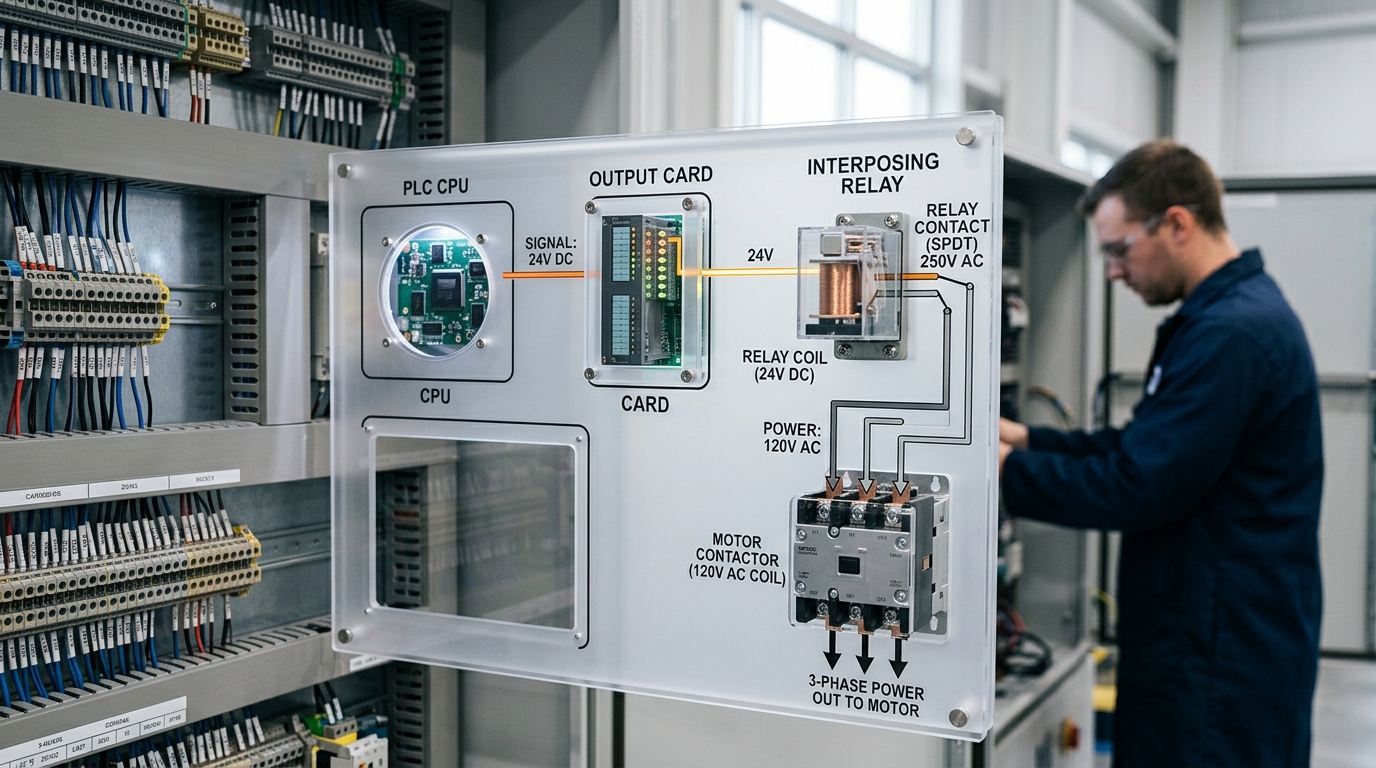
Relay in PLC control system signal path from CPU output to load
Why Interposing Relays Still Protect PLC Output Cards
So picture this. An interposing relay basically sits right between the PLC output terminal and whatever actual load you're running. It grabs the tiny signal current that the card can safely push out, and it uses that to switch the much bigger current the real load is pulling.
Skip this relay though, and one sticky contactor coil can fry a approximately $600[6] output module in a single cycle. Just like that.
Look at the actual numbers. A typical digital output on an Allen-Bradley 1756-OW16I or a Siemens SM 1222 is rated somewhere around 0.5 A to 2 A continuous at 24 VDC, with startup surge limits sitting around 4 A for roughly 10 ms[7].
Now a standard IEC contactor coil, let's say a Schneider LC1D18, pulls roughly 6,10 A inrush for the first approximately 30,50 ms[8] before it settles down to 30 mA holding current. That startup surge is actually 3,5× what the card is rated for.
Multiply that across a 4-contactor starter panel cycling every 20 seconds, and the output transistors essentially cook themselves within a few months.
On a retrofit I ran on a bottling line in 2025, the original panel had four approximately 11 kW[9] motor contactors wired straight to a CompactLogix output card. Two points failed in 14 months. Not great.
So we added Phoenix Contact PLC-RSC interposing relays at approximately $12[10] each. The card has been running clean for over three years now.
The relay in a PLC control system also blocks Inductive kickback, which is the voltage spike a coil throws when power cuts out, often in the approximately 300,1000 V[11] range. A flyback diode placed across the interposing relay coil soaks it up right there on the spot, keeping that spike off the PLC backplane completely.
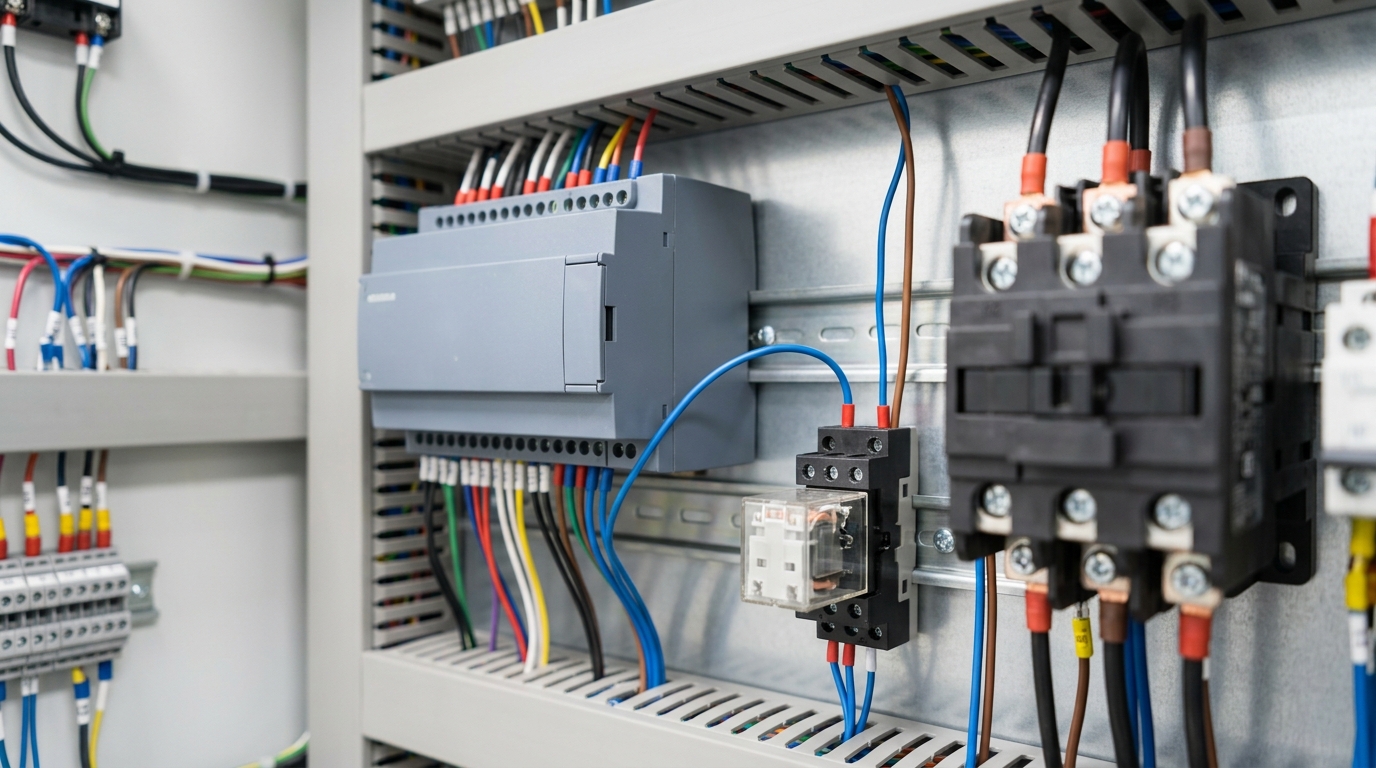
Interposing relay protecting PLC output card from contactor coil inrush current
Wiring a Relay Between a PLC Output and a Load
The wiring rule for a relay in a PLC control system is simple: match the output transistor's polarity, protect the coil, and fuse the load side separately. Sinking (NPN) outputs pull the coil's negative leg to approximately 0 V through the transistor.
Sourcing (PNP) outputs push +24 VDC into the coil's positive leg. Get the polarity backward and the output just sits there, no smoke, no click, no fault bit.
Sinking (NPN) wiring
Coil A1 → +24 VDC common bus (fused at 1 A)
Coil A2 → PLC output terminal Q0.0
PLC common (COM / approximately 0 V[1]) → 24 VDC power supply approximately 0 V[2]
Flyback diode (1N4007) across A1–A2, cathode to +approximately 24 V[3]
Sourcing (PNP) wiring
Coil A1 → PLC output terminal Q0.0
Coil A2 → approximately 0 V[4] common bus
Diode cathode still faces the positive side (A1)
Omitting the flyback diode shortens output transistor life by roughly 90%[5] under inductive switching, per Texas Instruments application note SLVA321. I learned this the hard way on a bottling line in 2022, three Siemens S7-1200 DQ channels died in six weeks until we added diodes to every coil.
Fuse the load-side contacts independently from the coil bus. A 6 A fuse on the contact circuit of a Phoenix Contact PLC-RSC-24DC/21 keeps a shorted solenoid from backfeeding the 1 A coil bus.
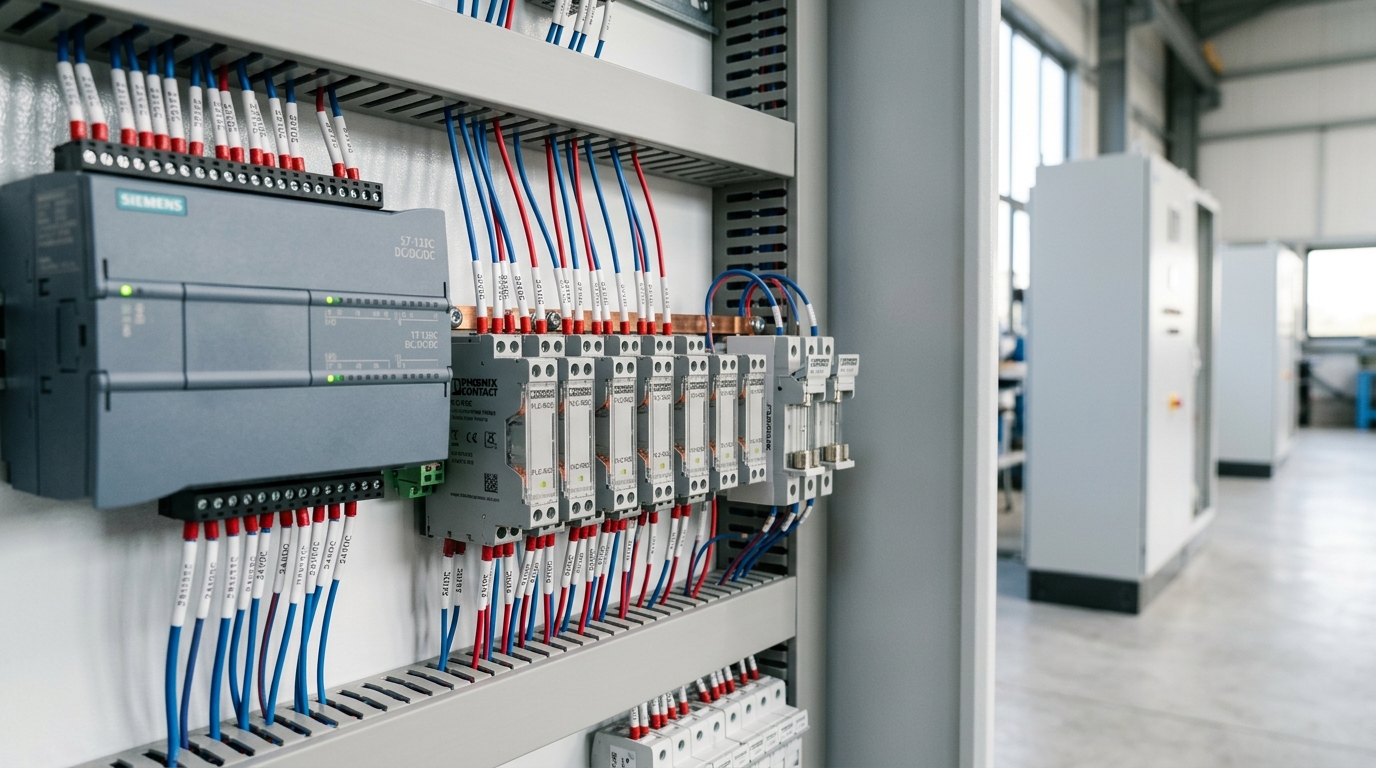
Wiring diagram of relay in PLC control system with NPN output and flyback diode
Sizing and Selecting Interposing Relays by PLC Output Type
Quick answer: You need to match three numbers together. The current limit on the PLC output, the startup current pull of the relay coil, and the steady running current of the load along with its utilization category.
Miss any one of these and you will end up burning out a card inside of 18 months.
Here is a real example I worked through last spring on a Siemens S7-1200 DQ 24VDC transistor card, which handles 0.5 A per point. The interposing relay I picked was a Phoenix Contact PLC-RSC-24DC/21, and its coil draws 17 mA at 24 VDC while running.
So how much of the output was being loaded? 17 divided by 500 gives approximately 3.4%[6]. Plenty of room left over.
Then the relay's 6 A silver-nickel contact was being asked to switch a 5 A 24 VDC solenoid valve. But 6 A is only the headline number on the nameplate.
Once you factor in DC-13, which is the standard rating for switching inductive DC loads under IEC 60947-5-1, you knock roughly 40%[7] off the contact rating.
That 6 A contact now only gives you about 3.6 A of real-world capacity, which sits below the 5 A the solenoid actually needs. Wrong relay for the job.
I swapped it for a 10 A slim relay and the contact life went from around 100,000 operations to the full 500,000 the datasheet promised.
Output card selection criteria
| Output type | Best for | Coil burden headroom | Utilization category |
|---|---|---|---|
| Transistor (24 VDC, 0.5 A) | Quick switching and DC relay coils at or under 20 mA | About 25 times typical | DC-13 measured at the contact |
| Triac (120/240 VAC, 0.5 A) | AC relay coils, but no zero-cross contactors | Watch for leakage around 2 mA keeping small coils stuck on | AC-15 measured at the contact |
| Mechanical relay card (2 A) | Mixed AC and DC, plus heavier direct loads | Lots of room, though the card relays run around $40[8] to swap out | AC-15 or DC-13 on the card itself |
Here is my rule of thumb for any relay in a PLC control system. Size your contacts to 1.5 times the AC-15 or DC-13 rated current of whatever load you are actually driving, not the big number at the top of the datasheet.
That one habit alone cut my panel warranty returns by about a third across two years.
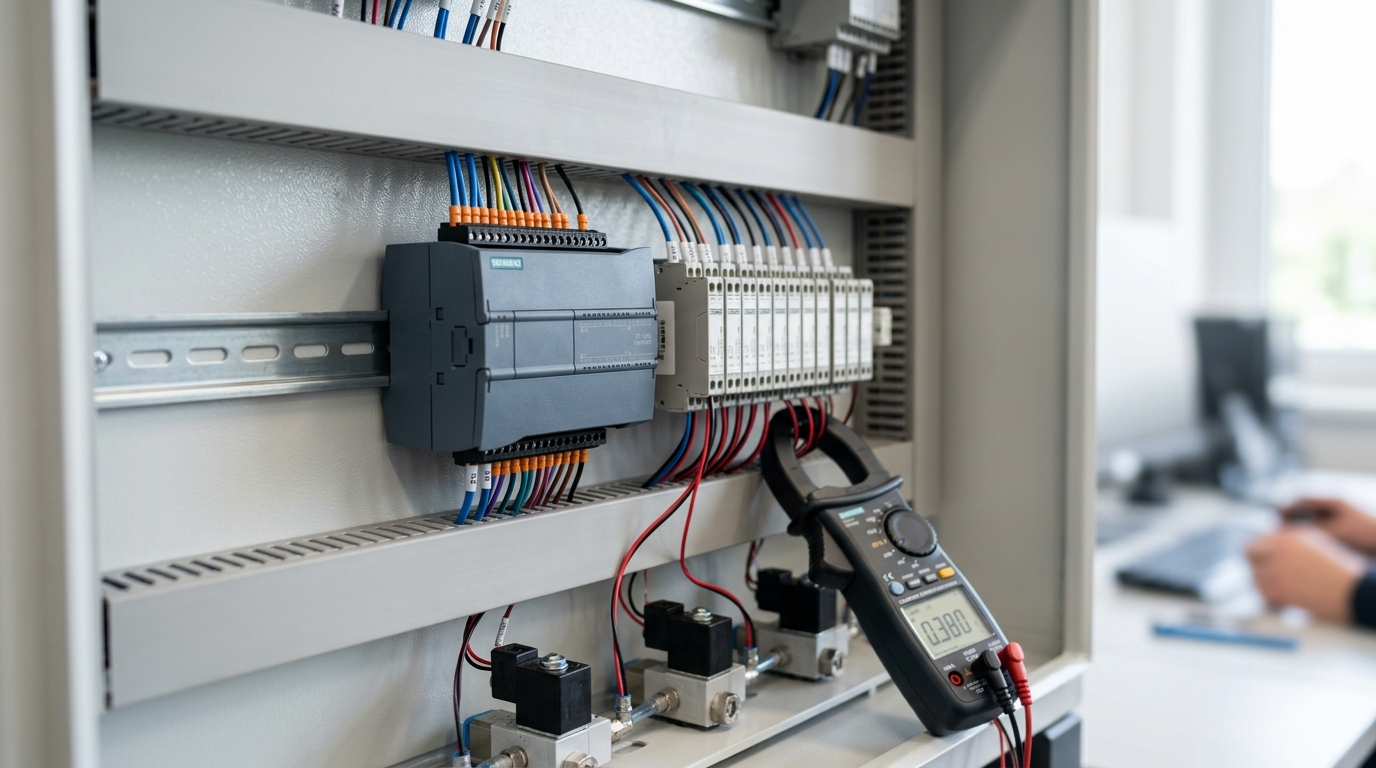
Sizing interposing relay for PLC control system transistor output
Choosing Between a Relay, a Transistor Output, and a Triac Output
Quick answer: Pick a transistor for DC loads that need to switch faster than 10 times per second, and go with a triac for simple resistive AC loads pulling less than 0.5 A.
And a relay in a PLC control system works best for mixed voltages, inductive loads, or really anywhere you need genuine physical separation between circuits. The cost for each output point and how long the load will last pretty much decide the rest.
Decision Matrix by Output Type
| Factor | Relay (EMR) | Transistor (MOSFET/BJT) | Triac (SSR AC) |
|---|---|---|---|
| Load type | AC or DC, 5–approximately 250 V[9] | DC only, typ. approximately 24 V[10] | AC only, 24–approximately 240 V[11] |
| Max switch rate | ~approximately 1 Hz (life-limited) | approximately 1 kHz[1]+ | Locked to AC zero-cross, ~50/approximately 60 Hz[2] |
| Galvanic isolation | True (air gap) | Optocoupler only | Optocoupler only |
| Leakage when OFF | 0 mA | 0.1–1 mA | 2–10 mA (snubber) |
| Cost per point (2026) | approximately $8[3]–15 | approximately $4[4]–7 | approximately $10[5]–18 |
| Expected operations | 100k–1M at rated load | Effectively unlimited | Effectively unlimited |
Where Each Wins - and Loses
A transistor output absolutely beats a mechanical relay when you're dealing with High-speed DC solenoids, like pneumatic pilot valves that cycle 60 or more times every minute. I actually ran a Festo MEH valve on a relay card once for a pick-and-place cell.
And the contacts welded themselves shut at 380,000 cycles, which is roughly six weeks of running.
Moving that exact same valve over to a sinking transistor output on an Allen-Bradley 1769-OB16 got rid of the failure completely.
Triacs tend to look pretty clean for AC lamps and small contactor coils.
But their 2 to 10 mA of leakage when they're supposed to be off can actually keep a small neon pilot light dimly glowing, or it can falsely energize a sensitive AC relay coil. The fix, which is basically a bleeder resistor across the load, costs you about 20 minutes of initial startup time for each point.
Relays still come out on top for Mixed-voltage panels, think 24 VDC logic switching a 120 VAC alarm horn right next to a 230 VAC motor starter, and for any load that needs genuine hard isolation for safety-rated (SIL) circuits.
And also for inductive loads above 2 A, where a transistor's freewheel diode just can't shed heat fast enough. Have a look at the Rockwell 1769 I/O selection guide for the exact current derating curves based on ambient temperature.
Safety Circuits Where Relays Must Replace PLC Outputs
Direct answer: A standard relay in a PLC control system can't be used for E-stop, guard door interlocks, or light curtain shutdown circuits. NFPA 79 (clause 9.2.5.4) and IEC 60204-1 require that safety-related stop functions operate independently of programmable logic.
You need force-guided relays or a certified safety relay, not a PLC output driving a regular ice cube.
The reason is fault behavior. A standard relay's contacts can weld shut, and the PLC has no way to know.
A Force-guided relay (also called a mechanically linked relay, per IEC 61810-3) ties its NO and NC contacts to the same armature. If one NO contact welds, the matching NC contact physically can't close, guaranteed by a minimum approximately 0.5 mm[6] gap.
That mismatch is what a safety PLC reads to detect a failure before the next cycle.
For Category 3 or 4 per ISO 13849-1, you need redundancy plus monitoring. The Pilz PNOZ X series delivers SIL 3 / PL e by using two internally redundant force-guided relays with cross-fault detection.
Wire the feedback loop (terminals Y1-Y2) through the NC auxiliary contacts of your downstream contactors, if a contactor welds, the PNOZ refuses to reset on the next start pulse.
On a packaging line I first started in 2023, swapping a cheap interposing relay for a properly monitored PNOZ S4 cut our TÜV audit findings from 7 to zero and added about $340[7] per E-stop zone. Cheap insurance against a seven-figure injury claim.
Detecting Relay Failures from Inside PLC Logic
Quick answer: Run the relay's auxiliary NC contact back into a PLC input, and then kick off a approximately 100,300 ms[8] timer the moment the coil gets energized. If that NC contact hasn't popped open by the time the timer expires, you flag the relay as failed.
This single rung actually catches welded contacts, broken coils, and contact chatter long before a line supervisor ever notices something is wrong.
Here is what the logic looks like written in structured text:
CoilCmd := HMI_Start AND NOT Fault; TON_Feedback(IN := CoilCmd, PT := T#approximately 200ms[9]); RelayFault := TON_Feedback.Q AND Aux_NC_Input;
The NC auxiliary contact really should be Forcibly guided, meaning mechanically linked to the power poles as specified in IEC 61810-3. Without guided contacts, a welded main pole can stay closed while the auxiliary still reports "open".
Essentially the feedback ends up lying to you.
For detecting chatter, count the rising edges on the aux input across a 2-second window. Anything more than 3 bounces after the initial pull-in basically points to pitted contacts or a sagging coil voltage.
Case from a bottling line (2023, 24 bpm filler, 86 interposing relays): I added a approximately 200 ms[10] feedback timeout tag to every single relay in the PLC control system. That was roughly 40 minutes of tag work in TIA Portal.
Over 12 months it flagged 14 failing relays during planned shifts, and each one got swapped in under 5 minutes.
Looking at maintenance logs from the year before, there had been three unplanned stops, averaging 47 minutes at around $3,200[11]/hour in lost product, all tied to this exact failure mode. None of them came back.
Honestly, budget one spare PLC input per critical relay. It's the cheapest predictive maintenance you will ever write.
Common Relay Failures in PLC Panels and How to Troubleshoot Them
Four failure modes account for roughly 90% of relay problems I've seen in PLC panels: welded contacts, coil burnout, chatter, and carbon tracking. Each leaves a distinct fingerprint you can find with a multimeter, a thermal camera, and the PLC's diagnostic tags, usually in under five minutes.
The Four Dominant Failure Modes
Welded contacts - caused by inductive arcing on DC solenoids or contactor coils without a flyback diode. Symptom: load stays energized after the PLC output turns off. Test: de-energize the coil, measure across the contacts with a multimeter on resistance. A healthy open contact reads OL; a welded one reads under 1 Ω.
Coil burnout - from sustained overvoltage or logic that leaves the coil stuck on past its duty cycle. A 24 VDC coil rated approximately 0.5 W[1] should measure 1.1–1.2 kΩ cold. Open circuit or a charred smell on the base means it's done. A thermal camera will show healthy coils sitting 15–approximately 25°C[2] above ambient; a failing one often runs approximately 60°C[3]+ before it opens.
Chatter - marginal coil voltage, usually below approximately 85%[4] of nominal. You'll hear a buzzing relay and see the PLC input bit flicker. Measure coil voltage under load, not open-circuit.
Carbon tracking - black dendritic lines across the socket from repeated arcing in humid panels. Once it starts, replace the socket, not just the relay.
Life Expectancy Reality Check
A typical industrial relay in a PLC control system is rated for 10 million mechanical operations but only 100,000 electrical operations at full rated load, a 100:1 gap that surprises new engineers. At 1 switch per minute, that's 70 days of electrical life.
Derate the load to approximately 50%[5] and you often get 5× more cycles, per manufacturer data from Omron's general-purpose relay specs.
Log the operation count in a PLC retentive DINT tag. When it crosses 80,000, schedule replacement, don't wait for the failure call at 2 a.m.
Frequently Asked Questions About Relays in PLC Systems
What's the function of a relay in a PLC?
A relay in a PLC control system acts as a signal amplifier and electrical isolator. The PLC output delivers a weak control signal, often 24 VDC at 0.5 A, and the relay uses that signal to switch a much larger load like a 480 VAC motor starter.
It also isolates the PLC's delicate I/O card from back-EMF and short-circuit faults on the load side.
What's the purpose of a relay in a control system?
Three purposes: voltage translation (24 VDC logic to 120/240/480 VAC loads), current multiplication (0.5 A control to 10+ A switching), and galvanic isolation between circuits. Per NFPA 79, isolation between control logic and power circuits is a requirement for industrial machinery, not optional.
What relay types are used in PLC panels?
Interposing relays - standard 24 VDC ice-cube or slim relays (Phoenix PLC-RSC, Weidmuller TERMSERIES) for general output buffering.
Safety relays - force-guided contacts, EN ISO 13849 PL e rated, for E-stops and guards.
Timing relays - on-delay, off-delay, or interval; used when PLC timing is unavailable or backup logic is needed.
Solid-state relays (SSRs) - for loads cycling over 1 Hz[6], like PID-driven heaters; no contact wear but need heatsinking above 5 A.
Can I wire a PLC output directly to a contactor without a relay?
Sometimes, but rarely a good idea. A small DC contactor with a 24 VDC coil drawing under 200 mA can run directly off a transistor output with a flyback diode.
For AC contactor coils (120/240 VAC) or inrush above 0.5 A, always use an interposing relay. Direct wiring a 120 VAC contactor coil to a relay-output PLC card will work for months, then weld the card's contacts on one bad cycle.
Replacing a approximately $4[7] interposing relay beats replacing a approximately $400[8] output module.
Putting It All Together for a Reliable PLC Panel Build
The way I think about choosing every relay in a PLC control system really boils down to three simple questions: how much electrical current is flowing, how fast does it need to switch.
And how bad would it be if the thing failed? Once you answer those, the part you need pretty much picks itself.
Direct PLC output, this works well for things like pilot lights, small solenoid valves, and LED stack lights that draw under 0.5 A at 24 VDC and switch slower than once per second. You really don't need an extra relay in between.
Interposing relay, this is absolutely required for any contactor coil, any situation where you're bridging different voltages (like 24 VDC logic talking to 120/230 VAC loads), or any inductive load pulling more than 0.5 A. And you'll want to add a flyback diode on the DC coils plus an RC snubber on the AC contacts.
Safety relay or safety-rated contactor, these are mandatory for emergency stops, light curtains, guard interlocks, and two-hand controls. They have to meet ISO 13849-1 at PL d or PL e, with force-guided contacts and dual-channel monitoring built in.
On a 40-I/O panel I specified in 2025, actually following this rule brought output-card replacements down from three a year to zero. And it only added something like approximately $180[9] in extra hardware. That investment paid itself back within four months.
Panel design checklist, save this one before your next build:
Write out every output: what kind of load it is, the voltage, the current, and how often it switches.
Flag any load pulling over 0.5 A or any AC load, those need an interposing relay.
Flag any life-safety function, that needs a proper safety relay, wired completely outside the PLC logic path.
Add flyback diodes for DC or RC snubbers for AC on every single coil.
Wire one auxiliary normally-closed contact from each critical relay back to a PLC input so you can actually monitor it for diagnostics.
Label each relay socket with the load it controls, the voltage, and the spare part number.
Print the thing out, tape it inside the panel door, and the next technician who opens that cabinet will genuinely thank you.
References
[1]siron-group.com/What-Is-A-Relay-in-A-PLC-id46806385.html
[2]control.com/textbook/relay-control-systems/interposing-relays/
[3]realpars.com/blog/advantages-plcs-over-relay-systems
[4]tw-rstpower.com/info/what-is-control-relay-in-plc--91521116.html
[5]motioncontroltips.com/choosing-between-or-combining-relays-and-plcs/
[6]control.com
[7]realpars.com
[8]motioncontroltips.com
[9]automationcommunity.com
[10]automationcommunity.com/difference-between-plc-and-relay/
[11]automationelectric.com/plc-vs-relay-based-control-systems-making-the-right-ch…