

Introduction of Automotive Relays
Relay is such an electric component that has the capability to connect and disconnect circuits even to amplify signals. They are in wide use in automobiles and other applications to control electrical devices such as lights, starters, horns, etc. A relay can control the switch in a circuit at its output end by controlling an electrical signal input at one of its ends.
The role of automotive relays
In other words, the main job done by automotive relays is the switching of electrical circuits. The moment a certain current passes through the starting circuit, the internal electromagnet at the relay will turn on, opening the normally closed switch circuit to direct the circuit to the device to be controlled. The relays can convert a small current into a larger current, thus driving those devices that want larger currents like electric windows, electromagnetic locks, etc. Besides that, relays can also be used to protect the circuit and prolong the life of electrical equipment. Relays in an automotive circuit can effectively avoid overheating or great current damage to the electrical equipment, prolonging the service life.
Structure of Automotive Relays
This is the most common type of automotive relay. It is composed of coils, iron cores, armatures, contacts, etc. When the coil is powered on, it generates a magnetic field that attracts the armature to move, causing the contacts to close or open, thereby achieving the on/off control of the circuit.
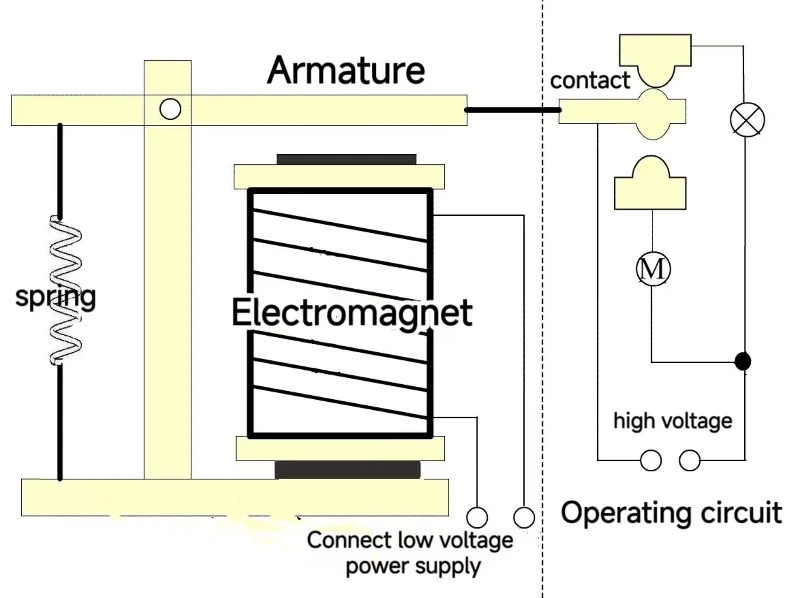
Structural diagram of automotive relay
Types of automotive relays
There are mainly the following types of automotive relays:
Activate the relay
Mainly used in car starting systems to control the power on/off of the starter motor. When the ignition switch is turned on, the starter relay coil is energized, the contacts are closed, and power is supplied to the starter motor to start the engine. Starting relays are usually able to withstand large currents.
Light relay
Used to control various lights of the car, such as headlights, fog lights, turn signals, etc. The light relay can control the on/off of the light according to the switch signal, and also protect the light circuit to prevent damage to the bulb and circuit due to excessive current.
Horn relay
Responsible for controlling the work of car horns. Due to the high current required for horn operation, direct control by the switch can easily damage the switch contacts. Therefore, controlling the power on/off of the horn through a horn relay can improve the service life of the switch and the reliability of the circuit.
Fan relay
Used to control the operation of the car engine cooling fan. According to the temperature signal of the engine, the fan relay can automatically control the start and stop of the fan to ensure that the engine operates within the appropriate temperature range.
Wiper relay
Control the operation of car wipers. The wiper relay can achieve different speed adjustment and intermittent wiping functions of the wiper, meeting different usage needs.

Advantages of Automotive Relays
Improve the reliability of the circuit
Relays can reduce the direct control of high-power electrical equipment by switches and other control components, reduce the possibility of wear and damage to switch contacts, and thus improve the reliability and stability of the whole circuit system.
Functional expansion and intelligent control
Therefore, automotive relays can be easily used for intelligently expanding automotive functions by using various sensors, controllers, and so on. For instance, cooperation with temperature sensors, pressure sensors, and so on can realize automation control of automotive air conditioning, cooling systems, and so on. Meanwhile, relays are able to perform logic controls even more complicated by programming or other means to meet the constant development of automotive electronics demands.
Improve energy use efficiency
Relays can control the working time and power of electrical equipment, with precision in terms of actual requirements, thus avoiding unnecessary waste of energy. For example, when the car is waiting for parking, the turning off by relay automatically of some of the unnecessary electrical equipment such as radios, headlights, etc. will reduce the power consumption of the car, thereby improving energy efficiency.
Fault diagnosis and repair are easy
Most automotive relays are installed in relay boxes and are clearly identified and numbered. If malfunctioning occurs in a car, maintenance personnel can check the status of operation of the relay more conveniently to promptly determine the range of faults to improve the efficiency of maintenance.

How to choose the appropriate car relay
Determine application requirements
1.Clearly define the controlled object
First, specify what automotive electrical equipment the relay is controlling, whether it be starter motors, lights, speakers, or fans among many other devices; different devices have different requirements of the current, voltage, and power of relays.
2.Consider the working environment
The working conditions for an automobile relay are relatively harsh, and temperature, humidity, vibration, and dust should be considered: for example, relays used in high temperatures require a good heat resistance. Relays operating under high moisture conditions must be moisture-resistant.
View technical specifications
1.Rated voltage and current
Select the appropriate relay rated voltage and current based on the operating voltage and current requirements of the controlled object. The rated voltage of the relay should be slightly higher than the operating voltage of the controlled object to ensure that the relay can operate normally. At the same time, the rated current of the relay should be greater than the operating current of the controlled object to avoid overload damage to the relay.
2.contact rating
Contact capacity refers to the maximum current and voltage that relay contacts can withstand. The contact capacity should be greater than the operating current and voltage of the controlled object to ensure that the relay will not be damaged due to contact overload during operation.
3.Coil Voltage
Relay coil voltage means operating voltage for a relay coil. It should be matched with the voltage of the car power system, which is normally set to 12V or 24V. A mismatch in the operating voltage of the coil with the voltage of the power system will result in malfunctioning in the operation of a relay.
Consider brand and quality
QIANJI wins customer trust with quality and promotes cooperation with sincerity
01
Famous brand automotive relays normally have very high quality and are reliable. These brands of relay normally undergo severe quality inspection and test during the production process to make sure their performance and quality meet standards.
02
For example, the relays for automotive from the likes of QIANJI, Bosch, Delphi, Meishuo, etc., have high recognition and reputation within the market. These brands could be given priority in selection. Quality certification: Check it out.
03
Should choose the automobile relay with quality authentication, such as ISO9001 quality management system authentication, TS16949 car industry quality management system authentication, etc. QIANJI's automobile relays are certified with these certificates, also other certificates like CE, CQC, UL, etc.

Compare price and cost-effectiveness
The price also varies according to brand, model, and parameters. While selecting relays, one should not just focus on the price but take an integral look into factors like performance, quality, and pricing to get the product having the highest cost-effectiveness.
QIANJI automotive relays boast absolute advantages both in price and quality. QIANJI has supplied relays for automotive use for over 20 years, providing customers with first-class product quality.
After-sales Service
It is also important to select relay brands and suppliers that provide good after-sales service for automotive purposes. The QIANJI company has good after-sales services. When there is any problem with the relays, they can be repaired and changed well in time, thereby reducing losses due to the failure of the relays.
Click to view car relays
Contact us to develop automotive relay solutions