


A solid state relay is an electronic switch. You use it to turn circuits on or off. It does not have any moving parts. This device works faster than old relays. It also lasts longer than them. Many people pick it because it is quieter. It also needs less care and fixing. Knowing how a solid state relay works helps you choose better in electrical control.
Key Takeaways
A solid state relay is an electronic switch. It does not have moving parts. This makes it fast, quiet, and lasts a long time.
It uses semiconductors and optocouplers to control circuits. These parts help keep circuits safe. They also give strong electrical isolation.
Solid state relays switch much faster than electromechanical relays. They can last through millions of cycles.
They work well in many places. You can find them in factories, homes, medical devices, and solar power systems.
Picking the right relay is important. You need to check voltage, current, and cooling needs. This helps keep your system safe and reliable.
Solid State Relay Basics
What Is a Solid State Relay
A solid state relay helps control electrical circuits. It does not use any moving parts. This device has electronic parts like semiconductors and optocouplers. You send a small signal to the input. The relay then turns a bigger load on or off at the output. There are no clicking sounds because it has no mechanical contacts. This makes the relay quiet and very quick. You can trust it to work for millions of times without breaking.
Tip: Solid state relays are used when you need fast, quiet, and steady switching. They work well in homes and factories.
Key Features
You can tell a solid state relay by its main features. These features help you know if it is right for you. Here are some key points:
No moving parts, so it is quiet and lasts long.
Switches very fast, even thousands of times each second.
Stays strong against shaking, dust, and wetness.
Makes little electrical noise, so it does not bother other devices.
Keeps input and output safe from each other.
You can also look at the data sheet for technical details. These numbers show how the relay works:
Input voltage range and input current
Turn-on and turn-off voltages
Rated output voltage and working current
Output voltage drop and leakage current
Switching-on and switching-off times
Insulation resistance and dielectric strength
Working temperature and highest junction temperature
Power use and ways to mount it
Here is a table that shows some main differences between solid state relays and electromechanical relays:
|
Feature |
Solid State Relay (SSR) Characteristics |
Electromechanical Relay (EMR) Characteristics |
|---|---|---|
|
Switching Speed |
Up to 100 times faster |
Slower, mechanical movement |
|
Switching Method |
Zero voltage/current switching |
Mechanical contact, possible arcing |
|
On-State Voltage Drop |
Less than 2 volts |
Higher voltage drop |
|
Control Signal Sensitivity |
Works with low-level signals |
Needs higher coil current |
|
Isolation Voltage |
Several thousand volts (opto-isolation) |
Lower, uses coil and contacts |
|
Mechanical Wear |
None |
Present, leads to failure |
|
Electrical Noise and Arcing |
No spark, no arc, no bounce |
Spark, arc, and contact bounce |
|
Lifetime |
Very long, millions of cycles |
Limited by contact wear |
You can see that a solid state relay has many good points. It switches fast, works well, and stays quiet. You do not have to worry about contact bounce, sparks, or parts wearing out. This makes the solid state relay a smart pick for new electrical systems.
How Solid State Relays Work
Internal Structure
If you open a solid state relay, you will not see moving parts. You will see electronic pieces like semiconductors and optocouplers. The optocoupler works like a bridge between input and output. It uses light to send signals from one side to the other. This keeps the control side and load side apart. This is called electrical isolation. The input and output can be separated by up to 5,000 Vac. This strong separation helps stop electrical noise. It also keeps your circuits safe.
A solid state relay needs to stay cool to work well. If it gets too hot, the semiconductors can get damaged. You should use heat sinks and make sure air can flow around it. This helps keep the relay cool and working longer. Engineers test these relays at high temperatures and fast speeds. These tests show if the relay will last and if the design is strong enough.
Note: To keep your solid state relay working, check for damage, clean it, and make sure all wires are tight.
Some important things about the inside of a solid state relay are:
Optocouplers give strong electrical isolation and lower noise.
Heat sinks and airflow stop overheating and help the relay last.
Good wiring, like keeping signal and power wires apart, lowers interference.
Checking and cleaning the relay helps it work well for a long time.
Switching Mechanism
A solid state relay uses semiconductors to turn circuits on and off. There are no clicks because there are no moving contacts. The switching happens very fast and is very clean. When you send a small signal to the input, the relay uses electronic parts to control a bigger load at the output.
Here is a table to compare solid state relays and relays with moving contacts:
|
Feature |
Semiconductor-based SSRs |
Mechanical Contacts |
|---|---|---|
|
Switching Speed |
Very fast, high-frequency switching |
Slower, mechanical movement |
|
Contact Bounce |
None, clean switching |
Present, causes noise |
|
Acoustic Noise |
Silent |
Audible clicking |
|
Leakage Current |
Higher (up to 10mA) |
Very low (nanoamps) |
|
Failure Modes |
Predictable, sensitive to voltage spikes |
Robust, but wears out |
|
Thermal Management |
Needs heat sinks and airflow |
Less critical |
This way of switching gives you many good things:
No contact bounce means less electrical noise.
Silent switching makes your system quiet.
Fast switching lets you control things quickly and well.
The relay can work millions of times without wearing out.
You also get better electrical isolation. The optocoupler and semiconductors keep the control and load sides apart. This lowers interference and stops voltage spikes. Some solid state relays switch when the AC power crosses zero. This timing lowers electrical noise and protects your equipment.
Full electrical isolation keeps your circuits safe.
Zero-cross switching lowers interference.
Low capacitance and low on-resistance make it faster and save power.
You get high reliability and long life, even in hard places.
Tip: You can use solid state relays where you need quiet, fast, and steady switching, like in factories, medical machines, and solar power systems.
Solid State Relay vs. Electromechanical Relay
Main Differences
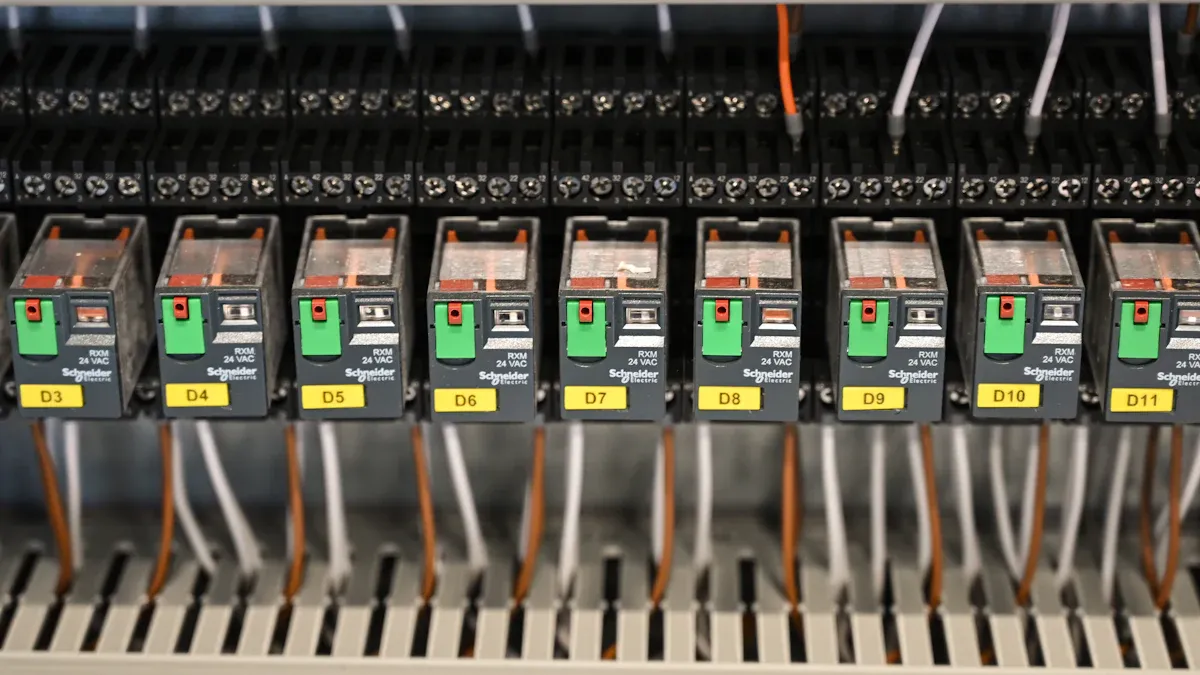
You might wonder how these two relays are different. The biggest difference is how they work. A solid state relay uses electronic parts. An electromechanical relay uses moving contacts and coils. This makes them act differently and work best in different places.
Here is a table that shows some important differences:
|
Characteristic |
Electromechanical Relay (EMR) |
Solid State Relay (SSR) |
|---|---|---|
|
Sensitivity to misuse or misapplication |
Good |
Poor |
|
Sensitivity to corrosion/oxidation |
Yes |
No |
|
Sensitivity to shock/vibration |
Yes |
No |
|
Sensitivity to radiation |
Fair |
Poor |
|
Package versatility |
Good |
Fair |
|
Cost per pole |
Best |
Fair |
|
Input TTL & CMOS compatibility |
Fair |
Best |
|
Operate and release time |
5-20 ms |
0.25-10 ms |
|
Military/aerospace spec compatibility |
Good |
Poor |
|
Ease of troubleshooting |
Good |
Poor |
|
Input to output isolation capability |
4 kV |
>4 kV |
|
Normal failure mode (output) |
Open |
Shorted |
|
Normal wearout mechanism |
Contacts |
LED |
A solid state relay can switch much faster than an electromechanical relay. It does not care about dust, shaking, or bumps. An electromechanical relay is better for rough use and costs less for each pole. It is also easier to fix if something goes wrong.
Tip: If you want fast, quiet, and steady switching, try a solid state relay. If you need something tough or cheaper, an electromechanical relay might be better.
Advantages
Picking a solid state relay gives you some big benefits:
Longer life: It has no moving parts, so it lasts longer. You can use it millions of times.
Silent operation: It does not make any clicking sounds. This is good when you need things to be quiet.
Faster switching: It can turn on and off in less than a millisecond. This is much quicker than a mechanical relay.
Better for sensitive electronics: It works well with low signals from TTL or CMOS devices.
No contact bounce: You do not get extra noise or wrong signals.
A solid state relay usually fails by staying "shorted." An electromechanical relay fails by staying "open." You should remember this for safety. Solid state relays can cost more and are harder to fix. But they are very reliable and need less care.
Remember, pick the relay that fits your needs. For most new control systems, a solid state relay gives you speed, quiet, and long life.
Functions and Applications
Typical Uses
You can see solid state relays in many places. In factories, they help control machines, motors, and lights. They are used in HVAC systems to manage heating and cooling. Big buildings use them for lighting control. At home, you might find them in smart thermostats, ovens, or solar power systems. These relays are also in medical equipment like hospital beds and patient monitors. They are quiet and work well for a long time.
Here is a table that shows how different industries use solid state relays:
|
Aspect |
Statistic / Detail |
Application Examples / Notes |
|---|---|---|
|
AC SSR Segment Share |
Over 38.8% share in 2024 |
Used in HVAC, lighting control, industrial automation |
|
Energy & Power Segment Share |
Over 35.6% share in 2024 |
Used in solar inverters, wind turbines, battery storage |
|
Healthcare Sector CAGR |
Projected CAGR of 6.7% (2024-2030) |
Medical imaging, patient monitoring, hospital beds |
|
Panel Mount Share |
42% market share in 2023 |
Preferred for motor control and automation |
|
DIN Rail Mount Growth |
Fastest growing segment with ~6.13% CAGR |
Modular electrical systems, smart manufacturing |
Tip: Solid state relays are good for places where you need fast, quiet, and steady switching. You can use them at home or in factories.
Selection and Testing
When you pick a solid state relay, match it to your system. Check the voltage and current ratings. Make sure it can handle your load. Look at the mounting type, like panel or DIN rail, for easy setup. Think about the environment. If it gets hot, choose a relay that stays cool.
To test a solid state relay, do these steps:
Use a multimeter to check resistance between input and output. High resistance means the relay is off.
Give the right input voltage. The relay should turn on right away.
Switch the input signal a few times. The relay should turn on and off each time.
You can also pick relays that meet safety rules. Groups like UL Solutions test relays for safety and reliability. These tests help you trust your relay will work well.
Note: Always read the relay's data sheet and test it before using it. This helps you avoid problems and keeps your system safe.
You now know how these relays work and why they matter. SSRs switch fast, last much longer, and use less power than old-style relays. You get quiet operation and strong resistance to shock or vibration. Many industries trust SSRs for safe, reliable control.
|
Feature |
SSRs |
EMRs |
|---|---|---|
|
Power Consumption |
Up to 75% less |
4-5x more |
|
Lifespan |
~21 million hours |
~500,000 cycles |
|
Switching Speed |
>1 kHz |
Max 5 Hz |
|
EMI Noise |
Minimal to none |
Present |
Consider SSRs when you want efficient, quiet, and long-lasting electrical control.
FAQ
What is the main benefit of using a solid state relay?
You get fast, silent switching with no moving parts. This means your relay lasts longer and needs less maintenance. You also avoid sparks and noise.
Can you use a solid state relay for both AC and DC loads?
Yes, you can. Some SSRs work with AC loads, while others work with DC. Always check the relay's label or data sheet before you use it.
How do you know if a solid state relay is working?
You can test it with a multimeter. Apply the input signal. If the output switches on and off as expected, your relay works.
Why does a solid state relay need a heat sink?
A heat sink keeps your relay cool. SSRs can get hot during use. The heat sink helps prevent damage and makes your relay last longer.
Are solid state relays safe to use at home?
Yes, you can use them safely at home. Just follow the instructions and choose the right relay for your device. Always turn off power before wiring.