

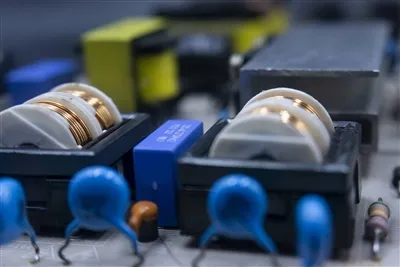
The essence of a power relay is a relay switch: a relay switch is an electrical control device based on low current, which achieves functions such as automatic adjustment, safety protection, and circuit conversion by operating high current. The core of a relay switch is that it can cause a predetermined step change in the controlled variable in the electrical output circuit based on changes in the input quantity. There is an interactive relationship between the control system (input loop) and the controlled system (output loop).
1. Function of power relay
Power relay is an electronic control device commonly used in industrial systems with high voltage and high current. Control the electrical system circuit through power relays. When the current and voltage in the circuit reach the specified values, the power relay will control the circuit to turn on or off to ensure the normal operation of the circuit. The common use in daily life is to use small currents to control large currents, playing a role in controlling circuits.
2. Working principle of power relay
The principle of power relay or starting from the principle of electromagnetic induction, when a circuit forms a closed circuit and generates a certain amount of current, the conductor is in a magnetic field, and the current will generate a magnetic field in the coil and produce magnetic force. The magnetic force will attract the spindle, causing the output circuit contacts to close or open, thereby achieving circuit control.
3. Switching ability of relays
The structure of a power relay mainly consists of: contacts, armature, spring, and electromagnet. Next, we will use a structural diagram to understand the switching capability of the relay,
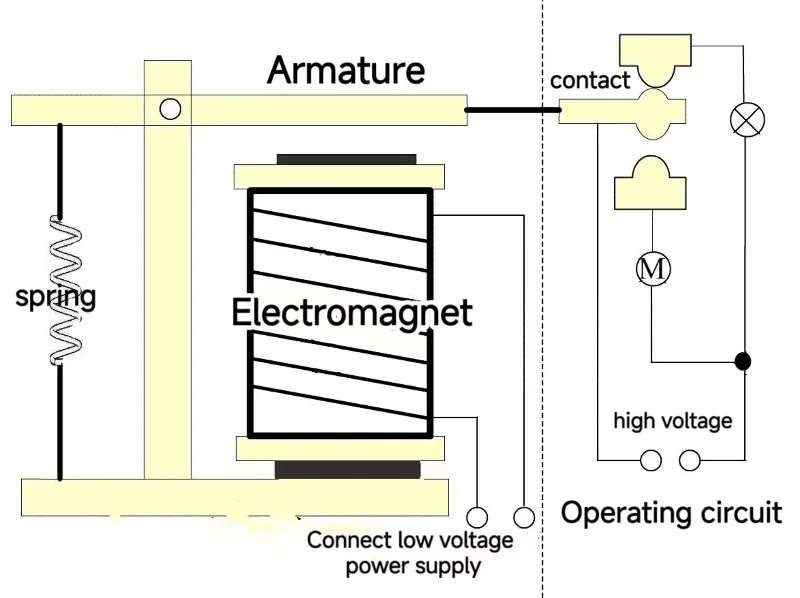
When the appropriate current and voltage are applied to the relay, a magnetic field is generated inside the coil. The magnetic force in the magnetic field attracts the movement of the armature, causing the connection and disconnection of the contacts and achieving the switching ability of the circuit
4. Classification of power relays
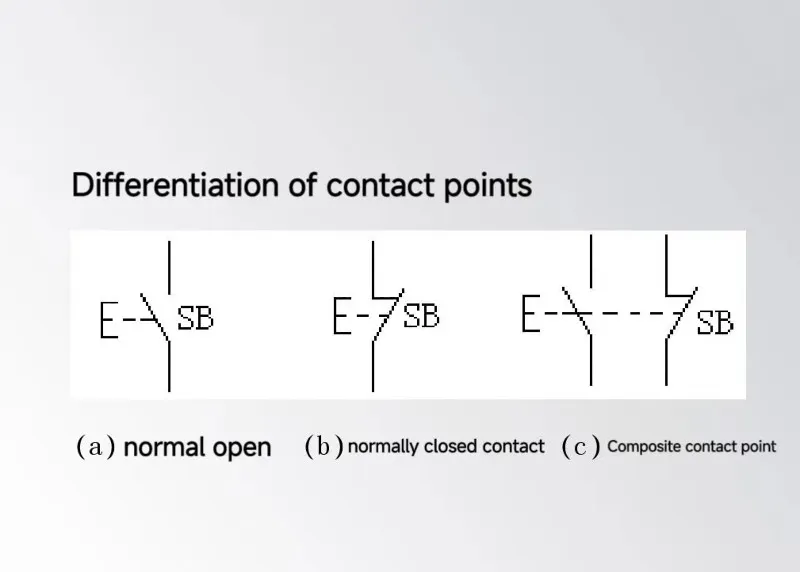
Firstly, according to the contact form, it can be divided into normally open form, normally closed form, and conversion form.
1. Normally open type:
In the absence of conducting current, the relay contacts are in an open state.
2. Normally closed:
There is no conducting current, and the relay contacts are closed.
3. Composite type:
The third type is quite special, it has two types of contacts: normally open and normally closed, which can be said to include the first two characteristics, that is, to achieve the closed state of the contacts through control.
Secondly, according to the type of load, it can be divided into DC relays and AC relays.
In practical application scenarios, some work environment circuits use alternating current, while others use direct current. According to the current situation, relays are also divided into DC relays and AC relays. When applying, selecting relays that match each other can work properly.
5. Main parameters of power relay
1. Rated working voltage:
The voltage required to maintain the operation of the relay under specified conditions. This is also the longest working voltage for relays.
2. Rated working current:
The current that allows the relay to operate normally under specified conditions.
3. Contact switch voltage and switch current:
Contact materials can be divided into two types: silver and copper. Each has its own advantages and disadvantages. Due to the different materials of the contacts, the working life and stability of the relay are the same. Enterprises can choose suitable contact materials according to specific needs. This is the only way to maximize the effectiveness of the power relay. Generally speaking, silver contacts have a longer lifespan and more stable conductivity and chemical properties than copper contacts. The switch voltage and current of the contact are the maximum voltage and current that the contact can withstand.
4. Inhalation voltage and release voltage:
Inhalation voltage refers to the current in the circuit. The electromagnetic field is generated inside the coil, and the voltage required to generate the electromagnetic field is the relay suction voltage. Release voltage is the no current in the circuit, and the release voltage when the coil current disappears inside the relay is the relay release voltage. In real life, the suction voltage is usually higher than the discharge voltage.
6. Application areas of power relays
1. Industrial automation control: specifically applied to large-scale industrial electrical control systems, motor control, and production line control.
2. Power system: used for relay protection, power switching, etc.
3. Household appliances: Control circuits for household appliances such as air conditioners, refrigerators, etc.
4. Automotive electronics: including engine control, headlight control, etc.
7. Advantages and disadvantages of power relays
advantage:
1. Power relays can use low current to control high current when the circuit enters high current, improving the safety of the circuit.
2. The relay has a fast response speed and can achieve rapid circuit switching. Secondly, the stability can be good and it can maintain long-term operation.
The shell material of PC material has good isolation performance, which can prevent mutual interference between different circuits and improve the safety performance of the circuit.
Disadvantages:
1. Relays may experience contact wear and performance degradation during long-term operation, and non manual faults may also occur during long-term use. All changes should be replaced regularly. But choosing the appropriate contact material can reduce similar situations and extend the lifespan of power relays. The power relays produced by QIANJI Relay have excellent quality and long service life, providing you with the best relay solution.
2. The second possibility is electromagnetic interference during work. Affects the performance of relays.
8. Selection and usage precautions of power relay
1. You can choose the appropriate model and parameters based on the actual application on site. For example, some of the application areas of sand are relatively large, which affects the normal operation of the product. At this point, you can choose a dust cover shell to effectively solve the problem. There are also some parameter requirements, either DC or AC, and you can choose the appropriate parameters.
2. Pay attention to the installation method and heat dissipation conditions to ensure the normal operation of the relay.
3. During use, avoid exceeding its rated parameters to extend its service life.
Search term:what is a relay switch,what is a power relay,relay on power supply,power relay switch,power relays