

In the world of electrical control and automation, solid - state relays (SSRs) play a crucial role. They offer a reliable and efficient alternative to traditional electromechanical relays. As a supplier of 3A DC solid - state relays, I am often asked about the differences between 3A DC solid - state relays and AC solid - state relays. In this blog, I will delve into these differences to help you make informed decisions when it comes to your electrical system needs.
1. Basic Operating Principles
The fundamental difference between a 3A DC solid - state relay and an AC solid - state relay lies in their operating principles.
3A DC Solid - State Relay
A 3A DC solid - state relay is designed to control DC loads with a rated current of up to 3A. It typically consists of an input circuit, an isolation mechanism, and an output circuit. The input circuit is usually a low - power DC signal, which can be provided by a microcontroller, a PLC, or other control devices. When a suitable DC voltage is applied to the input, it activates an optocoupler or other isolation components. The isolation ensures electrical separation between the input and output circuits, protecting the control circuit from the high - power output. Once the isolation component is triggered, it switches on the output circuit, allowing DC current to flow through the load.
AC Solid - State Relay
On the other hand, an AC solid - state relay is used to control AC loads. Similar to the DC relay, it also has an input circuit and an isolation mechanism. However, the output circuit is designed to handle alternating current. When an appropriate input signal is received, the isolation component activates a triac or a pair of SCRs (Silicon - Controlled Rectifiers) in the output circuit. These semiconductor devices can handle the bidirectional flow of AC current, enabling the relay to control AC loads effectively.
2. Input Requirements
The input requirements for 3A DC solid - state relays and AC solid - state relays also vary.
3A DC Solid - State Relay
A 3A DC solid - state relay requires a DC input signal. The input voltage range is typically specified by the manufacturer, and it can vary from a few volts to tens of volts. For example, some 3A DC SSRs may have an input voltage range of 3 - 32V DC. This low - voltage DC input makes it easy to interface with modern electronic control systems, such as microcontrollers and sensors.
AC Solid - State Relay
AC solid - state relays can have either AC or DC input. AC input SSRs are designed to be directly connected to an AC power source, usually with a specified input voltage range, such as 90 - 280V AC. DC input AC SSRs, like the Solid State Relay Ac Input Dc Output With Led, require a DC input signal to control the AC output. The input voltage range for DC input AC SSRs is also specified by the manufacturer and can vary depending on the model.
3. Output Characteristics
The output characteristics of these two types of relays are significantly different.
3A DC Solid - State Relay
The output of a 3A DC solid - state relay is a DC current with a rated current capacity of 3A. The output voltage is determined by the DC power source connected to the load. Since it is a DC output, there is no zero - crossing issue, which means the relay can switch on and off at any time without causing excessive electrical stress. This makes it suitable for applications where precise control of DC loads, such as DC motors, solenoids, and LED lighting, is required.
AC Solid - State Relay
AC solid - state relays have an AC output. The output voltage and frequency are determined by the AC power source. One important characteristic of AC SSRs is the zero - crossing feature. Most AC SSRs are designed to switch on and off at the zero - crossing point of the AC waveform. This reduces electrical noise and stress on the relay and the load, extending their lifespan. However, in some applications where fast switching is required, non - zero - crossing AC SSRs can be used.
4. Applications
The differences in operating principles, input requirements, and output characteristics lead to different application scenarios for 3A DC solid - state relays and AC solid - state relays.
3A DC Solid - State Relay
3A DC solid - state relays are commonly used in applications where DC power is prevalent. For example, in battery - powered systems, such as electric vehicles, solar power systems, and portable electronic devices, 3A DC SSRs can be used to control the charging and discharging of batteries, as well as the operation of DC motors. They are also widely used in industrial automation for controlling small - to - medium - sized DC loads, such as sensors, actuators, and control valves.
AC Solid - State Relay
AC solid - state relays are mainly used in applications where AC power is the primary source. In industrial heating systems, such as ovens, furnaces, and soldering irons, AC SSRs are used to control the heating elements. They are also used in lighting control systems for commercial and residential buildings, where they can dim or switch on/off AC - powered lights. Additionally, AC SSRs are used in motor control applications for single - phase and three - phase AC motors.
5. Advantages and Disadvantages
Both 3A DC solid - state relays and AC solid - state relays have their own advantages and disadvantages.

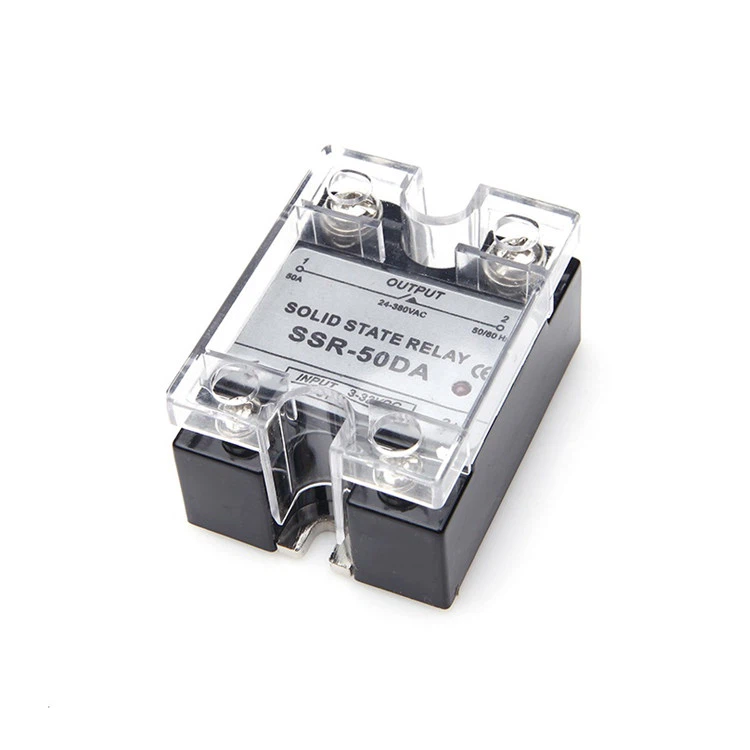
3A DC Solid - State Relay
Advantages:
- Low input power requirements, making them energy - efficient.
- Fast switching speed, which is suitable for applications requiring rapid response.
- No mechanical contacts, resulting in longer lifespan and less maintenance.
- Good isolation between input and output, providing electrical safety.
Disadvantages:
- Limited to DC loads, so they cannot be used directly with AC power sources.
- The output current capacity is relatively small (3A in this case), which may not be sufficient for high - power DC loads.
AC Solid - State Relay
Advantages:
- Can handle AC loads, which are widely used in industrial and residential applications.
- Zero - crossing switching reduces electrical noise and stress on the relay and the load.
- Long lifespan due to the absence of mechanical contacts.
Disadvantages:
- AC input SSRs may require additional protection circuits to prevent overvoltage and overcurrent.
- Non - zero - crossing switching can cause electrical noise and interference.
6. Considerations for Choosing between 3A DC and AC Solid - State Relays
When choosing between a 3A DC solid - state relay and an AC solid - state relay, several factors need to be considered.
- Load Type: The most important factor is the type of load. If you have a DC load, such as a DC motor or a battery - powered device, a 3A DC solid - state relay is the obvious choice. If you need to control an AC load, such as an AC motor or a heating element, an AC solid - state relay is required.
- Input Signal: Consider the type of input signal available from your control system. If you have a DC control signal, a DC input SSR is more suitable. If you have an AC power source available for the input, an AC input SSR can be used.
- Switching Requirements: For applications that require fast switching, a 3A DC solid - state relay may be a better option due to its lack of zero - crossing issues. However, if you need to reduce electrical noise and stress on the load, an AC solid - state relay with zero - crossing switching is preferred.
As a supplier of 3A DC solid - state relays, I offer high - quality products that meet various industrial and commercial needs. Our 3A DC SSRs are designed with advanced technology to ensure reliable performance and long lifespan. If you are interested in our products or have any questions about 3A DC solid - state relays or AC solid - state relays, such as the 100a Dc Solid State Relay or Mini Solid State Relays, please feel free to contact us for further discussion and procurement.
References
- Dorf, R. C., & Bishop, R. H. (2016). Modern Control Systems. Pearson.
- Boylestad, R. L., & Nashelsky, L. (2017). Electronic Devices and Circuit Theory. Pearson.