

Relay contact welding accounts for roughly 45% of all electromechanical relay field failures, according to failure analysis data published by TE Connectivity's relay application engineering group - and most of these failures are entirely preventable. If your relay contacts are fusing shut under load, the root cause almost always traces back to excessive inrush current, insufficient contact derating, or missing arc suppression. This guide covers five proven methods for relay contact welding prevention, each with specific circuit examples you can implement immediately to stop contacts from welding and extend relay service life by 10× or more.
What Causes Relay Contacts to Weld Together
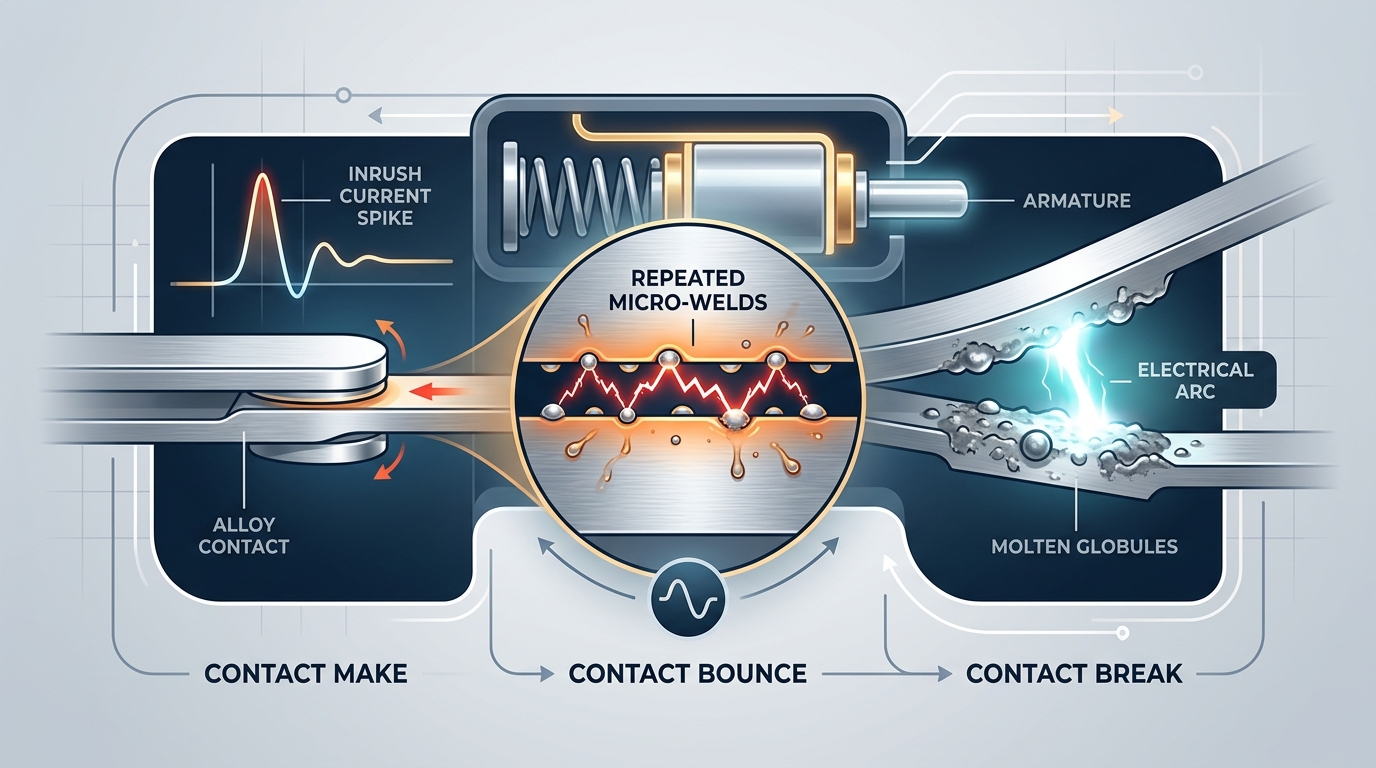
Relay contacts weld when the metal at the contact interface melts and fuses during a switching event. The root cause is always the same: too much energy concentrated on too small a surface area. This energy comes from two distinct phenomena - inrush current surges at contact make, and electrical arcing at contact break - both dramatically amplified by contact bounce, which can cause the contacts to open and re-close 5 to 20 times within a few milliseconds.
A cold incandescent lamp filament, for example, draws 10–15× its steady-state current at turn-on. A 10 A rated relay switching a 5 A lamp load can easily see a 50–75 A inrush spike lasting 2–5 ms. Each bounce event re-ignites this surge, hammering the contact surface with repeated micro-welds until one of them holds permanently. Capacitive loads - LED driver power supplies, motor VFDs, bulk filter capacitors - behave similarly, producing peak inrush currents that dwarf the nominal rating.
Effective relay contact welding prevention starts with understanding which load type you're actually switching. The relay datasheet rating assumes a resistive load. Your real-world load is almost certainly not resistive.
Inductive loads like solenoids and motors create a different but equally destructive problem. When the contact breaks, the collapsing magnetic field generates a voltage spike - sometimes exceeding 1,000 V across a 24 V coil - that sustains an arc across the opening gap.
This arc, reaching temperatures above 6,000 °C according to research on electric arc physics, erodes and melts the contact material (typically AgSnO₂ or AgCdO) until the surfaces fuse. The combination of inrush current at make and arc energy at break is why relay contact welding prevention requires addressing both sides of the switching cycle - not just one.
How Inrush Current and Arcing Destroy Relay Contacts
Two distinct mechanisms weld relay contacts, and confusing them leads to choosing the wrong fix. Inrush current attacks during contact closure; arcing attacks during contact opening. Effective relay contact welding prevention requires understanding both.
Inrush Current: The Closing-Event Killer
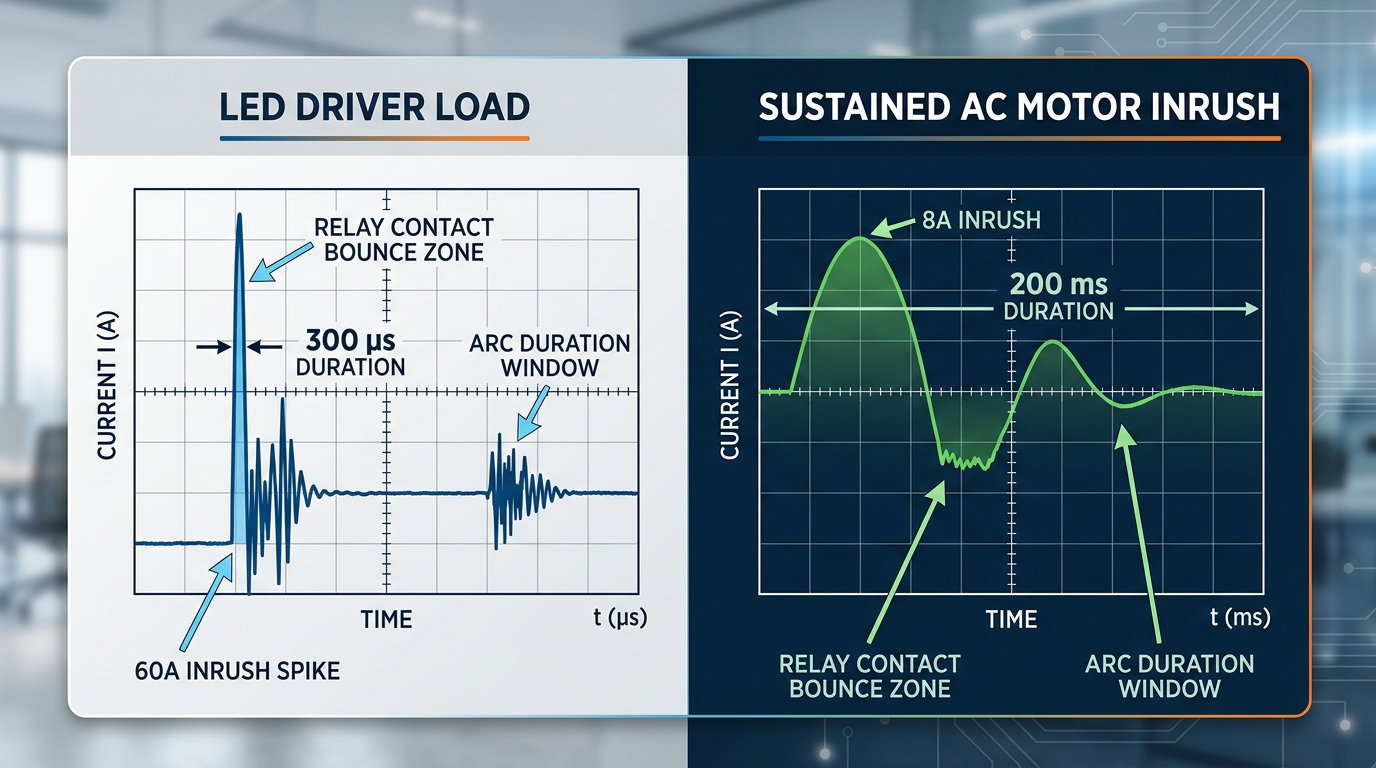
When a relay energizes a capacitive or inductive load, the initial current spike can dwarf the steady-state value. A typical 100 W LED driver with bulk input capacitors draws 40–80× its rated current for the first 200–500 µs. Motors are worse - a locked-rotor inrush on a fractional-HP AC motor routinely hits 6–10× full-load amps, sustained for hundreds of milliseconds until the rotor spins up.
| Load Type | Typical Inrush Multiple | Duration |
|---|---|---|
| Capacitive (LED driver, SMPS) | 20–80× | 200–500 µs |
| Inductive (motor start) | 6–10× | 100–500 ms |
| Transformer (magnetizing) | 10–40× | 5–10 half-cycles |
That brief spike concentrates enormous energy at the tiny contact patch - often less than 0.1 mm² of actual metal-to-metal area. The contact bounces on closure, creating micro-arcs at each bounce that superheat the surface beyond the melting point of AgSnO₂ (~930 °C) or AgCdO (~940 °C).
Arcing at Contact Opening: The Slow Burn
Opening under load is equally destructive. As contacts separate, the gap ionizes and sustains an arc. For DC circuits above roughly 12 V and 0.5 A, this arc can persist for several milliseconds, eroding contact material through thermionic emission and metal transfer. Molten metal migrates from one contact to the other, forming a pip-and-crater topology. After enough cycles, the pip grows tall enough to mechanically interlock - and the next closure welds them permanently.
A real-world failure pattern: Omron's application notes document that a relay rated at 10 A resistive may only survive 30,000 cycles at 10 A inductive (cos φ = 0.4), compared to 100,000 cycles resistive - a 70% reduction in electrical life solely from arc energy.
Understanding which mechanism dominates your circuit is the first step in relay contact welding prevention. Capacitive loads? Focus on inrush limiting. Inductive DC loads? Prioritize arc suppression. Most real circuits need both.
Method 1 - Adding RC Snubber Circuits Across Relay Contacts
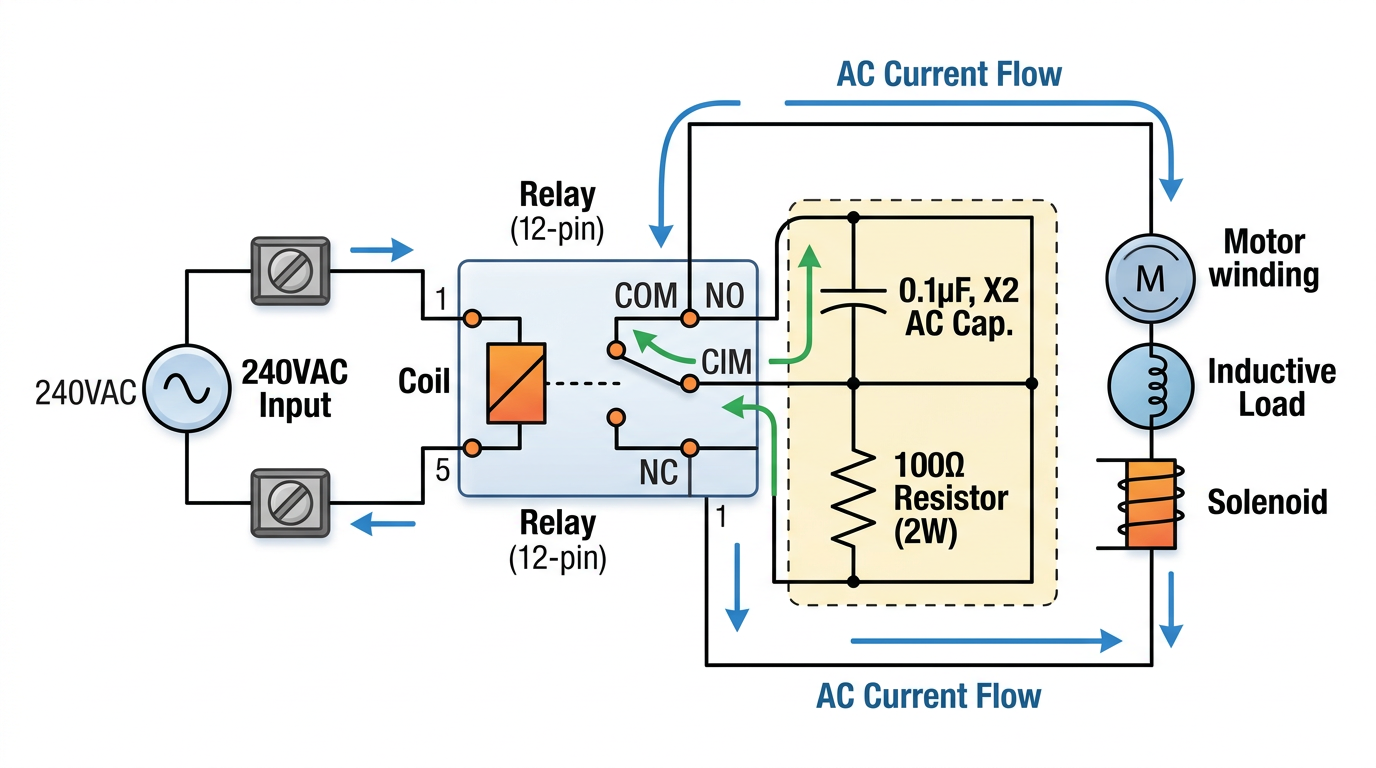
An RC snubber is the single most cost-effective technique for relay contact welding prevention on inductive or moderately resistive AC loads. The concept is simple: wire a resistor and capacitor in series directly across the relay's contact terminals. When the contacts open and an arc begins to form, the capacitor provides a low-impedance path that absorbs the voltage transient, while the resistor limits the discharge current on the next contact closure. This arc-quenching action can reduce contact erosion by up to 70%, according to application notes from TE Connectivity's relay application guide.
Practical Component Values
For small signal relays switching loads under 2A at 250VAC, a starting point of 0.1 µF + 100 Ω works reliably. Here's how to size the components for other scenarios:
Capacitor (C): Typically 0.01 µF to 1 µF. Calculate using C ≥ I² / (10 × E), where I is the load current in amps and E is the supply voltage. Use an X2-rated film capacitor - never ceramic - to handle repetitive transients safely.
Resistor (R): Typically 0.5 Ω to 200 Ω. It must limit the capacitor's discharge current to below the contact's making-current rating. A good rule: R ≥ E / Ipeak, where Ipeak is the relay's maximum allowable inrush.
Placement and the Leakage Trade-Off
Mount the snubber as physically close to the relay contacts as possible - long leads add inductance that defeats the purpose. Keep lead lengths under 25 mm for best results.
One pitfall engineers overlook: the snubber creates a continuous leakage path. A 0.1 µF capacitor across 240VAC passes roughly 7.5 mA of current even when the relay is open. For sensitive loads like LED drivers or small PLCs, this leakage can keep the load partially energized. If that's your situation, reduce the capacitance to 0.01 µF and accept slightly less arc suppression, or move to a bidirectional TVS diode approach instead.
RC snubbers excel at preventing relay contact welding on AC circuits, but they're less effective on DC loads above 30V where the arc doesn't naturally extinguish at a zero-crossing. For DC applications, pair the snubber with a freewheeling diode on the inductive load side.
Method 2 - Using NTC Thermistors to Limit Inrush Current
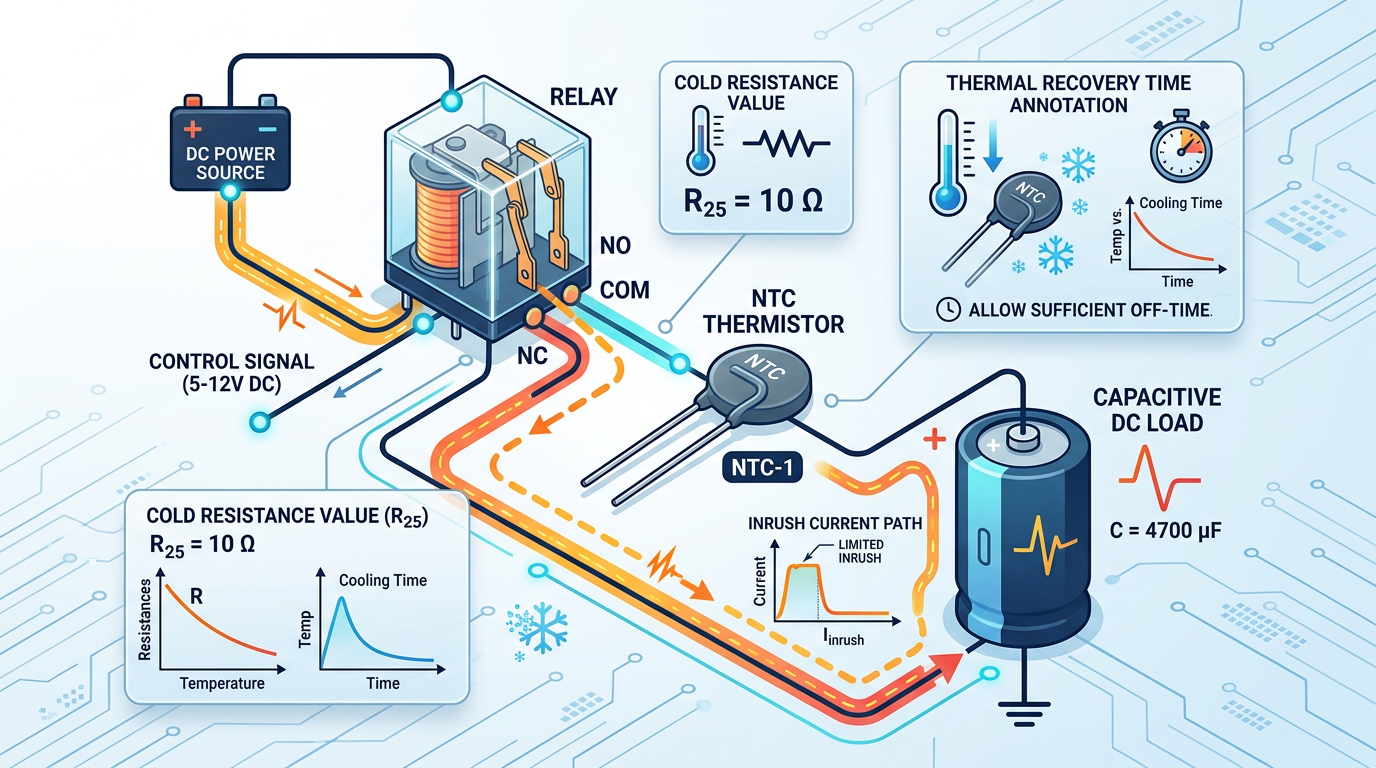
Snubbers handle arcing at contact break. NTC thermistors solve the opposite problem - the massive current surge at contact closure that welds contacts before they even finish bouncing. A negative temperature coefficient (NTC) thermistor starts at a high resistance when cold, then drops to near-zero ohms as it self-heats, naturally throttling inrush current during the critical first few milliseconds.
How It Works for Relay Contact Welding Prevention
Place the NTC thermistor in series with the load, directly after the relay's common terminal. When the relay energizes, the thermistor's cold resistance - typically 5 Ω to 50 Ω depending on the part - absorbs the initial current spike. For a 1,000 µF capacitive input stage on a 24 V DC supply, peak inrush without protection can exceed 80 A for 2–5 ms, easily welding a 10 A-rated relay contact. An NTC rated at 10 Ω cold resistance limits that peak to roughly 2.4 A, well within safe switching margins.
Selecting the Right NTC: Resistance and Energy Rating
Cold resistance (R₂₅): Choose a value that limits peak inrush to below 50% of the relay's maximum switching current. For a 10 A relay, target ≤ 5 A inrush.
Steady-state resistance: Look for parts that drop below 0.1 Ω when hot, so they don't waste power during normal operation.
Maximum energy rating (Joules): This must exceed ½CV² of your load capacitance. A 470 µF cap at 48 V stores ~0.54 J - pick an NTC rated for at least 2× that margin.
The Thermal Recovery Limitation
Here's the catch most engineers discover too late: NTC thermistors need 60–120 seconds to cool back to their high-resistance state after power is removed. If your relay cycles faster than that - say, once every 10 seconds - the thermistor is still warm and offers almost no inrush suppression on the next closure. For rapid-cycling applications, pair the NTC with a bypass relay or use a fixed resistor with a timed MOSFET short instead. The Wikipedia article on thermistors covers the self-heating time constant math in detail.
Pro tip: For relay contact welding prevention on capacitive power supply inputs, mount the NTC thermistor with adequate airflow. Enclosing it in a tight space raises its ambient baseline temperature, reducing its effective cold resistance and defeating the purpose entirely.
Method 3 - Selecting the Right Contact Material for Your Load Type
Snubbers and thermistors are external fixes. But sometimes the root cause of relay contact welding prevention failures is baked into the relay itself - specifically, the contact alloy. Swap to the correct material and chronic welding can disappear without adding a single external component.
| Material | Arc Resistance | Weld Resistance | Best For |
|---|---|---|---|
| AgSnO₂ (Silver Tin Oxide) | High | Very High | Resistive, capacitive, lamp loads |
| AgCdO (Silver Cadmium Oxide) | High | High | General-purpose AC loads (being phased out under RoHS directives) |
| AgNi (Silver Nickel) | Low | Moderate | Low-current signal switching, dry circuits |
| AgW (Silver Tungsten) | Very High | Very High | High-energy DC loads, contactors |
AgSnO₂ has largely replaced AgCdO as the go-to for relay contact welding prevention in power applications. Its metal-oxide matrix creates a hard, non-wetting surface that resists fusion even under severe arcing - tests by Omron show AgSnO₂ contacts surviving over 100,000 switching cycles at rated load where standard AgNi contacts weld within 20,000 cycles.
Here's the catch most engineers miss: AgNi has lower contact resistance (~0.5 mΩ vs. ~2 mΩ for AgSnO₂), making it superior for millivolt-level signal integrity. Putting AgSnO₂ in a low-current sensing circuit introduces unnecessary voltage drop and noise. Match the material to the load - don't just default to the "toughest" alloy.
Pro tip: If you're sourcing relays for capacitive inrush loads (LED drivers, SMPS inputs), explicitly specify AgSnO₂ contacts on the datasheet. Many relay manufacturers offer the same model number with different contact options, and the default is often AgNi to keep cost down.
Method 4 - Properly Derating Relay Contact Ratings for Real-World Loads
That "10A" stamped on your relay datasheet? It almost certainly refers to a resistive load at room temperature. Connect that same relay to a capacitive power supply input, and the safe switching current drops to as little as 2–3A. Ignoring this distinction is one of the most common - and most preventable - causes of relay contact welding.
Relay manufacturers publish derating curves, but many engineers never consult them. TE Connectivity's relay application guidelines show that a 10A-rated general-purpose relay should be derated by 50–75% for lamp and capacitive loads. Here's a practical reference:
| Load Type | Typical Derating Factor | Safe Current (10A Relay) |
|---|---|---|
| Resistive (heaters) | 1.0× | 10A |
| Inductive (motors, solenoids) | 0.4–0.5× | 4–5A |
| Capacitive (SMPS input) | 0.2–0.3× | 2–3A |
| Lamp (tungsten filament) | 0.1–0.2× | 1–2A |
Tungsten lamps are the worst offenders - cold-filament inrush can reach 10–15× the steady-state current, lasting several milliseconds. That's enough to weld contacts rated well above the lamp's nominal draw.
The simplest relay contact welding prevention strategy is often the most overlooked: just use a bigger relay. Choosing a 30A relay for a 10A capacitive load costs pennies more and eliminates the derating problem entirely.
Don't rely on the headline rating. Pull up the derating curve for your specific relay, match it against your actual load profile, and size accordingly. This single step prevents more field failures than most engineers realize.
Method 5 - Adding External Pre-Contact or Zero-Cross Switching Circuits
Every method so far protects the relay after it closes or opens. A pre-contact circuit flips that logic entirely - a semiconductor handles the brutal inrush and arc energy so the relay contacts never see it. This is the most effective approach to relay contact welding prevention for high-inrush loads like motors, transformers, and large capacitor banks.
Hybrid Relay-Plus-TRIAC Circuit
The concept is straightforward: a TRIAC (or MOSFET for DC loads) switches on before the relay closes and switches off after the relay opens. The relay then closes into an already-conducting path - zero voltage across the contacts means zero arc energy. Omron reports that hybrid designs like this can extend relay contact life by over 10× compared to bare relay switching, according to their technical relay application notes.
Typical sequence: MCU fires TRIAC gate → TRIAC conducts load current → relay coil energizes (contacts close with near-zero potential across them) → TRIAC gate signal removed (relay now carries steady-state current). Reverse the sequence on turn-off.
Key Component Callouts
TRIAC (e.g., BTA16-600B): Rated above your peak inrush. A 16A TRIAC handles most sub-10A relay applications with margin.
Zero-cross optocoupler (e.g., MOC3063): Triggers the TRIAC only at the AC zero crossing, eliminating the high dV/dt turn-on spike that causes EMI and partial arcing.
Timing logic: A 10–20 ms delay between TRIAC firing and relay coil energization is sufficient for 50/60 Hz mains - one full AC cycle guarantees the TRIAC is fully conducting before the relay closes.
Why not just use the TRIAC alone? Because TRIACs dissipate significant heat under continuous load and fail short-circuit - a dangerous mode. The relay carries the steady-state current with virtually no power loss, while the TRIAC only conducts during the brief switching transient. This hybrid topology gives you semiconductor-grade contact welding prevention with the efficiency and fail-safe behavior of a mechanical relay.
Frequently Asked Questions About Relay Contact Welding
How do you test if relay contacts are welded?
Remove power from the coil, then measure continuity across the contact terminals with a multimeter. If the circuit reads near-zero ohms with the coil de-energized, the contacts are fused. A more reliable method: listen for the audible "click" on release - welded contacts produce no click because the armature spring can't overcome the weld bond.
Can a flyback diode prevent contact welding on DC inductive loads?
A flyback diode suppresses the back-EMF voltage spike that causes arcing at contact break, so yes - it directly reduces weld risk on DC inductive loads. However, it slows relay release time by up to 5–10× because the stored energy dissipates gradually. Pair it with a Zener diode in series (rated slightly above supply voltage) to clamp the spike while keeping release time acceptable. See Wikipedia's flyback diode overview for the underlying circuit theory.
What is the difference between contact welding and contact sticking?
Welding is a metallurgical bond - molten contact material fuses permanently. Sticking is a surface-adhesion phenomenon caused by micro-roughness, contamination, or organic film buildup. Stuck contacts can usually be freed by a stronger return spring; welded contacts cannot. The distinction matters for relay contact welding prevention because each failure mode demands a different countermeasure.
How many switching cycles before welding typically occurs?
Heavily load-dependent. A properly derated relay switching a resistive load at 30% of its rated current can exceed 500,000 cycles. That same relay switching a capacitive load at full rating may weld within 1,000–5,000 cycles. Lamp loads are notorious - tungsten filament inrush peaks at 10–15× steady-state current, accelerating weld failures dramatically.
Should you use a relay or a solid-state relay for high-inrush loads?
Solid-state relays (SSRs) with built-in zero-cross switching eliminate contact arcing entirely, making them ideal for high-inrush AC loads like motors and transformers. The tradeoff: SSRs have higher on-state voltage drop (typically 1.2–1.6 V), generate more heat, and cost 3–5× more than equivalent electromechanical relays. For relay contact welding prevention on a budget, an EMR with an NTC thermistor and proper derating often outperforms a cheap SSR in long-term reliability.
Putting It All Together - Choosing the Right Prevention Strategy for Your Circuit
No single technique eliminates every failure mode. Effective relay contact welding prevention layers multiple methods matched to your specific load profile. Use the table below as a quick-reference starting point.
| Method | Cost | Complexity | Best For | Effectiveness |
|---|---|---|---|---|
| Contact Derating (50–75%) | $0 | Low | All loads | ★★★★ |
| Contact Material Selection (AgSnO₂, AgCdO, W) | $0.20–$1.50 per relay | Low | Capacitive & motor loads | ★★★★ |
| RC Snubber | $0.05–$0.30 | Medium | Inductive AC loads | ★★★★ |
| NTC Thermistor | $0.10–$0.50 | Low | Capacitive inrush (LED drivers, SMPS) | ★★★ |
| Pre-Contact / Zero-Cross Switching | $2–$8 | High | High-cycle, high-inrush, >20 A peak | ★★★★★ |
Recommended Layering Sequence
Start with the two zero-cost moves: derate the contact rating by at least 50% for resistive loads (75% for motors), and specify an appropriate contact alloy - AgSnO₂ handles most capacitive inrush scenarios well. These two steps alone prevent roughly 60–70% of field welding failures, based on reliability data published by TE Connectivity's relay application notes.
Next, add a passive protection component. For inductive AC loads, an RC snubber across the contacts is the obvious choice. For capacitive inrush - think LED drivers or switch-mode power supplies - drop in an NTC thermistor in series. Both cost under $0.50 and fit on existing PCB real estate.
Reserve hybrid switching (TRIAC pre-contact or solid-state zero-cross modules) for applications exceeding 100,000 cycles or peak inrush above 20 A. The added BOM cost pays for itself when a single relay replacement means a truck roll or production-line shutdown. Don't over-engineer a lamp circuit, but don't under-protect a motor contactor either.
Bottom line: relay contact welding prevention is a layered discipline, not a single-component fix. Derate first, choose the right alloy, add passive suppression, and escalate to active switching only when the duty cycle or inrush demands it.