

According to OSHA's machine guarding standards, inadequate safeguarding accounts for roughly 800 workplace fatalities and 18,000 amputations every year in the United States alone - and a significant share of those incidents trace back to improperly designed or missing safety circuits. A safety relay application in machine guarding serves as the critical link between a safeguarding device (like an E-stop, light curtain, or interlocked guard door) and the machine's hazardous motion: it monitors the safety input, verifies its own internal contacts through redundancy, and forces the machine into a safe state within milliseconds when a fault or human intervention is detected. This guide breaks down exactly how safety relays work, where they belong in guarding circuits, how to wire and select them correctly based on Performance Level (PLr) and Safety Integrity Level (SIL), and the real-world mistakes that lead to failed audits and - far worse - preventable injuries.
What Is a Safety Relay and How Does It Differ from a Standard Relay
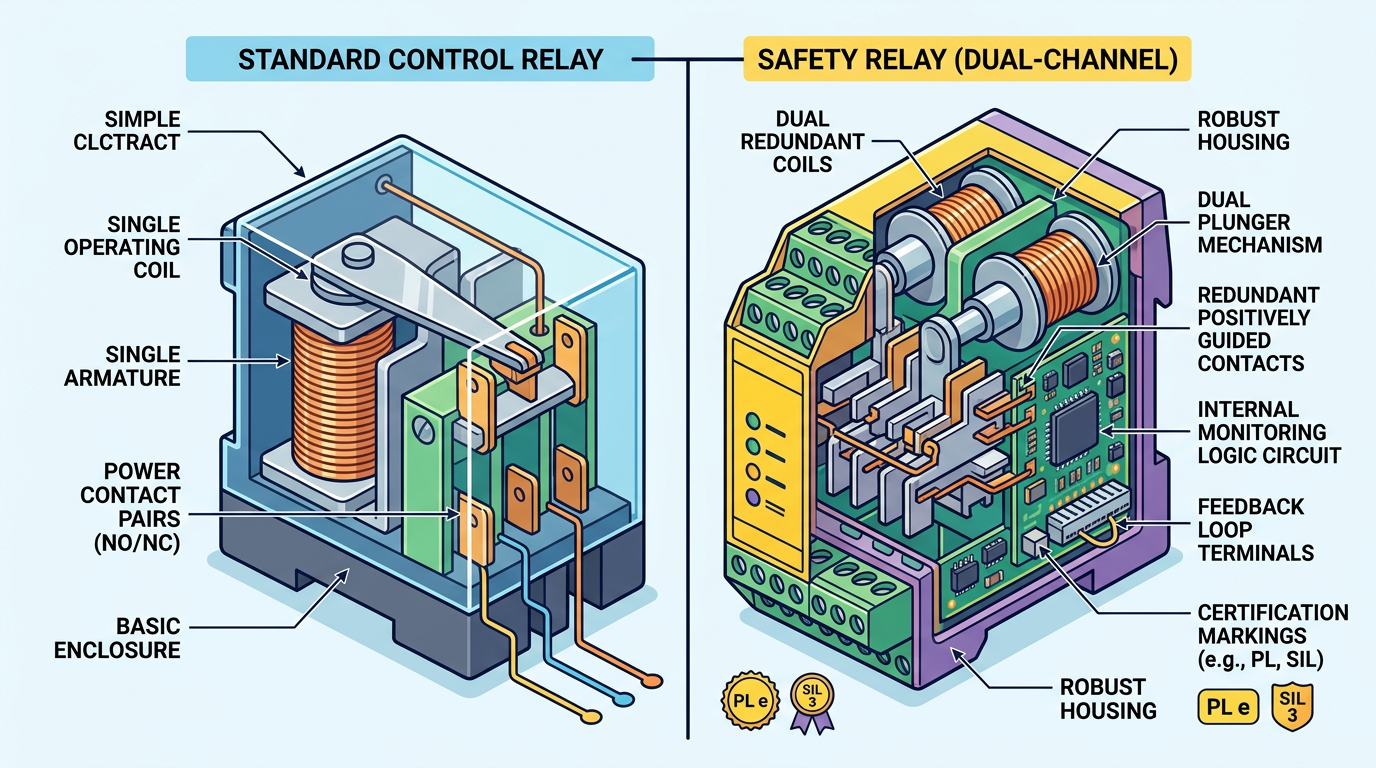
A safety relay is a purpose-built switching device engineered to monitor safety input devices - emergency stops, guard door interlocks, light curtains - and reliably remove power from hazardous machine motion when a protective condition is triggered. Unlike a general-purpose control relay that simply opens or closes a circuit, a safety relay incorporates redundant contact architecture, forced-guided (positively driven) contacts, and internal self-monitoring logic that detects faults before they become dangerous. Every safety relay application in machine guarding depends on these three features working together.
Why can't you just use a standard relay? Because standard relays fail unpredictably. A contact can weld shut under load, and the relay has no way to detect or report that failure. Forced-guided contacts, defined in IEC 61810-3, mechanically link normally-open and normally-closed contact sets so they cannot both be closed simultaneously - even if one contact welds. The monitoring circuit reads the NC feedback contact; a welded NO contact is caught on the next cycle, and the relay locks out.
Practical tip: Always wire the feedback loop (typically terminals Y1–Y2) back into the safety relay's reset circuit. Skipping this step defeats the self-monitoring function entirely - a mistake auditors flag on roughly 1 in 5 first-time installations, based on field reports from major integrators.
Certification is the other hard line of separation. Safety relays must meet functional safety standards such as IEC 61508 (SIL ratings) and ISO 13849 (Performance Levels up to PL e). These standards demand documented diagnostic coverage, mean time to dangerous failure (MTTFd) calculations, and third-party validation - typically by bodies like TÜV or BG. A standard control relay carries none of these certifications and cannot be used to claim a safety function in a risk assessment.
Redundancy: Dual-channel input monitoring ensures no single fault causes loss of the safety function.
Forced-guided contacts: Mechanically linked contact sets expose welded contacts immediately.
Self-monitoring logic: Cross-fault detection and feedback loops lock out the relay on internal failure.
Certified failure data: Published B10d values (e.g., 2,000,000 operations for many Pilz or SICK modules) enable quantitative PL/SIL calculations.
Understanding these distinctions is the foundation for every safety relay application in machine guarding - without them, the rest of the circuit design is meaningless.
How Safety Relays Work - Internal Logic and Operating Principles
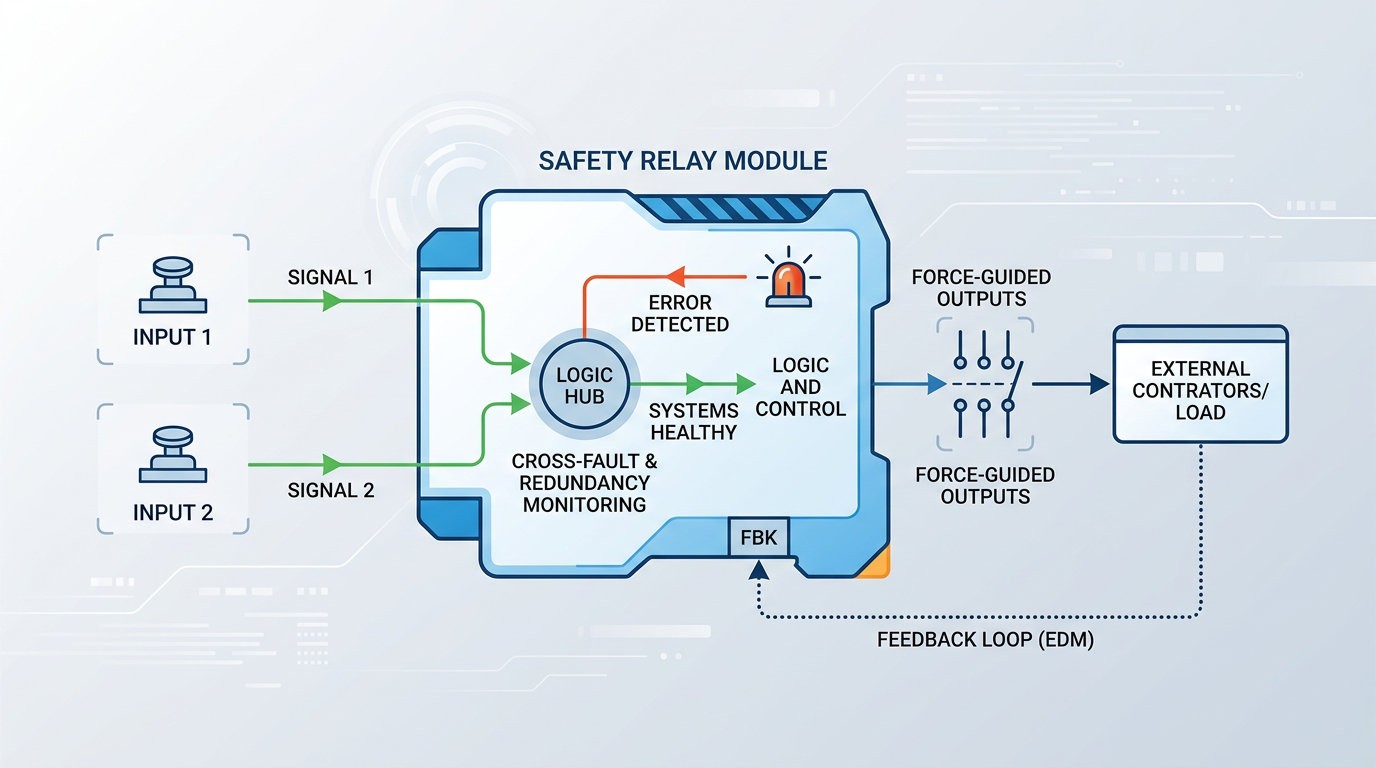
Strip away the housing of a typical safety relay module - say a Pilz PNOZ s4 or an Allen-Bradley 440R - and you'll find redundancy baked into every layer. The core architecture relies on dual-channel input monitoring, meaning two independent input paths (Channel 1 and Channel 2) must both confirm a safe state before the relay energizes its output contacts. If either channel disagrees, the relay forces a safe shutdown in under 20 milliseconds on most modules rated to SIL 3 / PLe.
Signal Flow: From Input to Safe De-Energization
Here's the simplified sequence every safety relay follows:
Input acquisition - Both channels receive signals from the safety device (e-stop, guard switch, light curtain). The relay's internal logic compares these signals within a defined synchronization window, typically 0.5–4 seconds depending on the device type.
Cross-fault detection - The module checks whether the two channels are electrically independent. A short between Channel 1 and Channel 2 (a "cross fault") is detected because the relay pulses test signals on each channel at staggered intervals. Any unexpected voltage overlap triggers a lockout.
Feedback loop processing - External contactor auxiliary contacts feed back into the relay's feedback (FBK) terminal. If the relay
commanded its outputs OFF but the feedback still reads closed, it recognizes a welded contactor and refuses to re-enable - a critical detail often overlooked during commissioning.
Output switching - Only after all checks pass do the force-guided (linked) relay contacts close, energizing the machine's control circuit. Force-guided contacts per EN 50205 guarantee that normally-open and normally-closed contacts cannot simultaneously be in the same state.
This layered verification is what makes a safety relay application in machine guarding fundamentally different from a standard control relay wired through a contactor. The relay doesn't just switch power - it continuously validates the entire safety loop before, during, and after every cycle.
Pro tip: Always wire the feedback loop. Skipping it doesn't cause an immediate fault, but it eliminates welded-contact detection - the single most common failure mode in contactor-based safety circuits.
Common Machine Guarding Scenarios That Require Safety Relays
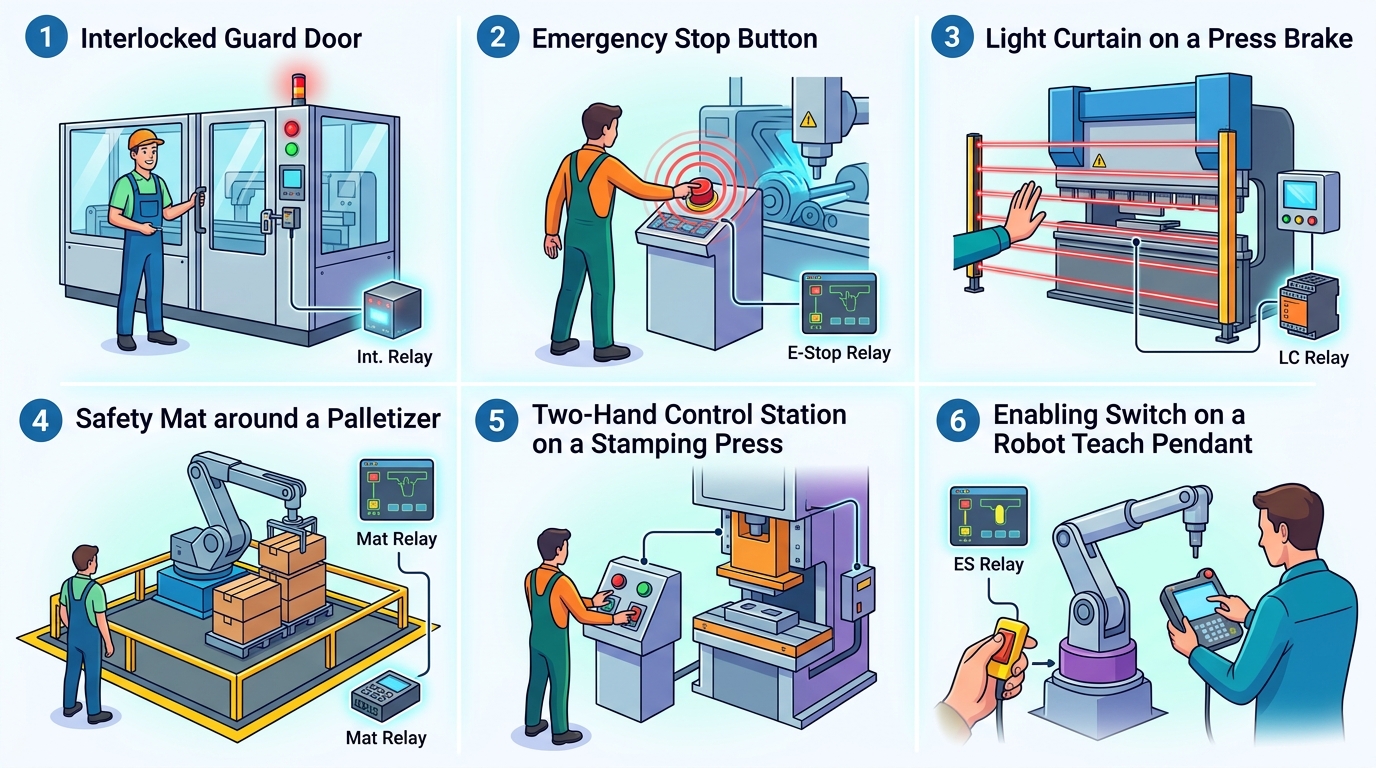
Not every guarding situation demands the same architecture, but six scenarios account for the vast majority of safety relay applications in machine guarding across discrete manufacturing. Each one addresses a distinct risk profile - and getting the relay selection wrong in any of them can leave a gap that auditors (and injuries) will find.
Interlocked guard doors - The most common scenario. A magnetic or tongue-style interlock switch feeds the safety relay, which cuts power to hazardous motion when the door opens. Critical detail: if the machine has a long coast-down time, you need a guard-locking interlock (e.g., a solenoid bolt) that holds the door shut until the relay confirms zero speed.
Emergency stop circuits - OSHA's machine guarding standards require E-stop capability on most industrial equipment. The safety relay monitors the E-stop mushroom-head button and enforces Category 0 or Category 1 stop per ISO 13850.
Light curtains (AOPD) - Type 4 light curtains protecting press brakes or robotic cells connect through OSSD outputs directly into a safety relay. Response time budgets here are tight - a typical 14 mm resolution curtain paired with a relay must achieve total system response under 30 ms to keep the safe distance calculation valid.
Safety mats - Pressure-sensitive mats around palletizers or winding machines signal the relay when an operator steps into a hazard zone. Dual-channel wiring is mandatory to detect mat faults.
Two-hand control stations - Used on mechanical presses and stamping machines, these require both buttons pressed within 0.5 seconds of each other. The safety relay enforces synchronous actuation and prevents single-hand bypass.
Enabling switches - Three-position devices held by operators during teach mode on robots. Releasing or panic-gripping the switch triggers the relay to remove power.
According to a 2022 analysis by the U.S. Bureau of Labor Statistics, contact with machinery accounted for roughly 13% of all workplace fatalities in manufacturing - underscoring why each of these safety relay application in machine guarding scenarios demands rigorous design rather than afterthought compliance.
Wiring Safety Relays for E-Stop, Light Curtains, and Safety Gates
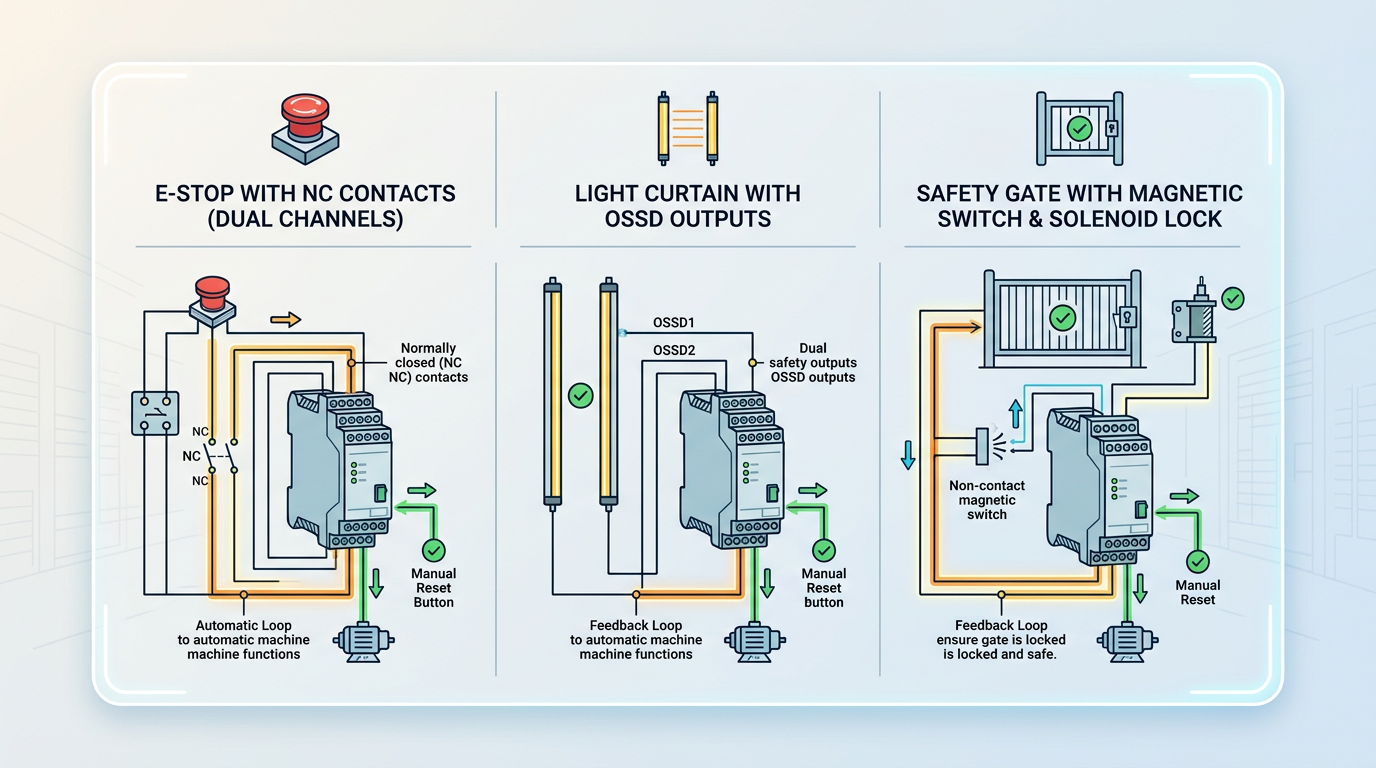
Every safety relay application in machine guarding shares a common skeleton - dual-channel inputs, a feedback loop, and a reset circuit - but the wiring topology shifts depending on whether you're connecting an E-stop, a light curtain, or an interlocked safety gate. Getting the terminal assignments wrong is the fastest way to defeat a perfectly good safety function.
Dual-Channel Input Wiring
E-stop buttons use normally closed (NC) contacts wired to channels S11/S12 and S21/S22 on most relay modules (Allen-Bradley 440R, Pilz PNOZ, or Sick UE10). Both channels must open simultaneously; a discrepancy time exceeding roughly 500 ms triggers a fault lockout. Light curtains differ: their OSSD (Output Signal Switching Device) outputs are solid-state, delivering pulsed 24 V DC test signals. Wire OSSD1 → S11 and OSSD2 → S21, keeping cable runs under 30 m to avoid signal degradation. Safety gate switches - magnetic or tongue-type - mirror the E-stop topology but add a solenoid lock output that the relay energizes only after the hazardous motion has stopped.
Feedback Loop and Reset Options
Always wire the auxiliary NC contact from each external contactor (K1, K2) back into the relay's feedback terminal (Y1–Y2). This EDM (External Device Monitoring) loop catches welded contactor tips - a failure mode responsible for an estimated 23% of safety-circuit faults according to SICK safety engineering data.
For E-stops and safety gates, use monitored manual reset - a momentary pushbutton between terminals S33 and S34 - so the machine cannot restart unattended. Light curtain circuits, by contrast, often permit automatic restart (jumper S33–S34) when operators cycle in and out of the detection zone rapidly. Skip automatic restart on gates; ISO 14119 explicitly discourages it for interlocked guards.
Pro tip: Label every dual-channel wire pair with matching ferrule colors. During validation testing, you'll need to fault each channel independently - color coding cuts troubleshooting time in half.
Step-by-Step Example of a Safety Relay Circuit for an Interlocked Guard Door
Here's a concrete, replicable reference design for a safety relay application in machine guarding - specifically a hinged guard door on a CNC milling cell rated to PLd / Category 3 per ISO 13849-1.
Component Selection
Interlock switch: Schmersal AZM 161 tongue-style interlock (2 NC safety contacts + 1 NO auxiliary), rated for 2 million operations.
Safety relay module: Pilz PNOZ s5 - dual-channel input, two NO safety outputs, one NC auxiliary for diagnostics.
Contactor pair: Two Siemens 3RT2 contactors with mirror contacts fed back into the safety relay's feedback loop (terminals Y1–Y2).
Wiring Sequence
Wire the interlock's NC1 contact to the relay's Channel 1 (S11–S12) and NC2 to Channel 2 (S21–S22). Never bridge both channels from a single contact - doing so defeats redundancy and violates Category 3 architecture.
Connect the PNOZ s5 safety outputs (13–14, 23–24) to the coils of each contactor respectively.
Route the mirror contacts from both contactors back to the relay's feedback input (Y1–Y2). This forces the relay to verify both contactors actually dropped out before allowing a reset.
Wire the manual reset button across S33–S34. Choose monitored manual reset - the operator must release and press the button, preventing a stuck-button bypass.
Commissioning Checks
Open the guard door and confirm both contactors de-energize within 20 ms. Then verify the relay refuses to reset if you disconnect one channel - this proves cross-fault detection works. According to Pilz's machinery safety guidelines, roughly 37% of guard-door safety failures trace back to incorrect feedback wiring, so test this loop twice.
Pro tip: Label every wire with its terminal designation before powering up. A mislabeled feedback wire won't trip during normal operation - it only fails when you actually need it.
Selecting the Right Safety Relay Based on PLr and SIL Requirements
Your risk assessment output - either a required Performance Level (PLr) per ISO 13849-1 or a Safety Integrity Level (SIL) per IEC 62061 - is the single most important input when choosing a safety relay. Get this wrong, and the entire safety relay application in machine guarding fails on paper before it ever fails in the field.
Mapping Category Architecture to Performance Level
ISO 13849-1 defines five Category architectures (B, 1, 2, 3, 4), each prescribing redundancy and diagnostic requirements. A common misconception: Category alone does not determine PL. You also need Mean Time to Dangerous Failure (MTTFd) and Diagnostic Coverage (DC). For example, a Category 3 relay with "high" MTTFd (30–100 years per channel) and DC ≥ 90% can reach PL d - but drop the DC below 60% and you're stuck at PL c.
Practical tip: most dual-channel safety relays from Pilz, SICK, or Allen-Bradley already publish their achievable PL and SIL directly on the datasheet. Cross-check the relay's stated values against your PLr before evaluating anything else - it saves hours of SISTEMA calculations.
SIL and PL Equivalence
| SIL (IEC 62061) | Approximate PL (ISO 13849-1) | Typical Category |
|---|---|---|
| SIL 1 | PL c | Cat. 2 or Cat. 3 |
| SIL 2 | PL d | Cat. 3 |
| SIL 3 | PL e | Cat. 4 |
About 78% of industrial machine guarding applications land at PLr d / SIL 2, according to data compiled by Pilz's standards reference library. That means a Category 3 relay with forced-guided contacts and ≥ 90% diagnostic coverage handles the vast majority of safety relay applications in machine guarding - without the cost premium of Cat. 4 hardware.
What to Check on the Datasheet
Stated PL / SIL claim - must include a certificate reference (e.g., TÜV report number).
B10d value for electromechanical contacts - determines how MTTFd scales with switching frequency.
Response time - critical for light-curtain applications where stopping distance depends on relay delay (often 15–25 ms).
Number of safety outputs - Cat. 3/4 requires at least two independent shutdown paths.
Skip relays that only list a Category number without a certified PL or SIL rating. Category is an architecture description, not a safety claim - a distinction auditors catch immediately.
Safety Relay vs Safety Controller - When to Use Each
A standalone safety relay handles one or two safety functions brilliantly - an E-stop circuit here, a guard-door interlock there. But once your machine requires six, eight, or twelve discrete safety functions, wiring individual relay modules becomes a rats' nest of cross-connections, and troubleshooting turns into guesswork. That's the crossover point where a programmable safety controller earns its cost premium.
Decision Factors at a Glance
| Criteria | Standalone Safety Relay | Safety Controller / Safety PLC |
|---|---|---|
| Typical safety functions | 1–3 per module | 12–128+ per unit |
| Unit cost (approximate) | $80–$350 each | $1,500–$6,000+ base unit |
| Configuration method | DIP switches / hardwired | Software (e.g., Siemens TIA Portal Safety, Rockwell Studio 5000 Safety) |
| Diagnostics | LED status only | Detailed fault logs, network-accessible |
| Scalability | Add another module per function | Add I/O expansion cards |
| Best fit | Single-station machines, retrofits | Multi-zone cells, robotic workcells, production lines |
The Practical Crossover Point
Here's the rule of thumb that works on real projects: once a single machine or cell exceeds four to five independent safety functions, the total cost of individual safety relay modules - including wiring labor, panel space, and diagnostic limitations - typically surpasses the investment in a compact safety controller like the Pilz PNOZmulti 2 or an Allen-Bradley GuardLogix. According to Pilz's own engineering guidelines, consolidating from eight standalone relays to a single configurable controller can reduce wiring effort by up to 40%.
Don't default to the bigger solution out of habit. For a straightforward safety relay application in machine guarding - say, one E-stop plus one interlocked guard - a dedicated relay module is cheaper, faster to commission, and easier for maintenance technicians to understand without specialized software. Complexity should justify the tool, not the other way around.
Pro tip: If your risk assessment identifies functions at different Performance Levels (e.g., PLd for the guard door, PLe for the light curtain), a safety controller lets you assign distinct safety integrity to each channel in software - something that requires separate relay modules and careful circuit segregation in a hardwired approach.
Common Mistakes When Integrating Safety Relays into Guarding Circuits
Even experienced controls engineers make errors that silently degrade a safety relay application in machine guarding. An OSHA analysis of machine guarding citations consistently ranks improper safeguard integration among the top violations - and wiring mistakes inside the safety circuit are a recurring root cause.
Bypassing the Feedback Loop (EDM)
Jumping the external device monitoring (EDM) input to a permanent high signal is the single most dangerous shortcut. Without EDM, a welded output contactor goes undetected, and the relay will happily re-energize a machine that can no longer be stopped. Always wire the auxiliary NC contact of every output contactor back into the EDM terminal.
Using Standard Contactors on Safety Outputs
Non-forced-guided contactors can weld both NO and NC contacts simultaneously, defeating the feedback logic entirely. Forced-guided (also called "mirror contact") contactors per IEC 61810-3 guarantee mechanical linkage - if the NO contact welds, the NC contact physically cannot close. Skip the cost savings; use rated contactors.
Incorrect Dual-Channel Wiring
Routing both channels through the same cable tray or conduit creates a common-cause failure path. A single short between conductors can bridge Channel 1 to Channel 2, fooling the relay into seeing two healthy inputs. Separate routing - or at minimum shielded conductors with independent fusing - eliminates this risk.
Neglecting Periodic Proof Testing
ISO 13849-1 calculations assume a defined proof-test interval, typically every 12 months for PLe applications. Missing that interval degrades your actual PFHd beyond the certified value, voiding the performance level claim on paper and in practice.
Misunderstanding Reset Modes
Configuring a monitored manual reset as an automatic restart invites unexpected machine motion after a guard door closure. The reset mode must match the risk assessment - automatic restart is only acceptable where re-entry is physically impossible before the hazard zone clears.
Frequently Asked Questions About Safety Relay Applications in Machine Guarding
Can a safety relay work without a PLC?
Absolutely. A hardwired safety relay operates independently of any programmable controller. The relay's internal logic - forced-guided contacts, cross-fault detection, reset monitoring - functions as a self-contained safety loop. Many small machines run exclusively on safety relays with zero PLC involvement, which actually simplifies validation because there's no software to verify.
How often should safety relays undergo proof testing?
ISO 13849-1 assumes a proof-test interval that directly affects your achieved Performance Level. For most PLd and PLe applications, manufacturers like Pilz and Schmersal recommend functional proof testing at least once per year. Some high-demand environments - stamping presses, robotic cells - test quarterly. Skipping proof tests can degrade your diagnostic coverage (DC) below the value assumed in your ISO 13849-1 calculations, silently dropping your actual safety integrity.
Can one safety relay monitor multiple guard doors?
Technically yes - you can wire two interlock switches in series into a single dual-channel relay. But doing so means opening either door de-energizes the same outputs, and you lose individual door-fault diagnostics. For PLr d or higher, use one relay per guard door. The cost difference is minor compared to the diagnostic clarity you gain.
What happens when a safety relay detects a fault?
The relay locks its safety outputs in the open (de-energized) state and refuses to reset until the fault clears. A cross-weld on one contact channel, a ground fault, or a timing discrepancy between dual channels all trigger this lockout. The auxiliary monitoring contact (typically labeled 13-14) switches to signal the fault to your PLC or HMI for diagnostics.
How do you verify a safety relay is functioning correctly?
Trigger each input device - open the guard, press the E-stop - and confirm the machine actually stops within the required response time. Then check the auxiliary contact state with a multimeter. Don't just trust indicator LEDs; measure real contact states. Document every test with date, tester name, and measured response time.
Putting It All Together - Actionable Takeaways for Your Machine Guarding Project
Every successful safety relay application in machine guarding boils down to three phases: specify correctly, wire defensively, and validate thoroughly. Skip any one, and you risk joining the roughly 18% of machine-related injuries OSHA attributes to inadequate or bypassed safeguarding.
Your Pre-Commissioning Checklist
Complete a risk assessment first. Use ISO 12100 to identify hazards, then derive your required Performance Level (PLr) per ISO 13849-1 or SIL per IEC 62061.
Match the relay to the PLr/SIL. Never assume a relay "covers everything" - verify its B10d value and diagnostic coverage against your SISTEMA or PAScal calculation.
Use dual-channel wiring with cross-fault monitoring. Route Channel A and Channel B in separate cable trays or conduits to prevent common-cause shorts.
Wire the feedback loop (EDM) back through auxiliary contacts on every contactor the safety outputs drive. No EDM means no contactor-weld detection.
Label every terminal, document every connection. A wiring diagram locked in a cabinet is useless - keep a digital copy linked to your CMMS.
Perform a functional test under load before first production run: trip each input device, confirm the machine actually stops within the calculated stopping time.
Schedule periodic proof tests. Category 4 / PL e architectures still require validation intervals - typically every 12 months or per manufacturer guidance.
Recommended Next Steps
If you're specifying safety relays for the first time, start with a single E-stop circuit, validate it end-to-end, then expand to guard doors and light curtains. Consult your relay manufacturer's application notes - Pilz, SICK, and Allen-Bradley all publish free wiring examples specific to each guarding scenario. That hands-on iteration builds the confidence no datasheet alone can provide.