

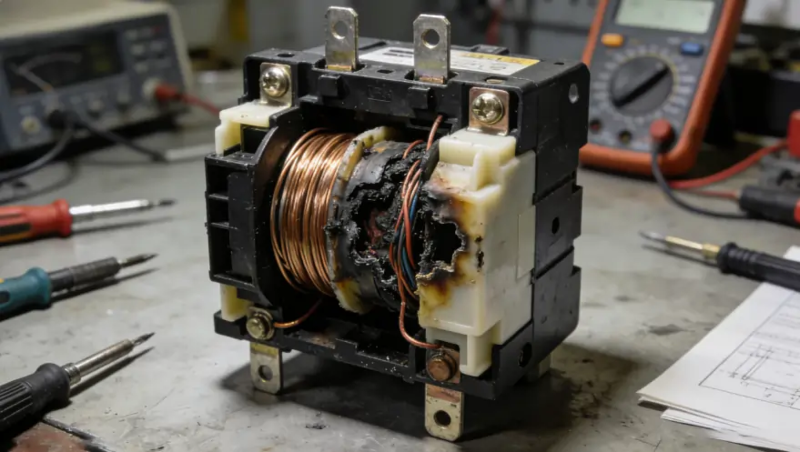
When an intermediate relay coil burns out, it's not just a small problem. It means unexpected downtime. It frustrates your maintenance team. And it slowly eats away at how efficiently your operation runs.
When a relay fails, production can stop completely. This creates a chain reaction of lost productivity and extra maintenance work. The relay itself might be simple and cheap, but when it fails too early, it usually means there's a bigger problem hiding in your control system.
A burnt coil isn't the real problem - it's just a warning sign. If you only replace the broken part without digging deeper, you're just putting a bandage on it. The failure will happen again.
This guide gives you a complete framework for analysis of intermediate relay coil burnout. We won't just talk about replacing parts. We'll dig into the real causes. We'll look at the three main troublemakers: electrical stress like overvoltage, how you use the relay like frequent switching, and tough environmental conditions including poor heat dissipation.
When you finish this guide, you'll know how to find exactly why a relay failed. You'll also know how to put strong, long-lasting prevention plans in place. We'll help you stop fixing problems after they happen and start preventing them before they occur.
What Happens When a Coil Burns Out
Understanding coil burnout at the physical level is your first step toward effective analysis. This moves you from just seeing a "burnt" part to understanding exactly what led to its destruction.
How a Healthy Coil Dies
A relay coil is basically an electromagnet. It's made from long, thin copper wire coated with a thin layer of enamel insulation. This wire is wrapped carefully around a bobbin. When you apply the right voltage, current flows and creates a magnetic field that moves the relay's contacts.
Coil burnout starts when the coil gets hotter than its enamel insulation can handle. This extra heat makes the insulation break down, get brittle, and eventually fail. Once the insulation is damaged, the copper wire windings next to each other can touch directly. This creates a short circuit.
The short circuit drops the coil's resistance dramatically. This causes a surge of current that leads to catastrophic overheating and the final, visible burnout. Think of it like the plastic covering on a regular wire melting away when it's severely overloaded, exposing the metal conductor underneath.
What to Look For
A failed coil gives you clear evidence of how it died. Recognizing these signs is crucial for getting your initial diagnosis right. We split these symptoms into what you can see and what you can measure electrically.
|
Category |
Symptom |
Description |
|
Visual Signs |
Discoloration |
The coil windings or bobbin look brown, dark, or black. This shows long exposure to too much heat. |
|
|
Deformation |
The plastic bobbin holding the coil might be melted, warped, or misshapen. This points to extreme heat, often from a short circuit. |
|
|
Acrid Smell |
A strong "burnt electronics" smell is a clear sign of thermal failure involving plastics and insulating materials. |
|
Electrical Signs |
Open Circuit |
A multimeter reading of infinite resistance (no continuity) means the thin coil wire has broken or melted open. |
|
|
Shorted Windings |
A resistance reading that's abnormally low, often near zero ohms, confirms that insulation failed and windings are shorted together. |
The Main Causes
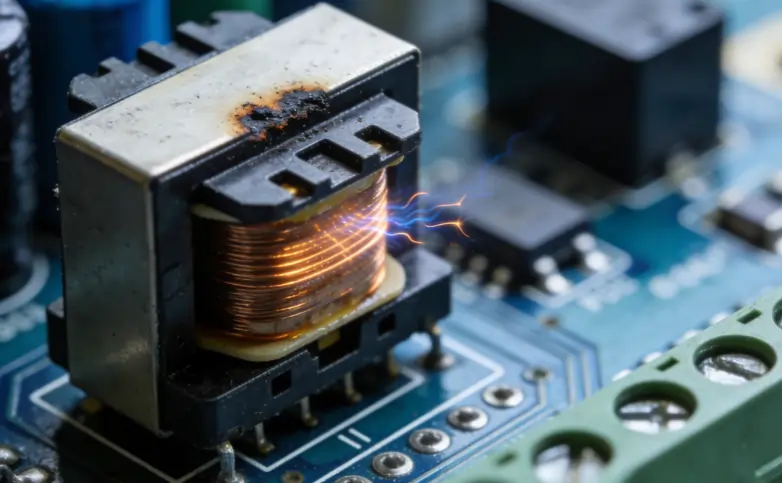
A thorough analysis of intermediate relay coil burnout shows that failures are rarely random. They're predictable results of specific stressors. We can group these main causes into three clear categories: electrical, operational, and environmental.
Electrical Stress
Electrical stress is the single most common cause of coil burnout. The coil is designed to work within a narrow electrical range. Any deviation can be destructive.
Overvoltage is the silent killer and most frequent culprit. Most standard industrial relays are designed to operate within a nominal voltage range of +/- 10%. Pushing the voltage even slightly above this sustained window has a dramatic and non-linear effect on heat generation.
According to the power law (P = V²/R), the power given off as heat is proportional to the square of the voltage. A mere 15% overvoltage (like applying 27.6V to a 24VDC coil) results in a 32% increase in heat generation (1.15² = 1.3225). The coil can't get rid of this extra heat. This leads to thermal runaway where temperature climbs until insulation fails.
Operating a relay outside its specified voltage range effectively cancels its life-expectancy ratings.
Undervoltage presents a less obvious but equally damaging failure mode. When the supplied voltage is too low to create enough magnetic field, the relay's armature may fail to pull in decisively. Instead, it might "chatter" or buzz, rapidly cycling between energized and de-energized states. This rapid switching generates excessive heat and causes significant mechanical wear on contacts and armature, leading to early failure.
Voltage fluctuations and transients introduce another layer of risk. Unstable power supplies, line noise, and switching of nearby inductive loads (like motors or solenoids) can add damaging voltage spikes to the coil's supply line. This back EMF (electromotive force) can subject coil insulation to momentary but extreme stress, leading to gradual breakdown or immediate failure.
Operational Stress
How you use a relay within a machine or process directly impacts its lifespan. Application-specific factors can work a relay to death long before its expected end-of-life.
Frequent starting, or high duty cycle, is a primary operational concern. Every time a relay coil energizes, it experiences a rush of current and its temperature rises. The "off" period is critical because it allows the coil to cool down and get rid of this heat.
If the "off" time is too short for adequate cooling, heat starts building up with each cycle. The coil's baseline temperature steadily climbs, eventually going past the thermal limit of its insulation. This is common in applications like sorting, counting, or rapid positioning systems, where the relay can't reach thermal balance.
Incorrect application is a critical and surprisingly common error. Coils are designed specifically for either AC or DC voltage. A DC coil has resistance that is its only impedance. An AC coil is designed with higher impedance that accounts for both resistance and inductive reactance.
Applying AC voltage to a DC coil will cause it to overheat and burn out almost instantly, as current will be far too high. Conversely, applying DC voltage to an AC coil will often result in weak magnetic field, potentially causing chatter or failure to actuate, though it's less likely to cause immediate burnout.
Environmental Factors
The environment inside a control cabinet is often far from ideal. A relay's performance and lifespan are directly linked to the conditions around it.
High ambient temperature is a critical accelerator of coil failure. A relay's primary cooling mechanism is convection, getting rid of heat into surrounding air. How well this heat dissipation works depends directly on the temperature difference between the coil and ambient air.
When a control panel is already hot, this temperature difference is reduced, crippling the relay's ability to cool itself. The heat generated by the coil has nowhere to go, causing internal temperature to rise dangerously. As a reliable rule of thumb, for every 10°C increase in operating temperature above the rated limit, the expected life of the coil's insulation is cut in half.
Poor ventilation directly makes the problem of high ambient temperature worse. Tightly packed components, with insufficient spacing between them, create pockets of stagnant, hot air. Control cabinet ventilation fans that are clogged with dust, or vents blocked by manuals or debris, effectively wrap components in an insulating blanket.
This lack of airflow prevents convective cooling and ensures that heat generated by relays and other devices stays trapped within the enclosure.
Vibration and shock, while primarily mechanical stressors, can also lead to electrical failure. In environments with heavy machinery, constant vibration can cause tiny fractures in the extremely fine wire used to wind the coil. Over time, these fractures can grow, leading to increased resistance at the fracture point or complete break in wire, resulting in open-circuit failure.
A Step-by-Step Diagnostic Process
When we encounter a burnt coil in the field, we follow this exact diagnostic procedure. This ensures we find the true root cause, not just the symptom. This systematic approach prevents repeat failures and saves valuable time.
Step 1: On-Site Inspection
Your first analysis begins before you even pick up a tool. Use your senses to gather critical data from the failure site.
First, perform a visual examination. Is the coil merely discolored and brown, suggesting a long-term, slow failure from moderate overvoltage or high ambient heat? Or is the bobbin melted and severely deformed? Extreme deformation points to a short-circuit condition and immense heat, often from severe overvoltage event or internal winding failure.
Next, note any distinct acrid or burnt smells, which confirm a thermal event. Finally, look at the bigger picture. Check surrounding components. Are adjacent relays also showing signs of heat stress, like discoloration? This would strongly suggest a system-wide problem, such as panel-wide overvoltage or dangerously high ambient temperature, rather than an isolated component defect.
Step 2: Electrical Tests
After visual inspection, turn off power and isolate the relay to perform safe electrical testing with a quality digital multimeter.
The primary action is to measure resistance across coil terminals. The reading will point you toward the failure mode. If the meter reads infinite resistance or "OL" (Open Loop), the fine coil wire has physically broken. This is common result of thermal stress, vibration, or manufacturing defect.
If the reading is near zero ohms or significantly lower than manufacturer's specification, windings have shorted together. This is the classic symptom of insulation breakdown and subsequent coil burnout.
If resistance reading is correct and matches datasheet specification, the coil itself may be functional. The problem might lie elsewhere, such as faulty driver circuit, poor connection at terminal, or mechanical failure within relay.
Step 3: Live Voltage Check
This is the most critical step for diagnosing electrical stress. With the faulty relay removed from its socket, carefully measure voltage present at coil terminals of the socket during machine operation.
The key question is: Is voltage stable and within the relay's specified +/- 10% rating? Check voltage in both de-energized (idle) and energized states. Use a multimeter with Min/Max capture function to record any fluctuations that occur over a few minutes of operation.
For more elusive problems, an oscilloscope is the definitive tool. It can reveal dangerous voltage transients, excessive ripple on DC supply, or distorted AC waveform that a standard multimeter would miss. This is the only way to definitively prove or disprove overvoltage as the root cause.
Step 4: Environmental Assessment
Finally, assess the relay's working environment. Conditions inside a control cabinet can be dramatically different from the surrounding room.
Use a thermocouple or infrared thermometer to measure ambient temperature inside the control cabinet, specifically near the failed relay. Is it significantly higher than room temperature? Readings above 40°C (104°F) should be a cause for concern and will accelerate component aging.
Check for adequate airflow. Are the cabinet's ventilation fans running and clean? Are air intake and exhaust vents unobstructed? Is there a visible layer of dust on components that could be acting as insulator? Are relays and other heat-producing components packed too tightly together, preventing proper heat dissipation through convection?
Prevention Strategies
Preventing coil burnout is far more cost-effective than repeatedly diagnosing and replacing failed components. A proactive approach focuses on creating a robust system where relays can operate comfortably within their design limits. The best prevention strategies directly address the root causes identified during analysis.
|
Problem Symptom |
Likely Cause |
Primary Prevention Strategy |
|
Blackened, overheated coil |
Sustained Overvoltage |
Install a high-quality, regulated power supply; verify output voltage under full load. |
|
Buzzing/Chattering relay |
Undervoltage |
Ensure power supply can handle inrush current; check for voltage drop on long wire runs. |
|
Failure in hot environment |
Poor Heat Dissipation |
Improve ventilation; add cabinet fans; increase spacing between relays; use heat sinks. |
|
Premature failure in rapid-cycle machine |
Exceeding Duty Cycle |
Select a relay specifically rated for high-frequency switching or opt for a solid-state relay (SSR). |
|
Sudden, violent burnout |
Inductive Kick/Transients |
Install appropriate suppression: a freewheeling diode for DC coils or an RC snubber/MOV for AC coils. |
Electrical System Health
The foundation of relay reliability is a clean, stable power source.
Voltage regulation is critical. Always use high-quality, regulated switch-mode power supplies for control circuits. Avoid using simple, unregulated transformer-rectifier setups, as their output voltage can vary significantly with changes in AC line voltage and load.
Transient suppression is essential when switching inductive loads. For DC coils, a freewheeling diode installed in parallel with the coil provides a path for the collapsing magnetic field's energy to dissipate safely. For AC coils, an RC snubber network or Metal Oxide Varistor (MOV) across coil terminals will effectively clamp high-voltage spikes generated during de-energization, protecting the coil's insulation.
Smart Operation Design
Selecting the right component for the job and respecting its operational limits is a core principle of reliable design.
Respect the duty cycle. When designing a system with high-frequency switching, consult the relay's datasheet for its maximum operations per minute. If the application's demands exceed this, heat will accumulate. In such cases, the correct solution is to select a relay specifically designed for high-frequency use or, more commonly, to specify a solid-state relay (SSR), which has no moving parts and generates less heat during switching.
Correct relay selection seems obvious, but is a frequent source of error. Always double-check that the coil's specifications-voltage rating (e.g., 24V, 120V), voltage type (AC or DC), and power consumption-are a perfect match for the application's power source and driver circuitry.
Temperature Control
Managing the thermal environment within a control panel is key to ensuring longevity of all components, not just relays.
Promote airflow at every opportunity. When laying out a panel, leave adequate space-a minimum of 10-15mm is a good starting point-between relays and other components to allow for natural convective air currents. Ensure cabinet ventilation paths are clear and that fans are clean and functional. For high-density panels or those in hot locations, installing forced-air cooling fans is a necessary investment.
Use the professional concept of component derating. This means intentionally selecting a component rated for more demanding conditions than your application requires. For example, if your panel's internal temperature might reach 50°C, choose a relay rated for operation up to 70°C. This builds in a significant safety margin and dramatically increases the component's lifespan and reliability.
Advanced Problem-Solving
Individual failures are often straightforward. However, the most challenging and chronic issues we see in the field are caused by a combination of factors. Several minor issues create a major problem.
When Problems Multiply
Relay failure is rarely the result of a single, massive error. More often, it's death by a thousand cuts. It's the combination of multiple, seemingly minor issues that creates the perfect storm for coil burnout.
Consider this common scenario: a power supply provides slight overvoltage of +8% (within the +/-10% spec, but on the high end). The control panel is located in a warm factory, leading to ambient internal temperature of 45°C. The machine it controls runs on a moderately frequent cycle.
Individually, none of these factors would cause immediate failure. The relay can handle slight overvoltage. It can operate at 45°C. It can handle the duty cycle. But when combined, they create destructive synergy.
The overvoltage generates extra heat. The high ambient temperature prevents that heat from dissipating effectively. The frequent cycling never allows the coil to fully cool down. The coil's temperature slowly creeps higher and higher until it inevitably fails. This is when 1+1+1=5, and it explains why simply replacing a relay in a "borderline" environment results in another failure months later.
Real-World Example: Panel Overheating
We were called to a food processing facility experiencing chronic relay failures on a critical packaging line. The intermediate relays in the control panel were burning out every two to three months. This caused costly downtime.
Initial on-site checks were inconclusive. The 24VDC power supply was measured and found to be stable at 24.2V, well within specification. The machine's duty cycle was moderate. The maintenance team was correctly replacing failed relays with identical parts. Yet, failures persisted.
The breakthrough came when we placed a small temperature data logger inside the sealed control panel and left it for 48 hours. The data revealed the silent killer. The panel was located next to a large window and was painted dark gray.
During the afternoon, direct sunlight on the cabinet, combined with normal waste heat from several large Variable Frequency Drives (VFDs) inside, was causing internal ambient temperature to spike to over 60°C (140°F).
This extreme ambient temperature crippled the relays' heat dissipation ability. The coils were slowly being "cooked" over several weeks until their insulation gave out. The solution had nothing to do with the electrical circuit.
We recommended two simple, non-electrical fixes: installing a thermostatically controlled cabinet cooling fan and adding a simple reflective sun shield to the panel door. The failures stopped immediately and have not recurred.
Building Reliable Systems
The analysis of intermediate relay coil burnout should never end with simple replacement of a failed component. A burnt coil is valuable data, a clue pointing toward weakness in the larger system.
We have seen that failures are consistently traceable to three main categories: electrical stress from overvoltage or transients, operational stress from improper application or high duty cycles, and environmental stress from excessive heat and poor ventilation. Rarely is there a single cause. More often, it's a combination of these factors working together.
By adopting a methodical diagnostic approach-inspecting the site, measuring electrical parameters, and assessing the environment-you can move beyond treating the symptom. You can identify the true root cause. This knowledge empowers you to shift from reactive repair cycle to proactive state of reliability.
You can implement strategic preventative measures that strengthen your entire control system. View every coil burnout not as a frustration, but as an opportunity to build a more robust and dependable operation.
Relay derating for high temperature and high altitude: Engineer's Guide
Relay Voltage Parameters Explanation: Rated, Switching & Pull-in Guide
Relay lifespan vs manual specifications: Why Your Relay Fails Early
Causes of relay contact adhesion and burning: Expert Solutions Guide