

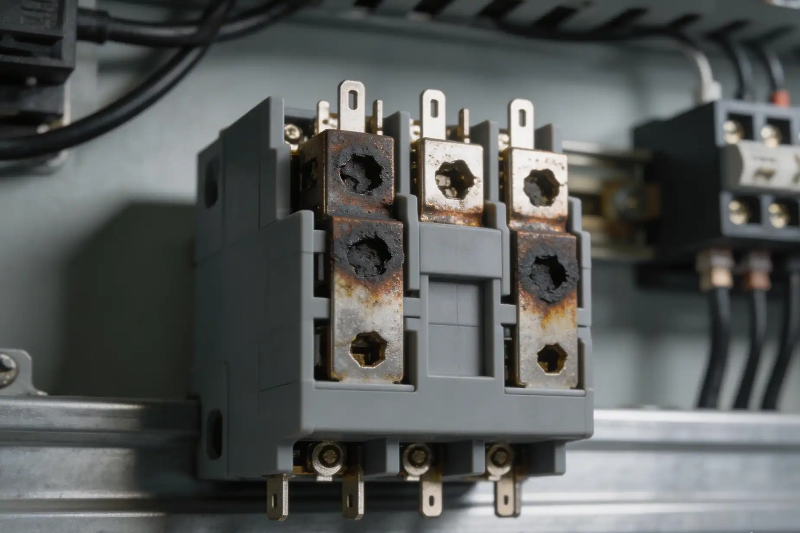
A critical system shuts down completely. The problem isn't a complicated software error or major mechanical breakdown. Instead, it's a tiny part that's often ignored: a relay with stuck contacts.
This failure is called contact adhesion or welding. It almost always happens because of too much heat. When contacts switch a circuit, they can create enough heat to briefly melt their surfaces.
We know what causes this damaging heat. We see the same problems over and over in field studies.
Electrical Arcing: This creates the most intense, focused heat when switching happens.
Overcurrent & Inrush Current: This pushes the relay way past what it was designed to handle.
Wrong Load Type: The relay doesn't match the electrical needs of what it's controlling.
Wrong Material Choice: Using contact materials that aren't right for the job.
This guide will break down these causes of relay contact adhesion and burning. Even better, we'll give you a complete set of proven strategies to stop these failures before they happen.
The Physics of Failure
To fix the problem, we need to understand how the failure works. People often use "sticking," "welding," and "burning" to mean the same thing. But they're actually different stages of how a relay dies.
Adhesion, Welding, and Sticking
"Sticking" is what you see happening. Adhesion and welding are what's actually causing it.
Contact Adhesion, or sticking, is a temporary failure. Tiny spots on the two contact surfaces melt and stick together. The relay's return spring is usually strong enough to break these small bridges. This lets the relay open, but the damage has started.
Contact Welding is permanent and catastrophic. The heat is so intense that large parts of the contact surfaces melt and fuse into one solid piece. The return spring can't break this bond. This creates a circuit that stays closed forever.
Contact Burning, or erosion, happens when material gets lost. The intense energy from an electrical arc turns tiny pieces of contact material into vapor or blasts them away. This creates pitting, increases contact resistance, and eventually causes failure.
|
Failure Mode |
Description |
Reversibility |
Primary Cause |
|
Adhesion (Sticking) |
Microscopic molten metal bridges temporarily hold contacts together. |
Often reversible by spring force, but damage is cumulative. |
Moderate arcing, minor inrush current. |
|
Welding |
Large areas of the contact surfaces melt and fuse permanently. |
Permanent failure. The relay is destroyed. |
Severe overcurrent, high inrush current, sustained arcing. |
|
Burning (Erosion) |
Material is vaporized or displaced from the contact surface by arcing. |
Irreversible material loss, leading to increased resistance and eventual failure. |
Repetitive arcing, especially with DC or inductive loads. |
The Vicious Degradation Cycle
Relay contact failure rarely happens all at once. It's a gradual process that gets worse over time.
First, a switching event creates a small electrical arc. This arc makes tiny pits and rough spots on the smooth contact surfaces.
These rough spots reduce the actual contact area. Current has to flow through fewer points. This increases current density and resistance in those spots.
Higher resistance creates more heat during later operations. This follows the I²R heating principle.
More heat leads to worse arcing and more material melting. The cycle repeats. Each operation causes more damage than the last one.
Eventually, the surface becomes so damaged that even a small overcurrent or normal switching can cause a final, permanent weld.
Primary Electrical Causes
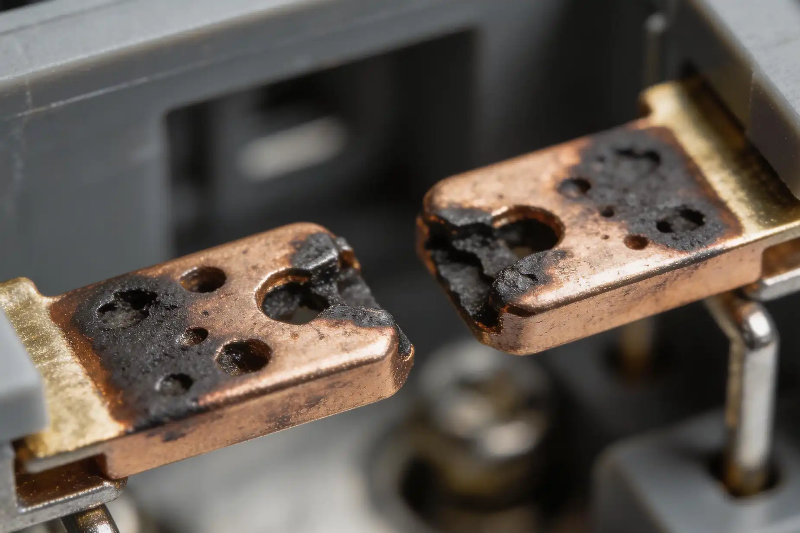
Understanding how failure works is essential. Now we need to look at the specific electrical conditions that start and speed up this destructive cycle. These are the real causes of relay contact adhesion and burning.
Electrical Arcing
The electrical arc is the biggest enemy of relay contacts. It's a plasma discharge-superheated, electrically conductive gas-that forms between contacts as they open or close.
This arc can reach temperatures over 3000°C. This is much hotter than the melting point of common contact materials like silver (961°C) or copper (1085°C). This extreme heat directly causes material melting and vaporization.
An arc can form when contacts close ("make") and when they open ("break"). However, the arc on break is much more destructive.
As contacts pull apart, voltage tries to bridge the growing air gap. For certain loads, especially DC and inductive AC loads, this voltage can keep a powerful arc going for a long time. This effectively turns the relay into a plasma cutter that destroys its own contacts.
Overcurrent and Overload
Every relay contact has a specific current rating. This is basically a heat limit. Going over this limit causes overheating and failure.
An overload happens when current is moderately above the relay's continuous rating. This doesn't cause instant welding but acts like a slow fever. It gradually raises the bulk temperature of the contact material. This softens the metal, making it "sticky" and likely to weld during the next operation.
A short circuit is massive overcurrent, often hundreds of times the rated current. The heat generated (I²R) is almost instant and catastrophic. It can melt or even vaporize the entire contact structure in milliseconds.
The Inrush Current Threat
Inrush current is the instant surge of current when a load first turns on. For many modern loads, this surge can be much higher than the normal operating current.
Not accounting for inrush is one of the most common causes of relay contact adhesion. A relay that's perfectly rated for running current can be destroyed by the initial peak.
Inrush current varies dramatically by load type.
|
Load Type |
Description |
Typical Inrush Current |
|
Resistive |
Heaters, incandescent bulbs (hot) |
~1x rated current |
|
Tungsten Lamp |
Incandescent or halogen bulbs (cold) |
10x to 18x rated current |
|
Capacitive (SMPS) |
Power supplies, LED drivers, electronics |
20x to 40x+ rated current |
|
Inductive (Motor) |
AC Motors, transformers |
5x to 10x rated current (LRA) |
A 10A relay might seem right for a device that draws 8A. But if that device is a power supply with a 150A inrush peak, the contacts will try to weld shut every time you turn it on.
Inductive Kickback
Switching an inductive load creates a unique challenge. This includes motors, solenoids, or even the coil of another contactor. The magnetic field in the inductor stores energy.
When you open the relay contacts to cut power, this magnetic field collapses. The stored energy has nowhere to go. It creates a massive voltage spike across the opening contacts. This is called back EMF or inductive kickback.
This high-voltage spike can be hundreds or thousands of volts. It easily jumps across the air gap between separating contacts. This creates and maintains a very powerful, high-energy arc.
This long-lasting arc is extremely destructive. It causes severe contact burning and material transfer, quickly destroying the relay.
The Ultimate Prevention Toolkit
Finding the cause is half the battle. The other half is using strong, proactive strategies to ensure long-term reliability. This is our expert toolkit for preventing contact failure.
Strategy 1: Arc Suppression
Since arcing is the main source of heat, controlling it is the most effective prevention strategy. An arc suppression circuit, or "snubber," provides a safe alternative path for energy that would otherwise create a destructive arc.
The RC Snubber for AC
For AC loads, the resistor-capacitor (RC) snubber is the standard solution. It connects in parallel across the relay contacts.
When contacts open, the capacitor briefly absorbs the rising voltage. This prevents it from reaching the level needed to create an arc. The resistor limits the current rush from the capacitor when contacts close again.
The Flyback Diode for DC
For DC inductive loads, the solution is simple and very effective: a flyback diode.
The diode connects in parallel directly across the inductive load (like a solenoid coil), but in reverse bias. During normal operation, it does nothing. When the relay opens, the inductive kickback creates reverse voltage. The diode then safely redirects this, allowing current to circulate and dissipate harmlessly within the load itself.
MOVs and TVS Diodes
For suppressing high-energy transients from external sources or very large inductive loads, we use Metal Oxide Varistors (MOVs) or Transient Voltage Suppression (TVS) diodes. These devices act as voltage-activated clamps. They short out any voltage that exceeds a specific threshold, protecting the contacts.
Choosing the right snubber depends entirely on the load. An RC snubber is ideal for AC inductive loads. A flyback diode is essential for DC inductive loads. MOVs/TVS diodes provide strong overvoltage protection.
Strategy 2: Correct Relay Sizing
Selecting the right relay is the most basic step. This goes far beyond matching the main current number on the relay's case to your load's operating current.
Read the Datasheet
The relay datasheet has the critical information. Look beyond the headline number, which is almost always the "Resistive Load Rating."
You must find the specific rating for your load type. Look for "Inductive Load Rating," "Motor Load Rating (HP)," or "Tungsten Lamp Rating." These ratings are always much lower than the resistive rating because they account for inrush and arcing.
We once worked on a system where a 10A-rated relay controlling an 8A motor failed weekly. The problem was buried in the datasheet's fine print: the 10A rating was for resistive loads only. The motor load rating, AC-3, was only 3A. The relay was severely undersized for its application. Upgrading to a relay with a proper motor rating completely solved the premature contactor sticking and burning.
Strategy 3: External Protection
Think of the relay as just one part of a system. Adding external protection provides an essential safety layer.
Overcurrent Protection
A correctly sized fuse or circuit breaker is essential. Its job is to protect the entire circuit, including the relay, from sustained overloads and damaging short circuits. It's the last line of defense against catastrophic thermal events.
Inrush Current Limiting
For loads with very high inrush, like large power supplies or banks of LED lights, you can actively limit the surge. An Inrush Current Limiter (ICL) is a device placed in series with the load.
The most common type is an NTC (Negative Temperature Coefficient) thermistor. It has high resistance when cold, limiting initial current. Then its resistance drops to a very low value as it heats up, allowing full operating current to flow. This "soft start" protects relay contacts from the damaging initial peak.
Strategy 4: Contact Material
The material science of the contacts themselves plays a crucial role. Different alloys are designed for different stresses. Choosing the right one is a key expert strategy.
|
Material |
Pros |
Cons |
Best Application |
|
Silver (Ag) |
Highest electrical conductivity. |
Soft, prone to sulfidation in certain environments. |
Low-voltage, low-current resistive loads where low contact resistance is critical. |
|
Silver-Nickel (AgNi) |
Good arc resistance, low erosion, harder than pure silver. |
Higher cost and slightly higher resistance than Ag. |
General purpose switching, light to medium inductive loads like contactors and switches. |
|
Silver-Tin-Oxide (AgSnO2) |
Excellent anti-welding properties, low material transfer. |
Higher contact resistance than Ag or AgNi, more expensive. |
The go-to choice for high-inrush loads (capacitive, lamp) and demanding DC loads. |
|
Tungsten (W) |
Extremely high melting point, exceptional arc resistance. |
High contact resistance, brittle, can form insulating oxides. |
High-voltage switching, or as dedicated "arcing contacts" in a dual-contact system. |
For most modern electronic loads, Silver-Tin-Oxide (AgSnO2) is the best choice because of its excellent resistance to welding under high inrush conditions.
Case Study: Industrial Motor
Theory is valuable, but seeing it applied in the real world makes the knowledge stick. This case study shows a common scenario we encounter and the process used to solve it.
The Scenario
A manufacturing facility reported recurring, unexplained downtime on a key production line. A 3-phase contactor controlling a conveyor belt motor was welding shut at random times.
The maintenance team had already replaced the contactor twice with an identical model. But the failure kept happening every few weeks. This required a technician to manually pry the contacts apart, causing significant production delays.
The Diagnostic Process
We approached the problem systematically to find the true root cause, not just treat the symptom.
Visual Inspection: The most recently failed contactor showed classic signs of relay contact burning. The surfaces were heavily pitted and blackened. One phase had a visible glob of melted and re-solidified material, indicating a weld.
Data Gathering: We used a true-RMS clamp meter with a peak-hold function to measure the motor's current profile. The steady-state running current was 15A per phase, well within the contactor's supposed limits. However, the inrush current during motor startup (Locked Rotor Amps, or LRA) showed a massive spike to 95A for about 150 milliseconds.
Datasheet Review: We examined the datasheet for the installed contactor model. It was advertised with a 20A rating. However, this was its AC-1 rating, intended for purely resistive loads like heaters. Its AC-3 rating, the specific classification for switching squirrel-cage motors, was only 12A.
Root Cause Analysis
The diagnosis was clear. The causes of relay contact adhesion were a classic two-part mismatch.
First, the contactor's AC-3 motor rating of 12A was insufficient for the motor's 15A steady-state current. The contactor was constantly overloaded, causing it to run hot and soften the contacts.
Second, and more critically, the contactor wasn't designed to handle the repetitive 95A inrush current. Each startup cycle caused a small amount of micro-welding. Over thousands of cycles, this damage built up until a permanent weld was inevitable.
The Multi-Faceted Solution
We implemented a two-stage solution to ensure long-term reliability.
Immediate Fix: The undersized unit was replaced with a correctly sized contactor. We selected a model with an AC-3 rating of at least 25A to provide a healthy safety margin. Critically, we chose a contactor that specified Silver-Tin-Oxide (AgSnO2) contacts, using their superior anti-welding characteristics to handle the motor's inrush current.
Long-Term Improvement: We recommended the future installation of a soft-starter for this application. A soft-starter gradually ramps up the motor's voltage. This dramatically reduces both mechanical stress on the conveyor system and, more importantly, the electrical inrush current. This would extend the life of not only the new contactor but the motor itself.
Conclusion: Building for Reliability
Mastering the forces that destroy relay contacts is fundamental to engineering reliable systems. By moving past surface-level analysis and understanding the true electrical dynamics, we can eliminate a major source of frustrating and costly downtime.
Key Prevention Takeaways
If you remember nothing else, remember these four principles for preventing contact failure.
Analyze the Load First: The load's electrical personality-resistive, inductive, capacitive, and its inrush current-is more important than the relay's headline rating.
Arcing is the Primary Killer: You must manage arc energy. Do this through correct relay sizing and, when necessary, dedicated arc suppression circuits.
Inrush Current Cannot Be Ignored: It's a leading cause of relay contact welding in modern circuits filled with motors and switch-mode power supplies. Always measure it or account for it in your selection.
Prevention is System-Level: A reliable relay results from a system-level approach. This combines correct component selection, proper sizing for the specific load type, and appropriate external protective circuitry.
A Final Word
Understanding the causes of relay contact adhesion and burning is the first step toward designing and maintaining truly robust electrical systems. By adopting this comprehensive, physics-based approach, engineers and technicians can transform a common point of failure into a foundation of reliability.
How to extend relay life with arc suppression and snubber circuits
Causes and solutions for relay chatter in DC circuits: Complete Guide
Functions of Time Delay Relays in Industrial Automation Guide 2025
Selecting relays for LED lighting control systems: 2025 Engineer Guide