


You can find relay noise by hearing clicks or seeing odd circuit actions. Acting fast stops harm and keeps your system working well. Relay noise is common in many circuits, so do not stress. You can fix it with the right steps and make your circuits better. Both new learners and experts can handle relay noise with easy tools and ways.
Key Takeaways
You can find relay noise by listening for clicks or buzzing. Watch for strange circuit actions too. Checking often helps you spot problems early.
Use RC snubbers and flyback diodes to lower relay noise. These parts help control voltage spikes. They also keep your circuit safe from harm.
Good wiring is very important. Keep low-voltage wires away from high-voltage ones. This helps stop interference and noise.
Regular care is needed. Check relays and connections often. This stops noise issues and keeps your circuits working well.
Use filtering to clean up signals. Low-pass filters and signal averaging help cut down unwanted noise in your circuits.
Relay Noise Sources
Electrical and Mechanical Causes
Relay noise can come from electrical or mechanical reasons. When you work with circuits, you may see these electrical causes:
Capacitive coupling happens when high-voltage wires give energy to other wires. This is often because of voltage spikes or surges.
Inductive coupling is when a wire with current makes unwanted voltage in another wire. This can cause electromagnetic interference.
Flyback voltage shows up when you turn off an inductive load in a relay coil. The coil tries to keep the current going, which makes a big voltage spike. This spike can cause arcing and bring relay noise into your circuit. Sometimes, it can reset microcontrollers or hurt other parts.
Mechanical things also cause relay noise:
Arcing happens when relay contacts open or close. This makes electrical noise and can bother nearby devices.
You might hear static in audio signals because of arcing.
Relay contacts can wear out or stick together over time. This makes noise problems worse.
Switching inductive loads can make arcing and noise more likely.
Tip: Check and clean relay contacts often. This helps lower mechanical noise and makes relays last longer.
EMI and Environmental Factors
Electromagnetic interference (EMI) can add to relay noise. When you turn a relay on or off, the quick change in current can cause a switching surge.
"When electric current changes fast because of relaying or switching on-off (especially when the circuit turns off), a short high voltage happens at the contact point because of the circuit's inductance. This is called switching surge. The contact noise is the noise from a switching surge. Since very high voltage happens, it can make a spark or send out radio waves because the strong damped oscillating current at the contact point mixes with inductance."
Things around you can also change relay noise. The table below shows how different things can affect relay performance:
|
Environmental Factor |
Effect on Relay Performance |
|---|---|
|
Temperature |
Can harm relay contacts |
|
Humidity |
Can cause parts to rust |
|
Dust |
Can make the relay not work right |
You should think about these causes when you want less relay noise in your circuits. If you know about both electrical and environmental causes, you can make your circuits quieter and work better.
Identifying Relay Noise
Audible and Visual Signs
You can find relay noise by using your senses. Listen for odd clicks, buzzing, or popping when the relay works. These sounds might mean arcing or contact bounce inside the relay. Look for tiny sparks or flashes near the relay contacts. Sometimes, you may see lights blink or screens act weird when the relay turns on.
Looking at your circuit board helps you spot problems. Check the board closely to follow wires and find broken or old parts. This way, you can see if anything looks wrong. You do not need special tools for this step. Careful checks help you find problems early and keep your circuit working well.
Tip: Use a magnifying glass to look at relay contacts and solder joints for signs of damage or burning.
Measurement Tools
You can use tools to find relay noise more exactly. Devices with 24 V digital I/O work well for this. These tools give better noise margins and block bad signals. Many have input filters you can set. These filters get rid of false signals from contact bounce when the relay switches. Isolation in these tools also helps by blocking noise from other power supplies. With the right tools, you can check and prove relay noise in your circuit.
Circuit Behavior
Relay noise can make your circuit act oddly. You might see random resets, missed signals, or strange device actions. Sometimes, microcontrollers restart or sensors show wrong readings. If your circuit is fine until the relay switches, noise is likely the reason. Watch for patterns, like problems only when the relay turns on or off. Keeping notes of these events can help you find and fix the noise source.
Relay Noise Reduction Methods
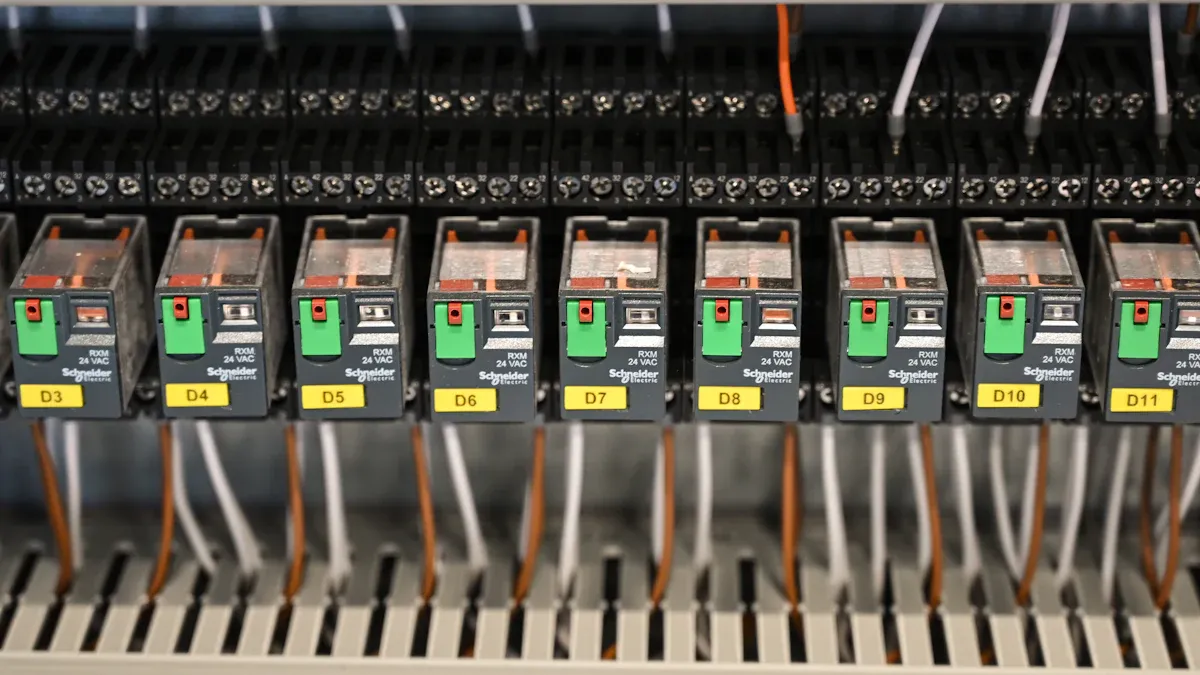
RC Snubbers and Flyback Diodes
You can lower relay noise with RC snubbers and flyback diodes. An RC snubber uses a resistor and capacitor together across relay contacts. This setup keeps the voltage from getting too high when contacts open or close. It helps stop arcing and cuts down on the energy that makes noise. Most circuits use a 0.1μF capacitor and a 50Ω to 100Ω resistor. If you have a high-voltage relay, use a capacitor that can handle more voltage than your circuit's highest point. If the part is too small, it will not block spikes. If it is too big, it can slow switching and hurt your parts.
Flyback diodes are great for DC circuits with inductive loads. You put the diode across the relay coil. When the relay turns off, the diode gives the coil's energy a safe way out. This stops spikes and keeps other parts safe. Without a flyback diode, the coil's energy can cause arcing and damage. Using a flyback diode is an easy way to cut relay noise and protect your circuit.
Metal oxide varistors (MOVs) also help stop noise. They can handle big surges and cost less for high-voltage jobs. But MOVs can wear out after many surges. TVS diodes clamp at lower voltages and last longer with small surges, but they might cost more for some uses.
|
Feature |
MOVs |
TVS Diodes |
|---|---|---|
|
Surge Handling |
High capacity for surges |
Lower capacity |
|
Degradation |
Degrades with surges |
Not degraded by small surges |
|
Clamping Voltage |
Higher |
Lower |
|
Voltage Range |
Good for high voltages |
Wide range |
|
Cost |
Lower for high voltages |
Varies |
Tip: Always check the ratings for your snubber or diode. Pick the right values for your relay and load to get the best results.
Filtering and Signal Averaging
Filtering helps remove high-frequency signals you do not want. Low-pass filters let low signals through but block higher ones. This keeps your signals clean and steady. You can make a low-pass filter with a resistor and capacitor. Put it before your analog-to-digital converter (ADC) to make signals clearer.
Signal averaging is another way to lower relay noise. By averaging many readings, you smooth out random spikes. This helps in circuits that measure small signals. Some data loggers let you set filter frequencies. For example, setting the filter to 50 or 60 Hz blocks noise from AC power lines. You can also use notch filters to block certain noise frequencies.
Note: In power supplies, low-pass filters keep the DC output steady by removing high-frequency noise from nearby circuits.
Wiring and Grounding
Good wiring and grounding help lower relay noise a lot. Keep low-voltage and high-voltage wires apart. If wires are too close, they can pass energy through capacitive or inductive coupling. This can cause voltage spikes and noise.
Use twisted or shielded wires for sensitive signals.
Do not run signal wires next to power lines.
Use thicker stranded wire for ground connections. This lowers resistance and blocks noise.
Connect grounds in parallel if you can. This removes ground problems, but may need more wire.
Proper grounding keeps noise from spreading. Do not use the hardware ground as a return for signals. This can put noise into your control electronics and cause problems.
|
Grounding Mistake |
Consequence |
|---|---|
|
Large ground loops |
Picks up interference, increases relay noise |
|
Chassis ground misuse |
Injects noise, causes system failures |
|
Multiple ground paths |
Acts as antenna, increases interference |
Tip: Keep your ground system simple and direct. Do not make big loops or use the chassis as a signal ground.
Mounting and Installation
How you mount your relay changes noise levels. Put the relay on a strong, steady surface. Thin or bendy panels can shake and make noise worse. Use the right hardware to keep the relay still.
Do not mount relays on panels that bend or shake.
In places with lots of shaking, use shields and quieter parts.
Check and balance moving parts, like rotors, to lower shaking.
Use thicker ground wires, like 14 AWG or bigger, to cut noise.
Note: Good mounting and installation not only lower relay noise but also help your circuit last longer.
Maintenance Tips
Regular checks keep relay noise down. Look at your relays often to find problems early. Watch for wear, loose wires, or dirt. Clean contacts and make sure all wires are tight.
Use cable shielding and keep parts apart.
Add ferrite beads or filters if you see extra noise.
Shield enclosures can block outside noise.
Check all connections often.
Tip: Make a habit of checking your relays and wires. This helps stop noise problems and keeps your circuits working well.
By using these methods, you can control relay noise and build circuits that work better and last longer.
You can control relay noise if you follow some simple steps:
Make sure all instruments are grounded the right way and keep wires neat.
Keep low-voltage wires away from high-voltage wires.
Put solid-state relays close to equipment that is sensitive.
Keep noisy parts away from controllers.
If you always use filtering, snubber circuits, and optical isolation, your circuits will work better. These habits help lower noise and make signals clearer. Keep using these tips so your circuits stay quiet and work well every day.
FAQ
What causes relay noise in my circuit?
Relay noise comes from electrical spikes, arcing, or poor wiring. You may see noise when contacts open or close. Mechanical wear also adds noise. You can lower noise by checking your relay and using good wiring.
How do I know if my relay is making noise?
You hear clicks, buzzing, or popping sounds. You may see lights flicker or devices reset. If you notice strange actions when the relay switches, noise is likely the cause.
Tip: Use a magnifying glass to check for burned contacts or loose wires.
What is an RC snubber, and how do I use it?
An RC snubber is a resistor and capacitor placed across relay contacts. You use it to stop voltage spikes and arcing. Pick values that match your relay's voltage and current. This helps keep your circuit quiet.
|
Component |
Typical Value |
|---|---|
|
Resistor |
220 ohms |
|
Capacitor |
0.01 μF |
Can I use a flyback diode for AC relays?
You use flyback diodes for DC relays only. AC relays need other methods, like RC snubbers or MOVs. Diodes do not work with AC because the current changes direction.
See also
Automotive Relay with Wiring Harness: Complete 2025 Installation Guide
Automotive Relays with Switches: 2025 Safety & Efficiency Guide
SSR Heat Dissipation Design for Maximum Lifespan - Engineer's Guide
Installation of Solid State Relays: Complete Setup & Care Guide 2025