

A single relay failure in a production line can trigger $10,000–$50,000 per hour in unplanned downtime costs, according to Schneider Electric's industrial asset management data - yet most relay failures are entirely preventable. Knowing how to extend relay lifespan in industrial environments comes down to a handful of actionable strategies: selecting the correct relay type for your load profile, applying electrical derating, suppressing contact arcing, and controlling the thermal and mechanical stresses inside your enclosure. This guide breaks each strategy into concrete, field-tested steps so you can push relay service life from a typical 100,000 operations well past the million-cycle mark.
Quick Answer - The Key Factors That Extend Relay Lifespan
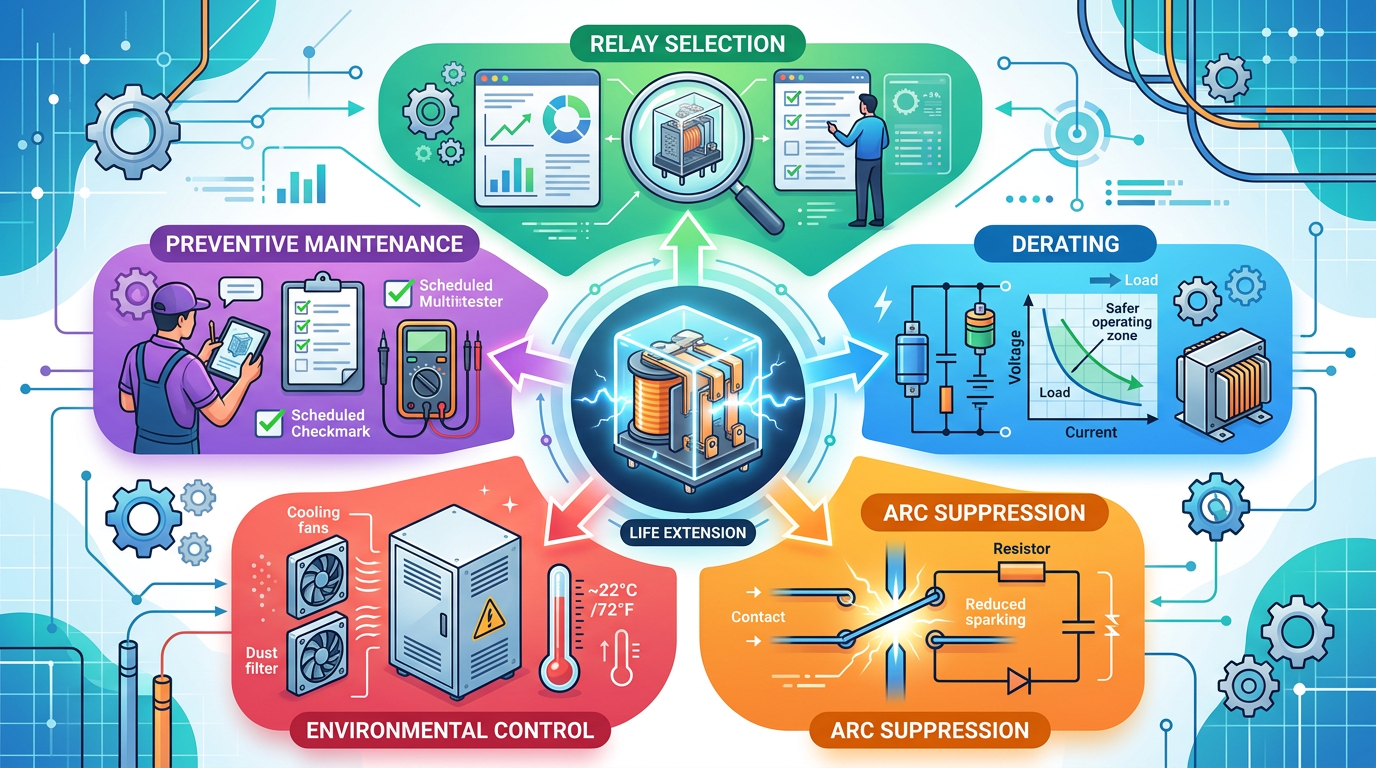
Five strategies matter most when figuring out how to extend relay lifespan in industrial environments: proper relay selection, electrical derating, arc suppression, environmental control, and scheduled preventive maintenance. Get all five right and you can push contact life well beyond the manufacturer's rated cycles - often by 2× to 5×, according to field data published by Omron's relay engineering resources.
Featured Snippet Summary: Derate contact current to 50–75% of the relay's rated maximum. Install RC snubbers or flyback diodes on inductive loads. Keep ambient panel temperature below 40 °C. Select relay types matched to your load profile (resistive, inductive, capacitive). Inspect contacts and coil resistance on a 6- to 12-month cycle.
The single biggest killer? Running relays at full rated load while switching inductive circuits - motors, solenoids, contactors - without arc suppression. That combination accelerates contact erosion by an order of magnitude. A relay rated for 100,000 mechanical operations might survive fewer than 10,000 electrical operations under those conditions.
Each section below unpacks one of these strategies with specific circuit designs, product recommendations, and maintenance checklists so you can extend relay lifespan across your entire industrial environment - not just in theory, but on the factory floor.
Understanding Why Industrial Relays Fail Prematurely
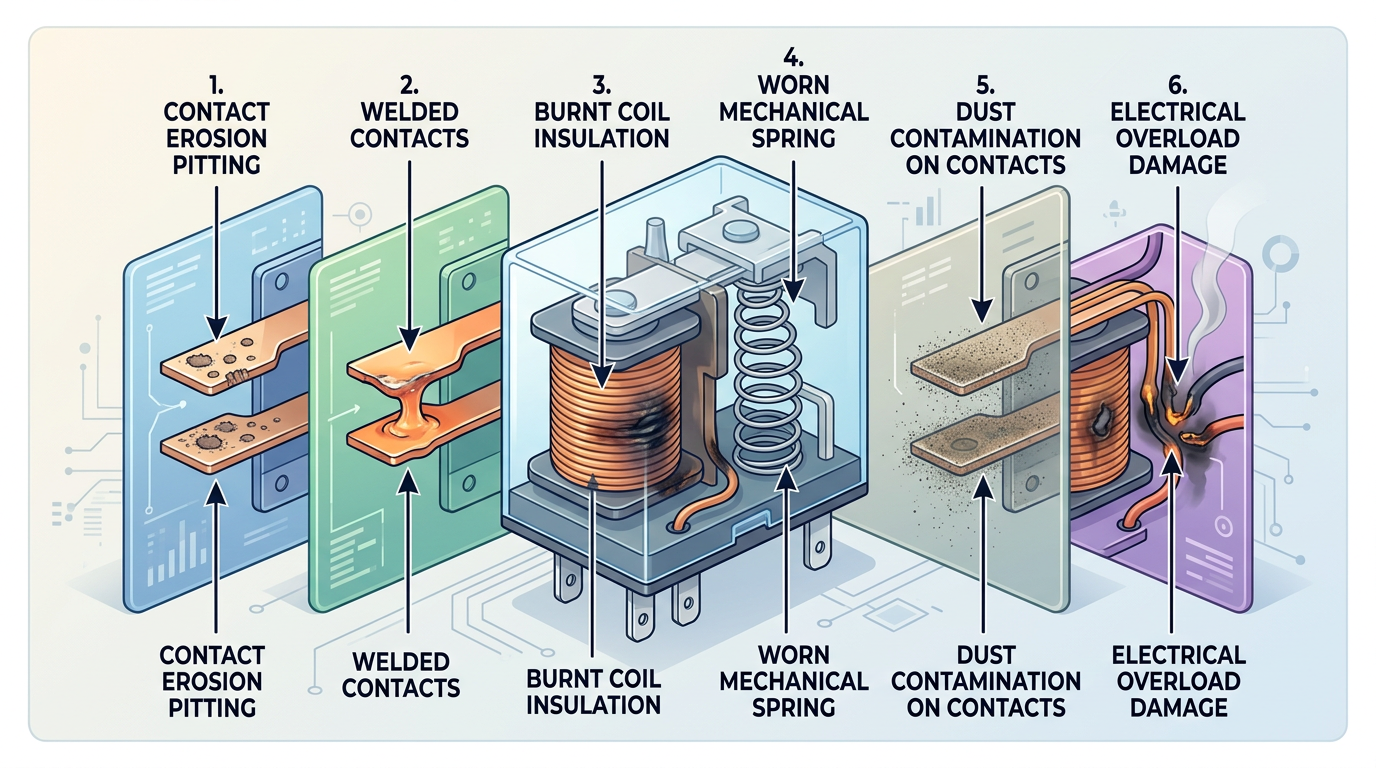
Before you can figure out how to extend relay lifespan in industrial environments, you need to understand what's actually killing them. Relay failures rarely happen overnight - they develop through cumulative degradation across several distinct mechanisms.
Contact erosion from arcing: Every time contacts open under load, a brief electrical arc vaporizes microscopic amounts of contact material. Over thousands of cycles, this pitting increases contact resistance and generates heat.
Contact welding: High inrush currents - common with motor and capacitive loads - can momentarily fuse contacts together. A single welded contact can lock a relay permanently closed.
Coil burnout: Sustained overvoltage or excessive ambient heat degrades coil insulation. Even a 10°C rise above rated temperature can halve insulation life, per Arrhenius' rule.
Mechanical wear: Springs fatigue, armature hinges develop play, and return mechanisms weaken - especially under high-frequency switching above 10 operations per second.
Environmental contamination: Dust, oil mist, and corrosive gases (hydrogen sulfide, chlorine) attack both contacts and coil windings, accelerating every other failure mode.
Here's the critical insight most engineers miss: these mechanisms compound each other. Contaminated contacts arc more aggressively, which accelerates erosion, which increases resistance, which raises temperature, which degrades the coil. One unchecked factor cascades into total failure far sooner than any single-mode calculation predicts.
Electrical Failure Modes vs Mechanical Failure Modes
Every relay failure falls into one of two buckets - electrical or mechanical - and misdiagnosing the category leads to fixes that solve nothing. Understanding which failure mode is killing your relays is the first real step in figuring out how to extend relay lifespan in industrial environments.
Electrical Failure Modes
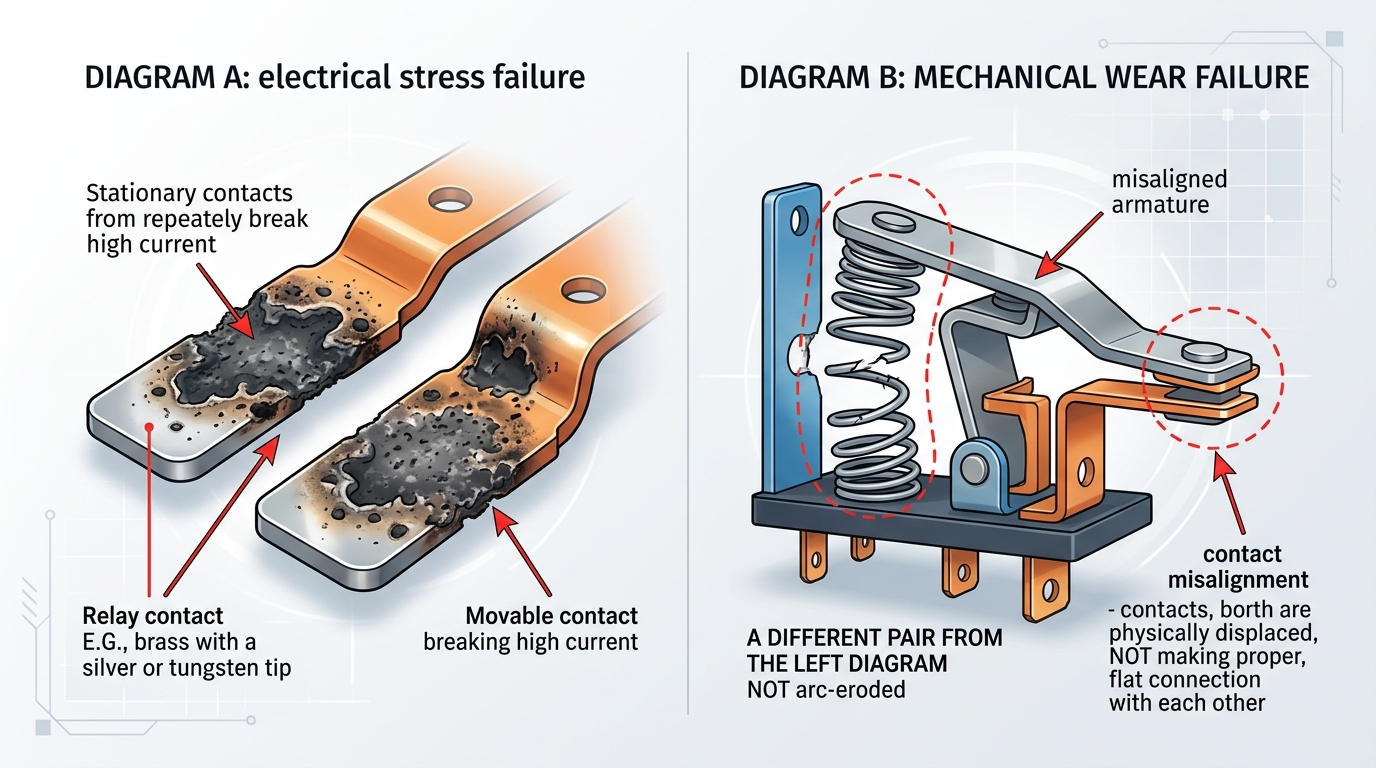
Arc erosion: Each time contacts open under load, a brief electric arc vaporizes contact material. Switching inductive loads (motors, solenoids) generates arcs 3–5× more destructive than resistive loads at the same current rating.
Coil overheating: Sustained overvoltage on the coil - even 10% above nominal - accelerates insulation breakdown, cutting coil life roughly in half per the Arrhenius relationship.
Inrush current: Lamp and capacitive loads can draw 10–15× steady-state current at turn-on, welding contacts shut.
Mechanical Failure Modes
Contact bounce: Contacts physically rebound on closure, creating micro-arcs that pit the surface. High-cycle applications above 100,000 operations per month see accelerated wear here.
Spring fatigue: The return spring loses tension over millions of cycles, causing incomplete contact separation and intermittent faults.
Vibration-induced loosening: Panel-mounted relays near rotating machinery experience continuous micro-movement that degrades socket connections and shifts armature alignment.
Quick diagnostic: blackened or pitted contacts point to electrical stress. Sluggish armature response or intermittent open circuits usually signal mechanical wear.
According to Omron's reliability data, approximately 70% of electromechanical relay failures in industrial settings are electrically driven, meaning arc suppression and proper derating deliver the highest ROI. Mechanical failures dominate only in very high-cycle, low-current applications. Knowing your dominant failure mode lets you target the right countermeasures - covered in the derating and arc suppression sections ahead.
Choosing the Right Relay Type for Your Application
Mismatched relay selection kills more relays than overloading does. A plant engineer might grab an electromechanical relay (EMR) rated for resistive loads and drop it into a circuit switching a 3-phase motor - then wonder why contacts weld shut within six months. The single most impactful step in how to extend relay lifespan in industrial environments starts before installation: picking the correct relay type for the actual load profile.
Three categories dominate industrial panels:
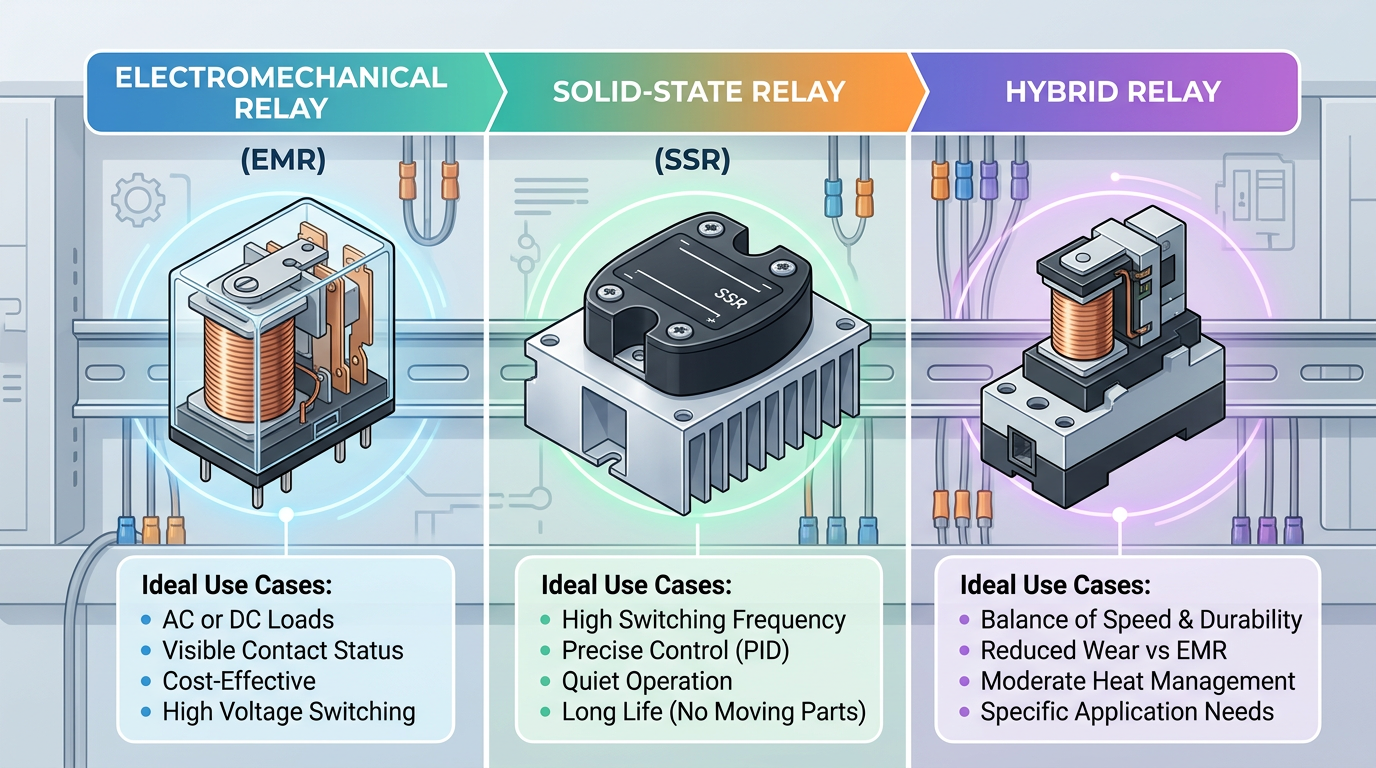
Electromechanical relays (EMRs) - Best for low-frequency switching (under 10 operations per minute) with resistive or lightly inductive loads. Their mechanical contacts handle high inrush currents well but degrade with arc erosion over millions of cycles.
Solid-state relays (SSRs) - Zero-contact switching eliminates arc erosion entirely, making them ideal for high-frequency applications exceeding 100 operations per minute. The tradeoff? They generate heat and require proper heatsinking, especially above 10A.
Hybrid relays - Combine SSR switching at the zero-crossing point with EMR contacts that carry steady-state current, reducing both arc damage and thermal losses.
Here's what most spec sheets won't tell you: duty cycle matters as much as load rating. According to TE Connectivity's relay application guidelines, an EMR rated for 100,000 mechanical operations at full load can exceed 10 million operations when derated to 25% of its nominal contact rating. That's a 100× lifespan difference from one selection decision.
Pro tip: Document the actual switching frequency, load type (AC category - AC-1 through AC-15), and ambient temperature before opening a catalog. Guessing any of these three parameters is how to shorten relay lifespan in an industrial environment, not extend it.
When Solid-State Relays Outperform Electromechanical Relays and Vice Versa
Choosing between SSRs and EMRs isn't about which is "better" - it's about matching the relay to the stress profile of your application. Get this wrong, and no amount of derating or maintenance will save you.
Where SSRs Win
High-frequency switching: Applications cycling more than 10 times per minute destroy EMR contacts within months. SSRs handle millions of cycles because there's no physical contact to erode - a critical factor in how to extend relay lifespan in industrial environments with rapid on/off demands like injection molding heaters.
Dusty or corrosive atmospheres: Cement plants and chemical processing lines benefit from SSRs' fully sealed, no-moving-parts design.
Contact bounce sensitivity: PLC input circuits and precision measurement systems can't tolerate the 1–5 ms bounce typical of EMRs.
Where EMRs Still Dominate
Heat-constrained panels: SSRs dissipate roughly 1–1.5 W per amp of load current. A 40 A SSR dumps ~50 W of heat into your enclosure. EMRs generate negligible heat in the closed state.
Wide voltage tolerance: EMRs handle transient overvoltages far more gracefully than SSRs, which can fail from a single spike exceeding their breakdown voltage rating.
Budget-sensitive, low-cycle applications: For a motor starter that trips twice daily, a $3 EMR rated for 100,000 mechanical operations lasts over 130 years on paper - SSRs cost 5–10× more with no longevity advantage here.
A practical rule: if your switching frequency exceeds roughly 1 cycle per minute and the load is resistive, SSRs almost always extend relay lifespan in industrial settings. Below that threshold, EMRs paired with proper arc suppression remain the smarter investment.
Applying Proper Electrical Derating to Maximize Contact Life
Running a relay at its maximum rated load is like driving a car at redline - technically possible, but destructive over time. The single most effective way to extend relay lifespan in industrial environments is electrical derating: deliberately operating contacts well below their published maximums for current, voltage, and power.
Here's the math that matters. According to TE Connectivity's relay application guidelines, operating a general-purpose relay at just 50% of its rated resistive load can increase contact life by 4× to 10× compared to full-load operation. That's not a marginal gain - it's an order-of-magnitude improvement for a zero-cost design decision.
Derating Rules by Load Type
| Load Type | Recommended Derating | Why |
|---|---|---|
| Resistive (heaters, lamps at steady state) | 75% of rated current | Minimal inrush; moderate arc energy |
| Inductive (motors, solenoids, contactors) | 40–50% of rated current | Back-EMF generates severe arcing at break |
| Capacitive (LED drivers, switching PSUs) | 25–35% of rated current | Inrush peaks can reach 10–60× steady-state current, welding contacts on make |
Most engineers check the datasheet's headline rating and stop there. Don't. Dig into the manufacturer's derating curves - graphs plotting expected lifecycle (in operations) against percentage of rated load. These curves are non-linear; the steepest gains come from the first 20–30% reduction below maximum.
Pro tip: For capacitive loads, the inrush current - not the steady-state current - determines contact wear. Size your relay for the peak, then derate from that figure.
Knowing how to extend relay lifespan in an industrial environment often comes down to this single discipline: choose a relay rated for twice what you actually need, and you'll rarely replace it.
Implementing Effective Arc Suppression Techniques
Arcing is the single biggest killer of relay contacts. Every time contacts open under load, a plasma arc forms across the gap, reaching temperatures above 6,000°C - hot enough to vaporize silver alloy contact material in microseconds. Without suppression, a relay rated for 100,000 mechanical operations might only survive 10,000 electrical switching cycles. The most direct way to extend relay lifespan in industrial environments is to quench that arc before it eats through your contacts.
Matching Suppression Devices to Load Type
Not all suppression methods work everywhere. Here's a quick decision framework:
| Suppression Device | Best For | Avoid When |
|---|---|---|
| RC Snubber (0.1µF + 100Ω typical) | AC inductive loads | DC circuits - arc won't extinguish at zero-crossing |
| MOV (Metal Oxide Varistor) | AC transient clamping | Repetitive surges - MOVs degrade over time |
| Flyback Diode | DC inductive loads (coils, solenoids) | AC loads - diode blocks half the cycle |
| TVS Diode (bidirectional) | Fast DC transient clamping | High-energy surges exceeding TVS rating |
Installation Mistakes That Negate Your Efforts
Place the suppression device across the load, not across the relay contacts. Mounting an RC snubber directly at the contact terminals is a common shortcut - it reduces arcing but dumps stored energy into the relay housing, accelerating thermal degradation. According to snubber circuit design principles, the suppressor should sit as physically close to the inductive load as possible to clamp voltage at the source.
One more tip most datasheets won't tell you: when using flyback diodes on DC solenoid valves, add a small series resistor (10–50Ω) to speed up flux decay. A bare diode extends the solenoid's release time by 5–10×, which can cause process timing issues and mechanical wear on downstream components.
Suppression Circuit Design for Inductive Loads
Motors, solenoids, and transformer coils generate voltage spikes that can exceed 10–20 times the supply voltage at contact opening. A 24 VDC solenoid valve can easily produce a 500 V transient - enough to vaporize contact material in microseconds. Proper suppression circuit design is the most impactful step in how to extend relay lifespan in industrial environments handling inductive loads.
Where You Place the Suppressor Matters More Than Which One You Pick
Always install the suppression component directly across the inductive load (load-side), not across the relay coil. Load-side placement clamps the voltage spike at its source. Coil-side suppression only protects the relay's own drive circuit and does nothing to shield the switching contacts from the inductive kick.
Common pitfall: placing a freewheeling diode across a DC solenoid slows the release time by 5–10×, which can cause mechanical timing issues. Use a diode-resistor combination or a Zener clamp instead to limit release delay to under 2 ms.
Component Sizing Guidelines
RC snubbers (AC loads): Size the resistor at roughly the load's impedance and the capacitor between 0.01–0.1 µF rated for at least 2× the line voltage.
MOVs: Select a clamping voltage 20% above peak operating voltage. Replace MOVs periodically - they degrade with each surge event.
TVS diodes (DC loads): Choose a standoff voltage matching the supply rail. These respond in nanoseconds, far faster than MOVs.
According to TE Connectivity's relay application guidance, correctly sized suppression circuits can increase contact life by up to 50× compared to unsuppressed inductive switching. That single design choice often determines whether a relay lasts months or decades.
Managing Temperature, Humidity, and Vibration in Control Panels
Environmental stress silently degrades relays long before electrical overload does. A U.S. Department of Energy study on motor systems confirms that every 10°C rise above a component's rated temperature cuts its operational life roughly in half - a principle that applies directly to relay coil insulation and contact spring temper.
Knowing how to extend relay lifespan in industrial environments starts with thermal management inside the panel. Space relays at least 15 mm apart to allow convective airflow. Install forced-air fans with filtered intakes, and position relays away from heat-generating VFDs or power supplies. Thermal imaging once per quarter catches hotspots before they cause coil degradation.
Humidity and Condensation Control
Condensation on relay contacts accelerates oxidation and promotes tracking currents across insulation surfaces. In panels exposed to temperature swings - cold overnight, warm during production - install anti-condensation heaters rated at 10–50 W. Pair these with IP65-rated enclosures and silica gel desiccant canisters, replacing them on a fixed 90-day cycle.
Vibration-Dampening Techniques
Vibration above 10 G can cause contact chatter in electromechanical relays, producing micro-arcing that erodes contact surfaces. Mount relay sockets on DIN rails with rubber vibration-dampening clips, and avoid placing panels directly on machinery frames. For severe environments - stamping presses, crushers - use shock-absorbing cabinet mounts rated for the specific vibration profile.
Pro tip: Combine all three controls. A well-sealed, climate-managed, vibration-isolated panel is the single most cost-effective way to extend relay lifespan in any industrial environment.
Routine Maintenance and Inspection Best Practices
Knowing how to extend relay lifespan in industrial environments means nothing if you skip scheduled inspections. A relay that passed every spec at commissioning can silently degrade - pitted contacts, corroded sockets, loosened terminals - until it fails during a critical batch run.
Base your replacement intervals on switching cycle counts, not calendar time. A relay cycling 200 times per day hits its rated 100,000-cycle mechanical life in roughly 500 days, while an identical relay cycling 20 times daily lasts over 13 years. Arbitrary "replace every 3 years" policies waste good relays and miss worn ones.
Quarterly Inspection Checklist
Visual contact inspection: Pull the relay from its socket and examine contacts for blackening, pitting, or material transfer. Any crater deeper than 0.1 mm warrants replacement.
Contact resistance testing: Use a micro-ohmmeter; readings above 50 mΩ on contacts rated under 10 mΩ signal serious degradation.
Coil resistance measurement: Compare against the manufacturer's nominal value. A deviation exceeding ±10% indicates insulation breakdown or shorted turns.
Thermal imaging: Scan relay banks with an IR camera. Any relay running more than 20°C above its neighbors likely has high-resistance connections or internal damage.
Socket cleaning: Wipe socket contacts with isopropyl alcohol and a lint-free cloth. Oxidized socket pins increase contact resistance and generate localized heating.
According to NFPA 70B recommended practices, thermographic surveys alone can catch up to 68% of electrical connection failures before they cause unplanned downtime. Pair thermal scans with cycle-count tracking, and you shift from reactive replacement to genuinely predictive maintenance.
Using Predictive Monitoring to Catch Relay Degradation Early
Scheduled maintenance catches problems on a calendar. Predictive monitoring catches them on a curve - the actual degradation curve of each individual relay. That distinction is how to extend relay lifespan in industrial environments beyond what any fixed-interval program achieves alone.
Cycle counters are the simplest entry point. Most modern PLCs can log relay actuations via a high-speed counter input tied to the coil driver output. Once you know a relay's rated mechanical life - say, 10 million operations for a typical Omron MY series - you set an alarm threshold at 70–80% of that figure and schedule replacement during the next planned shutdown. One automotive stamping plant reported a 34% reduction in unplanned relay failures after implementing PLC-based cycle counting across 400+ control relays, according to case data shared by Rockwell Automation's predictive maintenance resources.
Contact Resistance Trending and Thermal Sensing
Cycle counts alone miss electrical degradation. A relay at 50% of its mechanical life can already have pitted contacts if it's switching inductive loads. Periodically measuring contact resistance - even a rise from 50 mΩ to 100 mΩ - signals material transfer and imminent welding risk. Integrate a low-current measurement routine during non-production windows and trend the data in your SCADA historian.
Infrared thermal sensors mounted inside panels add another layer. A relay running 15°C hotter than its neighbors under identical load is telling you something - don't ignore it. Feed that temperature data into your SCADA alarm matrix alongside cycle counts and resistance trends, and you build a three-dimensional picture of relay health that no single metric provides.
Pro tip: Tag each relay in your CMMS with its install date, cycle count source, and baseline contact resistance. Without that metadata, predictive analytics is just expensive data collection.
Frequently Asked Questions About Industrial Relay Lifespan
How many switching cycles should an industrial relay last?
Most general-purpose electromechanical relays are rated for 100,000 to 500,000 mechanical operations, but electrical life is far shorter - often 100,000 cycles or less at full rated load. Derate to 50–75% of rated current and you can realistically double that electrical life. The gap between mechanical and electrical ratings is where most confusion starts.
Do relay contact cleaners actually work?
They remove surface oxidation and light contamination, but they cannot reverse pitting or material transfer damage. Use them during preventive maintenance - never as a substitute for replacement once contact resistance exceeds the manufacturer's threshold (typically 100 mΩ for power relays).
How do I tell when a relay is about to fail?
Watch for intermittent load dropouts, audible buzzing from the coil, or a measurable rise in contact resistance over successive inspections. A coil pulling 15% more current than baseline is another red flag - it signals mechanical binding or spring fatigue.
Should I replace all relays during a scheduled shutdown?
Blanket replacement wastes money. A smarter approach: replace relays that have exceeded 70% of their rated electrical life or show degraded contact resistance. Batch-replace only within circuits sharing identical duty cycles. According to NFPA 70B maintenance recommendations, condition-based replacement consistently outperforms time-based schedules for switching devices.
How does ambient temperature affect rated lifespan?
Every 10 °C rise above the relay's rated ambient roughly halves coil insulation life - a principle rooted in the Arrhenius equation. If your panel runs at 55 °C instead of the typical 40 °C rating, expect coil failures 40–50% sooner. Understanding this thermal relationship is essential to figuring out how to extend relay lifespan in industrial environments where heat accumulates inside enclosed cabinets.
Putting It All Together - Your Relay Longevity Action Plan
You now have every strategy you need to understand how to extend relay lifespan in industrial environments. The difference between a relay that lasts 100,000 cycles and one that reaches 10 million comes down to disciplined execution across selection, protection, environment, and monitoring. According to the U.S. Department of Energy's O&M Best Practices Guide, proactive maintenance programs can reduce equipment failure rates by 25–35%. Relays are no exception.
Print this checklist and walk your facility this week:
Audit relay ratings vs. actual load - derate to 50–75% of nameplate capacity on every inductive circuit.
Verify arc suppression - confirm RC snubbers or flyback diodes are installed and correctly sized for each load type.
Check panel climate - measure ambient temperature and humidity; install forced ventilation if enclosures exceed 40 °C.
Inspect contacts - use a milliohm meter to baseline contact resistance; flag anything above 50 mΩ.
Deploy predictive monitoring - even basic coil-current trending catches degradation months before failure.
Document everything - log cycle counts, thermal readings, and replacement dates per socket.
Start with the highest-cycling relays on your most critical lines. One afternoon of auditing can prevent weeks of unplanned downtime. Don't wait for the next nuisance trip - act now.