


Choose the relay construction from the complete PCB process, not from the case label alone. A flux-protected relay is normally the starting point for automatic soldering when the board will not be washed. A sealed or plastic-sealed relay may be suitable when the approved process includes cleaning. An open or dust-cover relay belongs in a controlled process that keeps flux, wash liquid, coating and harmful contamination away from its mechanism.
The word sealed is not permission to use any cleaner, ultrasonic bath, coating or potting compound. It also does not automatically mean hermetic. The exact order code, manufacturer terminology, soldering instructions, cleaning method and field conditions must agree before production release.
Engineering boundary: This guide helps OEM, EMS, quality and sourcing teams compare PCB relay protective constructions. It does not replace the selected relay data sheet, the finished-equipment standard, the cleaner or coating supplier's compatibility information, or testing on production-representative assemblies.
Sealed vs Flux-Protected vs Open PCB Relays: Quick Decision
|
Construction |
Best Starting Point |
Do Not Assume |
|---|---|---|
|
Open or dust-cover |
Manual or tightly controlled assembly, no immersion wash, and a clean enclosure. |
A plastic cover makes the relay resistant to flux, cleaning liquid, coating or corrosive gas. |
|
Flux-protected / flux-resistant |
Automatic soldering in a qualified no-wash process. |
Flux protection means the relay is washable or safe for spray, soak, boil or ultrasonic cleaning. |
|
Sealed / plastic-sealed |
Automatic soldering followed by a cleaning process that the exact relay documentation approves. |
Every solvent, temperature, dwell time, coating or post-clean condition is allowed. |
|
Hermetically sealed |
An application that specifically requires a high-integrity metal-and-glass or equivalent hermetic construction. |
Every plastic-sealed PCB relay is hermetic, or a hermetic relay is automatically washable. |
Fastest selection rule: If the assembled board will be washed, begin with a relay whose exact ordering code is approved for that wash process. If the board is automatically soldered but not washed, a flux-protected construction may be sufficient. If neither liquid flux nor cleaning fluid can reach the relay and the service environment is controlled, an open or dust-cover construction may be considered.
The word may matters. Relay families can use different suffixes, vent features, sealing resins and process limits even when their footprint and contact rating look identical.
1. What Do the Protective-Construction Terms Mean?
Protective-construction names describe how a relay case and terminals manage specific manufacturing or environmental exposures. They do not describe the contact load rating, coil voltage, dielectric system, mechanical life or suitability for the finished equipment. Those requirements must be selected separately.
Panasonic's relay terminology provides a useful manufacturer example. It describes a dust-cover type as a covered construction that is not designed to stop flux or cleaning liquid during automatic soldering. It describes a flux-resistant type as a construction intended to prevent flux entry during automatic soldering but not to permit cleaning. Its sealed type is constructed to prevent flux and cleaning-fluid entry. These definitions clarify the process boundary, but another manufacturer's exact data sheet still controls another part.
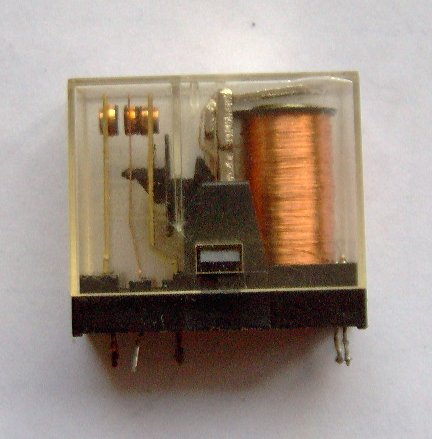
Image: Electronic component relay by FDominec, licensed under CC BY-SA 3.0 via Wikimedia Commons.
Open and dust-cover are not always the same
An open relay exposes most or all of the electromagnetic and contact mechanism. A dust-cover relay adds a case that reduces ordinary handling and large-particle exposure, but seams and terminal interfaces may remain open to process liquids. Some buyers use "open" loosely for every non-sealed relay. That shortcut can hide an important construction difference.
Write the manufacturer's exact term and order code in the bill of materials. If the supplier calls a product dust-cover, enclosed, open-frame or unsealed, record what that construction permits during soldering and cleaning rather than translating it into a preferred internal label.
Flux-protected describes a soldering boundary
During wave or selective soldering, liquid flux and heated vapour can move toward relay openings through board orientation, capillary paths, excess application or pressure. A flux-protected construction is intended to resist this soldering exposure within the stated process. It does not prove resistance to the longer dwell, pressure, chemistry, rinsing or drying involved in a board washer.
This is why "flux-protected" and "washable" should never be treated as synonyms on a drawing, RFQ or incoming-inspection checklist.
Plastic-sealed and hermetically sealed are different claims
A plastic-sealed PCB relay is commonly process-sealed around its case, base and terminals so that approved soldering and cleaning operations do not introduce liquid into the mechanism. Plastic materials and resin joints are not automatically gas-tight for the product's full service life.
A hermetically sealed relay uses a separately specified high-integrity enclosure, commonly metal and glass or ceramic sealing. Hermetic construction must be explicitly stated. It is not a stronger spelling of "sealed," and it does not by itself authorize a particular PCB cleaning process.
2. Start with the Actual Factory Route
A relay can meet its electrical catalog rating and still be wrong for the assembly line. Map every operation after the relay enters the factory: storage, placement, fluxing, soldering, cooling, cleaning, rinsing, drying, coating, potting, rework, electrical test and enclosure assembly.
|
Process Question |
Selection Effect |
Release Evidence |
|---|---|---|
|
Will liquid flux reach the relay during automatic soldering? |
Usually excludes a construction intended only for manual soldering. |
Relay soldering instruction, flux level, board orientation and measured profile. |
|
Will the board be sprayed, soaked, immersed or ultrasonically cleaned? |
Requires method-specific approval; flux protection alone is not enough. |
Cleaner, concentration, temperature, dwell, rinse, dry cycle and relay approval. |
|
Will conformal coating or resin contact the relay? |
May require a keep-out, mask, different assembly order or compatible relay. |
Chemistry, cure schedule, masking drawing and tested production samples. |
|
Does the selected relay have a temporary vent? |
May add a controlled post-clean vent-opening step before electrical use. |
Part-specific vent instruction, work instruction and inspection record. |
|
What contaminants exist in service? |
Process sealing may not address condensation, silicone vapour, sulfur, oil mist or conductive dust. |
Environmental specification, enclosure plan and application-level validation. |
This route map prevents a common failure: purchasing approves a relay for the circuit, manufacturing later adds a board wash, and quality assumes that the original component approval still applies. A cleaning-fluid change, nozzle-pressure change, coating change, relay alternate or factory transfer can all change the relay's exposure.
3. Match Automatic Soldering to the Relay Construction
Automatic soldering can be compatible with flux-protected and sealed relays when the exact part documentation permits the method. The process still needs control. Excess flux, an incorrect board angle, poor preheat or solder flowing onto the component side can overcome the intended protection or damage the case and seal.
Panasonic's soldering and cleaning guidance explains that preheating helps reduce flux penetration in dust-cover and flux-resistant constructions and says the actual board must be evaluated. TE's PCB relay processing guidance also calls for non-corrosive flux, minimum wave exposure and cooling before cleaning. Use these as examples of the controls manufacturers publish, not as universal profiles for a QIANJI or alternate relay.

Image: Soldering-PCB-b.jpg by Tlapicka, licensed under CC BY-SA 3.0 via Wikimedia Commons.
No-clean does not mean no process risk
A no-clean line can make a flux-protected relay a practical choice because routine post-solder washing is not planned. However, no-clean flux still leaves residues. The board, insulation system and service environment must tolerate them within the qualified process.
Control local hand cleaning and rework as well. An operator who brushes a strong solvent around a nearby connector can expose a flux-protected relay to a liquid operation that the original line qualification never included. The same issue appears when a customer requests cleaner-looking boards and production quietly adds a wash step.
4. Why Flux-Protected Relays Should Not Be Treated as Washable
Washing is a different stress from soldering. A cleaning machine can add longer liquid contact, pressure from sprays, surfactants, repeated rinse cycles, temperature change and vibration. A seal designed to stop a short flux exposure may not be designed for those conditions.
Manufacturer guidance makes this distinction explicit. Panasonic says dust-cover and flux-resistant relays should not be cleaned by immersion. TE says never to immersion-clean its open or dust-covered PCB relays and gives separate instructions for plastic-sealed relays. OMRON's general relay precautions likewise distinguish flux-protection from plastic-sealed construction.
The safe purchasing statement is therefore not "flux-protected relays can never be cleaned by any method." It is: do not authorize a cleaning method from the term flux-protected alone. If the exact manufacturer permits a limited method, follow that product-specific method and validate it. If no permission exists, treat cleaning as prohibited.
5. A Sealed Relay Still Needs a Defined Cleaning Recipe
"Washable" is incomplete without the recipe. Release the relay and cleaning process as one controlled combination.
|
Cleaning Input |
Why It Matters |
What to Record |
|---|---|---|
|
Chemistry and concentration |
A cleaner can attack plastic, resin, marking, tape or internal materials. |
Trade name, formulation revision, concentration, rinse medium and written compatibility. |
|
Method and pressure |
Spray, immersion, vapour and ultrasound apply different liquid and mechanical stresses. |
Machine, nozzle direction and pressure, immersion depth, agitation and ultrasonic status. |
|
Temperature and dwell |
Thermal shock can damage seal integrity; longer exposure increases chemical and ingress risk. |
Cool-down delay, bath temperature, exposure time, number of cycles and worst-case tolerance. |
|
Rinse, dry and post-clean handling |
Residue or trapped moisture can reduce insulation margin and promote corrosion. |
Rinse quality, drying profile, hold time, vent step and electrical acceptance tests. |
Avoid thermal shock
Do not move a hot relay directly from soldering into a cold cleaning liquid unless the exact process is approved. Both Panasonic and TE warn that thermal shock can damage sealing performance. Define cooling and transfer time in the work instruction instead of relying on operator judgment.
Ultrasonic cleaning is a separate approval
Sealing against liquid does not prove that the coil, contacts and mechanism can tolerate ultrasonic energy. Panasonic warns that ultrasonic cleaning can contribute to coil-wire breakage or slight contact sticking. Other relay families may publish different guidance. Mark ultrasonic status as a separate yes/no requirement in the supplier response and process control plan.
6. Some Washable Relays Must Be Vented After Cleaning
Some sealed washable relays use a manufacturer-provided tape-covered hole or removable vent nib. The closed condition protects the relay through assembly and cleaning. The vent is then opened after the approved process and before electrical service so the relay can operate under the conditions used for its published ratings.
TE's venting guidance applies specifically to sealed relays that TE provides with a vent. It says those relays must be vented after PCB assembly and cleaning but before electrical use unless TE Engineering advises otherwise. TE identifies possible insulation failure and reduced contact switching life as consequences of improper venting.
Do not generalize this instruction to every sealed relay. Some relays have no vent feature. Never pierce a case, remove a tab or open tape unless the exact manufacturer instruction identifies it as the venting method. When venting is required, assign the step to a process owner and make the open vent inspectable. Coating or adhesive must not block the specified airflow path.
7. Conformal Coating and Potting Need Their Own Review
Wash sealing does not automatically make a relay safe for conformal coating. Low-viscosity material can wick through seams, terminal interfaces or vents. A solvent can soften the case or seal. Potting resin can shrink during cure, trap heat, block a vent or mechanically load the housing and terminals.
Panasonic advises against coating dust-cover and flux-resistant relays because material can enter and cause contact failure. It also warns that some coating solvents can damage cases or dissolve epoxy seals. Product-specific instructions may allow a different process, but that permission must be documented.
Use one of four controlled responses: create a coating keep-out around the relay, apply a validated mask, coat the PCB before installing the relay, or select a relay and chemistry that the manufacturer approves together. Then test the real cure schedule and film thickness. Do not fully embed a relay in resin unless the supplier has approved that exact method.
8. Field Contamination Can Be Harder Than the Wash Process
Assembly protection is only the first boundary. The finished equipment may see condensation, conductive dust, fibers, oil mist, salt, sulfur-bearing materials, silicone vapour, temperature cycling and vibration. A plastic-sealed case can reduce some exposure, but it is not a universal harsh-environment enclosure.
For example, Panasonic notes that plastic material is porous and warns against silicone exposure for its sealed type. OMRON tells designers to select the protection type for the atmosphere and mounting condition. These cautions show why the relay case, equipment enclosure, ventilation, material selection and environmental test plan must be designed together.

Image: Relay Parts.jpg by David Boettcher, released into the public domain via Wikimedia Commons.
The mechanism explains the risk. Deposits on contacts can raise contact resistance or create intermittent switching. Contamination around the armature can restrict motion. Moisture and ionic residue can reduce insulation resistance. Corrosion can affect coil wire, springs, terminals and contact surfaces. The symptom may appear long after the board passed its first functional test.
Case construction does not replace contact-load selection
A sealed relay with an undersized contact system is still the wrong relay. Specify AC or DC voltage, steady current, inrush, load type, switching frequency, duty cycle, ambient temperature and required electrical life. Motors, solenoids, lamps, capacitive inputs and DC arcs stress contacts differently. Protection from wash liquid cannot compensate for overload, insufficient arc control or excessive temperature.
9. Which Construction Fits Common Production Scenarios?
|
Scenario |
Preferred Starting Point |
Verification Before Release |
|---|---|---|
|
No-clean wave or selective soldering in clean enclosed equipment |
Flux-protected may fit. |
Confirm automatic-solder permission, no later wash, coating restrictions and field contamination. |
|
Aqueous or solvent wash after soldering |
Exact sealed relay approved for that cleaning process. |
Lock cleaner, temperature, dwell, method, rinse, dry, venting and acceptance tests. |
|
Manual assembly, no wash, accessible low-risk equipment |
Open or dust-cover may fit. |
Confirm soldering method, handling cleanliness, enclosure and contact duty. |
|
Coated control board |
Construction selected with a validated coating plan. |
Approve chemistry, mask or keep-out, cure, vent condition and post-process performance. |
|
Outdoor, industrial or corrosive environment |
Begin with the application environment, not a case label. |
Validate relay, enclosure, materials, thermal cycle, vibration, contamination and electrical endurance together. |
A sealed relay can be worth the additional component cost when it removes a wash exception, prevents manual masking or gives the process more margin. An open or flux-protected relay can be the more efficient choice when the line and field environment genuinely do not need wash protection. Compare total process cost and risk, not only unit price.
10. Diagnose Failures by Asking What Entered the Relay
|
Symptom |
Likely Mismatch |
Next Check |
|---|---|---|
|
Insulation resistance falls after washing |
Liquid entered an unsuitable relay, the sealed process limit was exceeded, or moisture remains. |
Quarantine the lot; review order code, cleaner, wash method, dry cycle and post-wash test data. |
|
Intermittent contact or rising contact resistance |
Residue, corrosion, harmful gas or electrical load damage. |
Analyze contamination and switching duty together; inspect failed contacts with the supplier. |
|
Failure begins after a coating-line ramp |
Coating entered the relay, blocked a vent or imposed cure/shrinkage stress. |
Review keep-out, masking, viscosity, cure and vent condition on failed and good boards. |
|
Early failures after cleaner or factory change |
The change-control review did not identify the relay as an affected component. |
Compare the full old and new process window and repeat representative qualification. |
A relay that still clicks is not automatically healthy. Include insulation resistance, operate and release behaviour, contact resistance and switching under the real load where appropriate. Destructive examination and residue analysis may be needed to confirm ingress or corrosion.
11. Qualification Workflow for a New Relay or Process Change
Step 1 - Freeze the candidate. Record manufacturer, full order code, protective construction, coil, contact form, terminal style and controlled data-sheet revision.
Step 2 - Map exposure. Document flux, solder method, thermal profile, cleaning, rinse, drying, coating, potting, rework, venting and final enclosure assembly.
Step 3 - Resolve permissions. Mark every operation as allowed, prohibited or requiring supplier confirmation for the exact part. Do not transfer permission from a similar relay family.
Step 4 - Build production-representative samples. Use real PCB finish, hole geometry, copper mass, component spacing, flux, cleaner, coating, fixtures and equipment settings. A bare relay dipped on a laboratory bench does not represent the assembly.
Step 5 - Test after the full process. Use visual inspection and suitable electrical checks. Depending on the risk, these can include coil resistance, operate/release voltage or time, contact resistance, insulation resistance, dielectric testing and switching under the intended load.
Step 6 - Add field stresses. Apply the relevant humidity, thermal cycle, vibration, corrosive atmosphere, contamination, inrush and endurance tests. IEC 61810-1 is an important relay standard, but the final test plan must also follow the applicable equipment standard and qualification requirements. See the official IEC 61810-1 publication page for the standard's current publication information.
Step 7 - Control changes. Define which changes reopen validation: relay alternate, resin or vent change, cleaner revision, bath temperature, pressure, dwell, coating, cure, factory transfer or PCB layout change. Keep lot traceability so a later failure can be linked to the assembly conditions.
12. PCB Relay RFQ Checklist
A supplier cannot recommend the right protective construction from coil voltage and contact current alone. Send enough application and process information to receive a technically useful response.
|
RFQ Section |
Information to Send |
Evidence to Request |
|---|---|---|
|
Electrical duty |
Coil supply, contact form, AC/DC voltage, steady current, inrush, load type, frequency and target life. |
Relevant ratings, test conditions, curves or application review. |
|
Assembly process |
Solder method/profile, flux, cleaning chemistry/method, rinse, dry, coating, potting and rework. |
Part-specific allowed and prohibited operations, including any vent instruction. |
|
Field environment |
Temperature, humidity, condensation, dust, gas, oil mist, vibration, altitude and enclosure. |
Relevant environmental limits, reports and recommended system controls. |
|
Quality and supply |
Volume, sample plan, traceability, qualification and approved-alternate policy. |
Controlled drawing/data sheet, lot coding, change notification and sample documentation. |
Ask the supplier to identify the exact construction for the exact ordering code. A family may offer open, dust-cover, flux-protected and sealed variants with different suffixes. Footprint compatibility does not prove cleaning compatibility.
13. Discuss Your PCB Relay Process with QIANJI
QIANJI's PCB relay range includes multiple product families and construction options. Before choosing a model, prepare the electrical load, coil supply, PCB soldering method, cleaning recipe, coating or potting requirement, field contamination and expected service life.
Send those details through the QIANJI inquiry page. Ask for confirmation of the full order code, protective construction, soldering limits, cleaning permissions, venting instructions and sample-validation plan. This is more reliable than requesting a generic "sealed relay" without defining what the relay must survive.
Frequently Asked Questions
Is a flux-protected relay the same as a sealed relay?
No. Flux protection normally addresses flux entry during an approved automatic-soldering process. A sealed or plastic-sealed construction may also address cleaning-liquid entry. Confirm the exact manufacturer definition and part number.
Can flux-protected PCB relays be washed?
Do not assume they can. Major manufacturers distinguish flux protection from washability. Use a cleaning method only when the exact relay documentation permits that method and the process has been validated.
Can an open PCB relay be wave soldered?
Only if the exact manufacturer instructions allow the process and flux is prevented from entering. Some open or dust-cover constructions are intended for manual soldering. The construction name alone is not enough.
Does a plastic cover make a relay dustproof or waterproof?
No. A cover can reduce some particle exposure, but it is not automatically an IP rating, wash rating or environmental seal. Use only the protection claims published for the exact relay and finished equipment.
Is a sealed PCB relay hermetically sealed?
Not necessarily. Plastic-sealed PCB relays are often process-sealed for soldering and approved cleaning. Hermetic sealing is a distinct construction claim and must be specified separately.
Can any sealed relay be immersion-cleaned?
No. Cleaning permission depends on the relay, chemistry, method, temperature, dwell, rinse and drying instructions. Some sealed constructions may have restrictions or may not be intended for PCB washing.
Can I use ultrasonic cleaning on a sealed relay?
Only with explicit part-specific approval. A liquid seal does not prove resistance to ultrasonic mechanical energy.
Does a sealed relay need to be vented?
Some washable relays with a manufacturer-provided vent must be vented after assembly and cleaning and before electrical use. Other sealed relays have no vent step. Follow the exact product instruction and never create an unapproved hole.
Can conformal coating cover the relay?
Only after a compatibility review. Coating can enter openings, attack plastic or resin, block a vent, or restrict operation. A validated keep-out or masking method is often required.
Which relay is best for a no-clean PCB process?
A flux-protected relay can be a practical starting point for qualified automatic soldering without later washing. It still must meet the electrical duty, coating plan and field-environment requirements.
Technical References
Panasonic Industry: Relay Terminology and Relay Soldering and Cleaning Guidelines.
OMRON: Safety Precautions for All Relays.
TE Connectivity: Mounting, Termination, and Cleaning of PCB Relays and Venting of Sealed (Washable) Relays.
IEC: IEC 61810-1:2015 - Electromechanical elementary relays.
Final Selection Rule
Select a PCB relay as part of a controlled manufacturing and application system. Use an open or dust-cover construction only where flux, cleaning liquid, coating and field contamination are controlled. Use a flux-protected construction for an approved automatic-soldering, no-wash route. Use a sealed construction only with the exact cleaning, drying and venting instructions for that order code.
Then validate the relay under the real electrical load and service environment. The lowest-risk choice is the construction whose documented process limits match what the factory and finished equipment will actually do.