

Relay and circuit breaker are two common electrical components in an electrical control system, taking different responsibilities and playing different roles. In the following sections, I am going to explain the difference in definition, function, and principle of operation, application scenarios, and summary between relays and circuit breakers.

Definition
Relay: A relay is an electrical control device that causes a predetermined step change in the controlled variable in the electrical output circuit when the input quantity (excitation quantity) changes to meet the specified requirements. It has an interactive relationship between the control system (also known as the input loop) and the controlled system (also known as the output loop). A type of "automatic switch" commonly used in automation control circuits to control high current operation with low current.
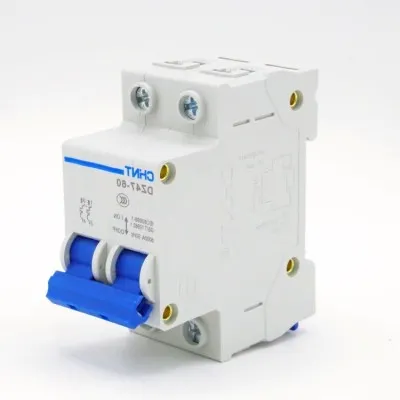
Circuit breaker: A circuit breaker refers to a switching device that can close, carry, and disconnect current under normal circuit conditions, and can close, carry, and disconnect current under abnormal circuit conditions within a specified time. Circuit breakers are divided into high voltage circuit breakers and low voltage circuit breakers according to their usage scope. The boundary between high and low voltage is relatively vague, and those above 3kV are generally referred to as high voltage electrical appliances.
Function
relay:
Expand control range: Through multi contact relays, multiple circuits can be switched, disconnected, and connected simultaneously.
Amplification: such as sensitive relays, intermediate relays, etc., can control high-power circuits with small control quantities.
Integrated signal: When multiple control signals are input into a multi winding relay in the prescribed form, they can be compared and integrated to achieve the predetermined control effect.
Automatic, remote control, monitoring: Together with other electrical appliances, it forms a program control circuit to achieve automated operation.
Circuit breaker:
Distribution of electrical energy: plays a role in distributing electrical energy in a circuit.
Protection of electrical equipment: When serious overload, short circuit, and undervoltage faults occur in electrical equipment, the circuit can be automatically cut off to prevent the accident from expanding and ensure safe operation.
Not frequently starting asynchronous motors: protect power lines and motors.
Working principle
relay:
Based on electromagnetic principles and electromagnetic induction. When current passes through the coil of a relay, a certain magnetic field is generated, which causes the mechanism of the relay to move, thereby opening or closing the contacts of the relay.
Circuit breaker:
Based on thermal protection and electromagnetic protection. When an overload or short circuit occurs in the circuit, the circuit breaker generates a large amount of heat and electromagnetic force, which can move the mechanism of the circuit breaker even if the circuit is disconnected. For low-voltage circuit breakers, after the main contact is closed, the free release mechanism locks the main contact in the closed position.
When a short circuit or severe overload occurs in the circuit, the armature of the overcurrent release will engage, causing the free release mechanism to operate and the main contact to disconnect the main circuit.
Application scenarios
relay:
As one of the most important control components in remote control, telemetry, communication, automatic control, mechatronics, and power electronic equipment.
Relays are key components in electrical control, and their lifespan to some extent determines the lifespan of electric meters.
Circuit breaker:
Used in household, commercial, or industrial circuits to protect electrical equipment and systems from the effects of overload and short circuits.
In the distribution system, low-voltage circuit breakers are widely used electrical appliances with various protection functions (overload, short circuit, undervoltage protection, etc.), adjustable operating values, high breaking capacity, easy operation, safety and other advantages.

Summarize
By the above analysis, we can see the differences of definition, function, working principle, and application scenarios between the relay and circuit breaker. In brief, relays are majorly used for controlling the switch of the circuit in order to control high current operation through small current and to achieve such function as automatic regulation and safety protection of circuits; circuit breakers mainly protect the electrical equipment and system, disconnect and connect the circuit to prevent equipment damage for overload, short circuit and other faults. In the relay field, in order to provide a good circuit environment for equipment, an excellent relay is needed to improve performance and prolong its service life. When purchasing relays, please choose QIANJI, one of the biggest relay factories in China, to provide your best service at the most favorable price.
Literature references
1.The electromechanical relay of Joseph Henry. Georgi Dalakov. Archived from the original on 2012-06-18. Retrieved 2012-06-21.
2.Ian Sinclair, Passive Components for Circuit Design, Newnes, 2000 ISBN 008051359X, page 170
3.Understanding Relays & Wiring Diagrams". Swe-Check. Retrieved 16 December 2020.