


A relay lets you control one circuit with another. It works like a faucet that uses a small push to move lots of water. Some relays use electromagnets to turn circuits on or off. You can find relays in things like air conditioners and circuit breakers. In solar power systems, relays keep people safe by stopping dangerous currents. Relays also help switch things automatically and protect equipment. The solar industry uses relays for battery management, inverter protection, and grid switching. Experts think the market for solar relays will double by 2033. This shows relays are becoming more important every year.
Key Takeaways
Relays work like smart switches in solar systems. They let you control big circuits with a small signal. This makes things safer and easier to use.
Relays help manage batteries. They stop batteries from getting overloaded. They make sure batteries charge the right way. This saves money and makes the system work better.
Relays keep solar systems safe. They can quickly turn off circuits if something goes wrong. This helps stop damage and accidents.
Picking the right relay means checking voltage and current ratings. You need to look for safety certifications. You should also think about the environment to make sure relays last.
Installing relays the right way is important. Testing relays often helps keep the system working well. This stops expensive problems from happening.
Relay Role in Solar Systems
Basic Function
A relay acts like a smart switch in solar systems. It lets you use a small signal to control lots of electricity. This means you can turn things on or off easily. You do not need to touch high-voltage wires. Relays help connect or disconnect your system from the grid. They protect against too much power and help control battery charging. Relays also help batteries charge and discharge safely.
Here is a table that shows what relays do in solar power systems:
|
Functionality |
Description |
|---|---|
|
Grid Connection |
Relays link or disconnect energy sources based on needs. |
|
Overload Protection |
They stop damage by cutting power during overloads. |
|
Energy Storage Control |
Relays manage battery charging and discharging. |
|
Safety and Longevity |
Good relays improve safety and make equipment last longer. |
|
Hybrid Relays |
Combine electromechanical strength with solid-state speed for efficiency. |
New relays use better technology now. Some have IoT features. You can check your system from far away. You get alerts right away if something is wrong. This helps you fix problems fast. Your solar power keeps working well.
Importance for Safety
Relays are very important for safety in solar systems. They act quickly when there is a problem. If there is too much power or a fault, relays disconnect parts before damage happens. Some relays can trip in just 40 milliseconds. This lowers the chance of accidents.
Extra safety comes from things like external trip functions. For example, if a fire alarm sounds, the relay shuts down the system fast. Many solar systems use more than one relay. If one relay fails, another relay works instead. This stops one problem from shutting down everything.
|
Feature |
Description |
|---|---|
|
External Trip Functions |
Tripping in response to fire alarms or system commands for reliability. |
|
Redundant Design |
Independent output relays prevent total system failure. |
|
Rapid Response |
Fault detection to trip command in as little as 40ms. |
|
Dual Protection |
Adds a second layer of safety for the inverter. |
|
Compliance with Regulations |
Required by national standards for medium and high-voltage solar plants. |
💡 Tip: Always pick relays that follow safety rules for your solar system. This keeps your equipment and people safe.
Relay Applications
Battery Management
Batteries store energy in your solar system. Relays help connect batteries, solar panels, and inverters. They work as smart switches to protect batteries. Relays make batteries last longer.
Relays turn off loads when not needed. This saves battery life.
They stop overloads and short circuits. This keeps your system safe.
Relays control electricity flow. Batteries do not get too full or empty.
Solar systems use voltage transducers. These devices tell the charger to lower current or switch to trickle charging when batteries are full. Some solar charge controllers use relays to disconnect or reconnect batteries during overcharging or deep discharging. This keeps batteries healthy and saves energy.
🔋 Tip: Using relays for battery management helps you save money on batteries. Your solar system works better and lasts longer.
Inverter Protection
Your inverter changes DC power from solar panels into AC power for your home. Relays help protect your inverter from harm. They watch electrical signals and separate the system if something is wrong.
|
Role of Relays in Inverter Protection |
Types of Faults Mitigated |
|---|---|
|
Watching electrical signals and separating the system during problems |
Overcurrent |
|
Stopping harm to the electrical system |
Over-voltage |
|
Quickly removing equipment to stop damage |
- |
Some inverters use reed relays. These are small and fast switches. They help with high-density circuit designs. You see them in test equipment and solar cell monitoring systems. Relays keep your inverter safe and your power on.
Grid and Generator Switching
Solar systems often switch between power sources. Relays help connect or disconnect from the grid or a backup generator. This happens by itself. You do not need to do it by hand.
|
Feature |
Description |
|---|---|
|
Relay Functionality |
Controls circuits, connects/disconnects loads, and keeps solar systems safe. |
|
Battery Charging |
Stops batteries from getting too full by connecting or disconnecting based on charge levels. |
|
Safety Mechanisms |
Disconnects broken parts to stop overheating or overvoltage. |
|
Load Control |
Manages loads based on battery power and current. |
|
Grid-Tied Switching |
Switches between grid and solar power when needed. |
|
Current Ratings |
Comes in 15A, 20A, and 30A to match circuit breakers. |
Relay modules let you switch battery banks and inverters for better energy use. You can trust these switches to keep your system safe and working well.
Load Control
Managing energy use is important in solar systems. Relays in load controllers act as automatic switches for your devices. They help you watch and control circuits. You can pick which devices get power during an outage.
Relays let you choose important loads, like lights or fridges.
They turn off less important loads to save battery power.
Automatic load management makes life easier and saves energy.
Load control gives you smart energy use, especially during outages.
It helps batteries last longer by focusing on important loads.
You get more reliable power and worry less about losing energy.
⚡ Note: Automatic load control with relays helps your solar system work smarter.
Relay Benefits
Safety Enhancement
Relays help keep your solar power system safe. They act fast if something goes wrong. Relays disconnect dangerous circuits right away. This stops faults from spreading to other parts. If a relay does not work, big problems can happen. Inverters can get damaged if relays fail. You might see signs of heat damage on AC-side isolation relays. High-energy arcing inside relays can cause big failures. When a relay breaks, it can hurt other parts nearby. Sometimes, the whole inverter can stop working.
Damaged relays show signs of heat damage.
Arcing inside relays can make the whole system fail.
If relays break, inverters can stop working.
Relays help stop accidents and protect your equipment. Using good relays lowers the risk of fire or electric shock.
Efficiency Improvement
Relays help your solar system work better. They switch circuits fast and keep power steady. Good relays help your system give steady energy. If a relay fails, power can stop or shut down. Relays also help you control loads and switch power sources.
|
Impact Type |
Description |
|---|---|
|
Performance Impact |
If relays fail, power can stop or become uneven. Sometimes, the whole system shuts down. |
|
Safety Impact |
Relays disconnect the system during problems or repairs. This keeps things safe and stops damage. |
You get steady power and fewer blackouts with good relays. Your solar panels, batteries, and inverters work well together.
⚡ Note: Good relays help your solar system stay safe and work well.
Maintenance Simplification
Relays make fixing your system easier. You can change a relay without taking apart everything. How long a relay lasts depends on many things. Heavy loads can wear out relay contacts faster. Turning relays on and off a lot also wears them out. High heat can make relays break sooner. Vibration and bad power quality can also make relays wear out faster.
|
Factor |
Description |
|---|---|
|
Contact Load |
Heavy loads wear out relay contacts faster. |
|
Switching Frequency |
Turning relays on and off a lot wears them out faster. |
|
Ambient Temperature |
Very hot or cold places can break relays sooner. |
|
Mechanical Shock and Vibration |
Shaking can make relay parts wear out faster. |
|
Quality of Power Supply |
Bad power can stress relays and make them break sooner. |
You can check and replace relays often to keep things working. Relays help you avoid long repairs and keep your solar power running.
Relay Selection and Installation
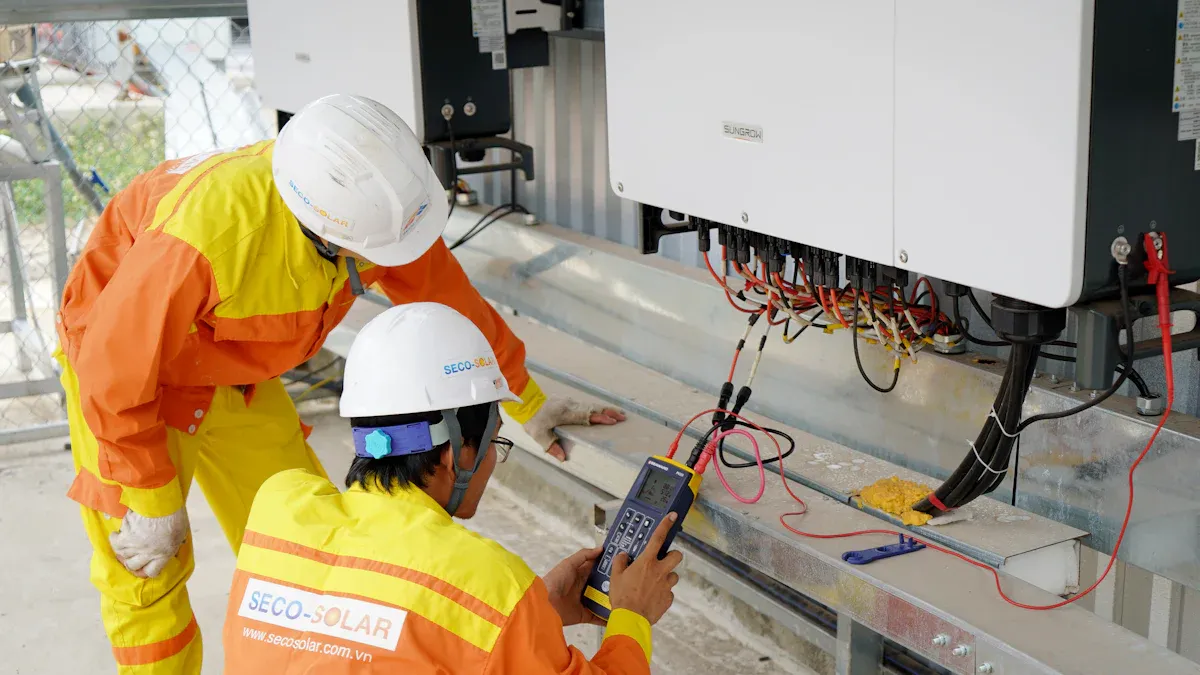
Choosing the Right Relay
You must pick the right relay for your solar system. The best relay depends on your setup and what you need it to do. First, check if the relay matches your system's voltage and current. The relay should handle more than the highest voltage and current in your system. This keeps your equipment safe from harm.
Look at the relay's contact material and resistance. Good contact materials last longer and work better. Check the highest switching values so the relay does not wear out too soon. Always pick relays with safety certifications. Look for marks like ISO, UL, CE, or TÜV. These show the relay meets safety rules.
Think about where your solar system is. If it is outside, pick relays that can handle heat, cold, humidity, and dust. Relays made for tough places last longer and work better. If you live near the ocean or in a city with lots of pollution, pick relays that do not rust.
Here is a table to help you compare relay choices:
|
Criteria |
Description |
|---|---|
|
Compatibility |
The relay must work with your solar power system. |
|
Current Ratings |
Match the relay to the circuit breaker's current rating. |
|
Safety Features |
Look for ISO, UL, CE, and TÜV certifications for reliability. |
|
Installation Considerations |
Follow proper installation steps for best performance and safety. |
Check if the relay has protective functions. Some relays help with undervoltage, overvoltage, under-frequency, and over-frequency. These features protect your solar system from power problems.
|
Protective Function |
Description |
|---|---|
|
27 |
Undervoltage |
|
59 |
Overvoltage |
|
81U |
Under-frequency |
|
81O |
Over-frequency |
|
79 |
Automatic reclose |
🛡️ Tip: Always pick relays with the right certifications and protective features for your solar system.
Installation Tips
You want your relay to work well and keep your solar system safe. Good installation helps you avoid problems. Many people make mistakes when putting in relays. If you rush, you might make errors. Take your time and follow each step.
Some people skip using a checklist. You should use one so you do not miss anything. Do not just look at the relay. Test it to see if it works right. Pretend your system is running to check how the relay works.
If teams do not talk, mistakes can happen. Always share your test results and keep everyone updated. Use software to keep track of testing steps. Write down everything and give copies to your clients.
Here are common mistakes and how to avoid them:
Rushing the installation job
Not using a checklist for commissioning
Only looking at the relay instead of testing it
Bad communication between teams
How to avoid mistakes:
Make a detailed checklist for commissioning.
Pretend your system is running to test the relay.
Use software to keep track of testing steps.
Write down and share your test results.
⚙️ Note: Careful installation and testing help your relay work safely and last longer.
A relay helps your solar power system work safely and well. It also makes your system more reliable. Experts say you should set pickup current, time delay, voltage and frequency limits, earth fault sensitivity, and anti-islanding protection for the best results:
Set pickup current so faults are found fast.
Change time delay so faults clear at the right time.
Use voltage and frequency limits to keep the grid steady.
Make earth fault sensitivity higher to find ground faults quickly.
Add ROCOF and vector shift to protect the inverter.
If you want to know more, look at this resource:
|
Aspect |
Description |
|---|---|
|
Focus |
Better fault protection in wind-solar grids |
|
Methodology |
Uses Improved Hyper Spherical Search Algorithm (IHSSA) for the best relay setup |
|
Key Findings |
Relay time is 18% shorter; coordination margin is 15% better; faults clear in 120 ms |
|
Importance |
Solves problems with changing fault currents in renewable energy systems |
Pick the right relay and put it in the right way. Your solar project will work better and last longer.
FAQ
What does a relay do in a solar power system?
A relay acts as a smart switch. You use it to control high-power circuits with a small signal. Relays help you protect equipment and automate switching between solar, battery, and grid power.
How do you choose the right relay for your solar setup?
You check the voltage and current ratings first. You look for safety certifications like UL or CE. You pick relays that match your system's needs and can handle tough weather if your setup is outdoors.
Why is relay safety important in solar systems?
Relay safety keeps you and your equipment safe. Fast-acting relays stop faults before damage happens. You lower the risk of fire, electric shock, and system failure by using reliable relays.
Can you replace a relay yourself?
You can replace a relay if you follow safety steps. Always turn off the power first. Use a checklist and test the new relay before using your solar system again.
What problems can a faulty relay cause?
A faulty relay can stop your solar system from working. You might see power loss, overheating, or damaged batteries and inverters. Regular checks help you catch relay problems early.
See also
Installation of Solid State Relays: Complete Setup & Care Guide 2025
Solid State Relay Controls Motor Start: Complete 2025 Guide
Tips for Picking the Best Timer Switch for Your Needs
Working principle and application of digital timer switch