


You can find out if relay contacts are normally open or closed by looking at what happens when the relay has no power. Normally open contacts do not touch until you turn on the relay. Normally closed contacts stay together until you give power. Relay contacts let you control circuits in a safe way. Knowing how to spot them keeps you safe from wiring errors. Use easy tests and labels to check each contact.
Key Takeaways
Normally open contacts do not touch when there is no power. They close when the relay gets power. This lets current move through.
Normally closed contacts touch when there is no power. They open when the relay gets power. This stops the circuit for safety.
Use the labels on relays to find contact types. Look for 'NO' for normally open. Look for 'NC' for normally closed. This helps you avoid wiring mistakes.
You can use a multimeter to test relay contacts fast. Set it to continuity mode. This checks if contacts are open or closed.
Always follow safety rules when you work with relays. Use tools with insulation. Wear safety gear to stay safe from accidents.
Relay Contacts Overvie
Relay contacts help control electrical circuits. There are two main types. These are normally open and normally closed. Each type works in its own way. They are used for different jobs in factories and safety systems.
Normally Open Contacts
Normally open contacts do not touch when there is no power. You need to turn on the relay coil to close them. When you do this, current can flow through the contacts. People use normally open contacts to start machines or set off alarms. For example, you can use them to control motors or lights. In factories, they help turn on equipment only when needed.
Tip: Remember, normally open contacts connect only when the relay is on.
Here is a table that shows how normally open contacts work:
|
Contact Type |
Normal State |
Energized State |
|---|---|---|
|
Normally Open (NO) |
Open (no current) |
Closed (current flows) |
These contacts need power to stay closed. This means the relay works a lot. It can wear out faster because of this.
Normally Closed Contacts
Normally closed contacts touch when there is no power. When you turn on the relay coil, the contacts open. These contacts are important for safety. You use them to keep a circuit closed until you want to stop something or shut down in an emergency. For example, emergency stop buttons use normally closed contacts. This keeps the circuit working unless you press the button.
Here is a table that compares how you use each type:
|
Contact Type |
Application Description |
|---|---|
|
Normally Open (NO) |
Used to control things like motors and lights. They turn on when powered. |
|
Normally Closed (NC) |
Used for safety. They keep the circuit closed until powered. Good for emergency stops. |
Normally closed relays only need power when you want to disconnect the load. This helps the relay last longer because it does not work all the time.
Relay contacts use special symbols and markings. These follow rules from IEC 60617 and ANSI/IEEE C37.2. These rules help people know which contact is which in different places.
Identification Methods
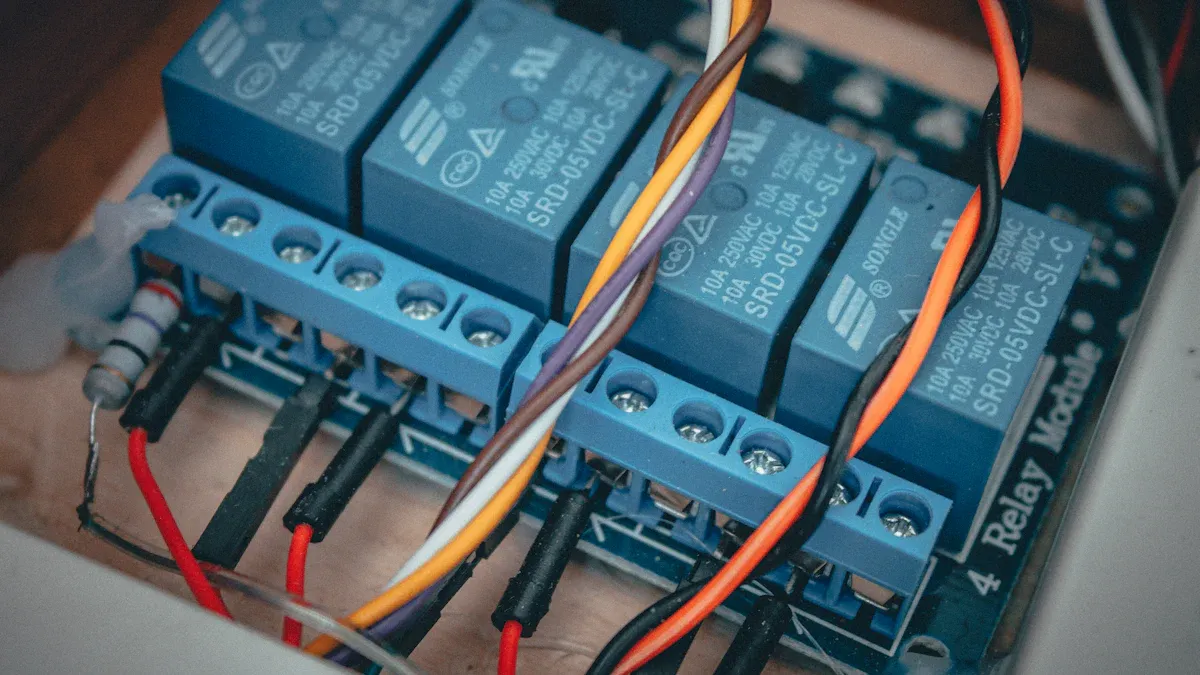
There are a few ways to tell if relay contacts are normally open or normally closed. Each way helps you know the contact type before you connect anything. Here are some common ways to check:
Relay Contacts Labels
Most relays have labels or marks near their terminals. These marks show which terminal is common, which is normally open, and which is normally closed. You might see "COM" for common, "NO" for normally open, and "NC" for normally closed. Some relays use numbers instead of letters. For example, many brands use these markings:
|
Terminal Type |
Marking |
Description |
|---|---|---|
|
Common Terminal (C) |
30 |
This is where all relay contacts connect. |
|
Normally Open (NO) |
87 |
Connects to common when the relay has power. |
|
Normally Closed (NC) |
87a |
Connects to common when the relay has no power. |
Tip: Always look at the relay or datasheet for these marks before wiring.
You can stop mistakes by matching these marks with your wiring diagram. This step helps keep your circuit safe from errors.
Multimeter Testing
A multimeter is a fast way to test relay contacts. Use the continuity setting to see if contacts are open or closed when the relay has no power. Try these steps:
Set your multimeter to continuity or resistance mode.
Put one probe on the common terminal and the other on the NO terminal.
If you do not hear a beep or see a number, the contact is open. This means it is a normally open contact.
Move the probe from NO to NC. If you hear a beep or see a low number, the contact is closed. This means it is a normally closed contact.
You can turn on the relay and test again. The NO contact will close, and the NC contact will open.
Note: Relay contacts change when you add power. Normally open contacts close, and normally closed contacts open.
Testing with a multimeter helps you make sure of the contact type. You can also find problems like contacts stuck together. Testing often can help you avoid mistakes, such as:
Overheating: Use the right relay for your circuit.
Contact Welding: Do not put too much load on the relay. Test contacts often.
Relay Sticking: Keep relays clean and put them in the right way.
Manufacturer Specs
Manufacturers give datasheets for every relay. These datasheets have important facts about relay contacts. You can find:
Types of relay contacts, like:
SPST – Single Pole Single Throw
SPDT – Single Pole Double Throw
DPST – Double Pole Single Throw
DPDT – Double Pole Double Throw
Contact actions, such as:
Make (M)
Break (B)
Forms of contacts:
Form A – Normally Open
Form B – Normally Closed
Form C – Change-over contacts
You can use this information to pick the right relay for your job. Datasheets also have diagrams and pin layouts. This helps you find each terminal and avoid mix-ups.
Note: Training is out there for all skill levels. Beginners learn the basics of relay contacts. New workers get to know plant systems. Advanced techs learn new ways to work.
Relay contacts are important in many circuits. Knowing what each contact does helps you build safe and strong systems.
Visual Differences
Physical Layout
You can tell the difference between contacts by looking at the relay. Most relays have marks next to each terminal. You will see "NO" for normally open and "NC" for normally closed. Some relays use numbers like 87 for NO and 87a for NC. The common terminal is often in the middle or marked "COM."
Here is a table that shows what each contact looks like in many relays:
|
Feature |
Normally Open (NO) |
Normally Closed (NC) |
|---|---|---|
|
State when de-energized |
Disconnected |
Connected |
|
State when energized |
Connected |
Disconnected |
|
Functionality |
Completes circuit when energized |
Breaks circuit when energized |
Tip: Always look at the relay for these marks before wiring. This helps you avoid mistakes.
Relay contacts may look the same, but their positions change. You can see the difference by checking the gap between contacts. Normally open contacts have a gap when the relay is off. Normally closed contacts touch when the relay is off.
Things like humidity can make it hard to see the marks. Humidity can cause rust, which hides the labels. Dust can cover the marks and block moving parts. Relays with sealed cases work better in tough places.
Contact Behavior
You can watch how contacts move when you turn on the relay coil. The contacts move in a set way. Here is a table that shows what happens:
|
Relay Condition |
Relay Coil |
NO Contact |
NC Contact |
|---|---|---|---|
|
Energized |
On |
Closed |
Open |
|
De-Energized |
Off |
Open |
Closed |
When you turn on the coil, the NO contact closes and the NC contact opens.
When you turn off the coil, the NO contact opens and the NC contact closes.
Note: In a relay with no power, the NO contact stays open and the NC contact stays closed until you add power.
You can hear a click when the contacts move. This sound tells you the relay is working. If you hear no sound or see slow movement, dust or water may be the problem. Sealed relays help stop these issues.
Safety Tips
Handling Relays
You should always follow safety rules with relays. Check your tools and equipment before you start. Look for any broken wires or connectors. Use the right tools for testing each time. A multimeter and test light help you check contacts. Insulated screwdrivers keep you safe from shocks. Wear safety glasses and insulated gloves for protection. Fire-resistant clothes and special shoes help keep you safer.
Here is a table that shows what you need:
|
Essential Equipment |
Safety Gear |
|---|---|
|
Multimeter |
Insulated gloves |
|
Test light |
Safety glasses |
|
Power supply |
Non-conductive footwear |
|
Relay socket |
Fire-resistant clothing |
|
Insulated screwdrivers |
Before testing, unplug the relay from power. Make sure the circuit is not on. Always use insulated tools and do not touch live parts. Put your tools away safely after you finish. This keeps your tools working and helps stop accidents.
Tip: Training teaches you how to handle relays safely. Safety meetings and talking with others help prevent accidents.
Electrical Safety
You need to know the safety rules for testing relays. These rules help keep you safe at home and work. Acceptance testing checks relays before you use them. Commissioning testing makes sure relays work in your system. Maintenance testing keeps relays working for a long time.
The table below shows when to do each test:
|
Testing Category |
Description |
Frequency Requirement |
|---|---|---|
|
Acceptance Testing |
Checks relays before you use them. |
Before service starts |
|
Commissioning Testing |
Makes sure relays work in your system. |
During installation |
|
Maintenance Testing |
Keeps relays working well. |
Every 2 years (NFPA 70B) |
Always wear the right safety gear. Watch voltage, current, and temperature during tests. If you see something odd, stop and check everything. After testing, turn the circuit back on carefully. Make sure all wires are tight and safe.
Note: Being careful keeps everyone safe. Good habits and regular checks help stop electrical dangers.
You can easily tell the difference between normally open and normally closed relay contacts by doing these things:
Get a relay, two pushbuttons, and a 24 VDC power supply to test.
Move the relay contacts by hand to watch how they work.
Add a Normally Closed switch or a capacitor to see more ways the contacts act.
Always check your relay before you put it in. Checking carefully helps you avoid mistakes and keeps you safe.
|
What You Check |
Why It Matters |
|---|---|
|
Pin layout and contact type |
Helps stop wiring mistakes and damage |
|
Pin configuration understanding |
Stops unsafe connections |
|
Careful relay identification |
Keeps away shorts, sparks, and broken parts |
Use these steps every time to make sure your relay work is safe and works well.
FAQ
What does "normally open" mean on a relay?
"Normally open" means the contacts do not touch when the relay has no power. You need to energize the relay to close the circuit and let current flow.
What does "normally closed" mean on a relay?
"Normally closed" means the contacts touch when the relay has no power. The circuit stays complete until you energize the relay, which opens the contacts.
What happens if you mix up NO and NC contacts?
If you connect wires to the wrong contacts, your circuit may not work as planned. For example, a machine might stay off when it should run, or safety features might fail.
What tools help you test relay contacts?
You can use a multimeter to check if contacts are open or closed. Look for labels on the relay or check the datasheet for more details.
What symbols show NO and NC contacts on diagrams?
You often see these symbols:
NO (Normally Open):
──o/ o──
NC (Normally Closed):
──o\ o──
Tip: Always check the legend on your wiring diagram for symbol meanings.
See also
How to Choose the Right Automotive Relays and Fuse Boxes
Automotive Relay with Wiring Harness: Complete 2025 Installation Guide
Automotive Relays with Switches: 2025 Safety & Efficiency Guide
SSR Heat Dissipation Design for Maximum Lifespan - Engineer's Guide