


You can safely test relay sockets using a multimeter by following clear steps and adhering to safety rules. Always turn off the power before you begin, and never touch relay terminals when they are energized. This prevents electric shock. Many technicians and DIYers regularly test relay sockets. It's important to understand how relays work and have some hands-on practice.
If you don't follow the proper steps when you test relay sockets, you risk electric shock, equipment damage, or even fire. Performing each step in the correct order helps keep you safe and ensures your relay socket test is accurate.
Key Takeaways
- Always turn off the power before you test. Remove the relay first to stay safe and avoid wrong results.
- Use the correct tools like a digital multimeter. Wear insulated gloves and use jumper wires for safe tests.
- Learn relay pin numbers and what they do. This helps you connect your multimeter the right way and get good results.
- Check voltage, measure coil resistance, and test contact continuity one at a time. This helps you find relay problems.
- Follow safety steps and check your work twice. This keeps you safe and helps your vehicle's electrical system work well.
Preparation
Tools Needed
Get all the tools you need before you start. The right equipment helps you avoid mistakes. It also makes your results more reliable.
- Digital Multimeter: Pick a digital multimeter with auto-ranging and true RMS. Fluke 88V or Fluke 175 are good for cars. These meters show coil resistance and contact continuity.
- Test Light: Use a test light to see if there is voltage at the relay socket.
- Jumper Wires: Use jumper wires with insulated alligator clips. These wires help you make safe connections.
- Insulated Hand Tools: Use screwdrivers, pliers, and wire cutters with rubber handles. This keeps you safe from shocks.
- Protective Gear: Wear insulated gloves to keep your hands safe from electricity.
- Good Lighting: Make sure your workspace is bright. This helps you see pin numbers and labels.
Tip: Check your tools for cracks or worn insulation before you use them. Hold tools only by their insulated parts.
| Tool | Purpose |
|---|---|
| Digital Multimeter | Measures voltage, resistance, and continuity |
| Test Light | Checks for voltage presence |
| Jumper Wires (Insulated) | Makes safe connections |
| Insulated Hand Tools | Prevents electrical shock |
| Insulated Gloves | Protects hands from shocks |
| Good Lighting | Improves visibility |
Safety Steps
Always follow safety steps when you test relay sockets. These steps keep you and your vehicle safe.
- Turn off the vehicle and disconnect the battery first. This stops shocks and damage.
- Take the relay out of its socket. This avoids wrong readings from other circuits.
- Look at the relay and socket for damage or loose wires.
- Do not touch battery terminals directly. Take off metal jewelry from your hands and wrists.
- Work in a dry, clean, and bright area. Keep flammable things away from your workspace.
- Find relay pins using the diagram on the relay or the vehicle's wiring chart.
- Take pictures of the relay and wiring before you disconnect anything. This helps you put everything back the right way.
Note: Never skip safety steps. If you rush or ignore safety, you can get hurt or damage something.
Identify Relay Socket Pins
Before you test relay sockets, you need to know how to identify each pin. Relay sockets use standard pin numbers. These numbers help you connect your multimeter to the right spot. Most automotive relays follow the DIN 72552 standard. You will see numbers like 85, 86, 30, 87, and sometimes 87a on the relay or socket.
Pin Numbers (85, 86, 30, 87)
Manufacturers label relay socket pins with clear numbers. These numbers match the function of each pin. You can find these numbers on the relay case, the socket, or in the vehicle's wiring diagram. Here is a table that shows the most common pin numbers and what they do:
| Pin Number | Function Description |
|---|---|
| 85 | Relay Coil Negative (Ground) |
| 86 | Relay Coil Positive (Power) |
| 30 | Battery Feed / Line In Positive |
| 87 | Common Contact (Switched Output) |
| 87a | Normally Closed Contact (NC, 5-pin) |
Tip: Always check the relay diagram before you connect your multimeter. This helps you avoid mistakes and keeps your test relay sockets safe.
You may also see extra pins like 87b, 88, 88a, or 88b on some relays. These are used in special relay types, but most car relays use only 85, 86, 30, 87, and sometimes 87a.
Pin Functions
Each pin has a specific job in the relay circuit. Knowing what each pin does helps you test relay sockets correctly.
- Pin 85: This pin connects to ground. It completes the coil circuit and lets current flow when the relay is activated.
- Pin 86: This pin receives power from the ignition switch or control module. When you apply voltage here, the coil energizes.
- Pin 30: This pin is the main power input. It connects to the battery and supplies high current to the relay.
- Pin 87: This pin is the switched output. When the relay coil is energized, power flows from pin 30 to pin 87, turning on the accessory.
- Pin 87a: This pin is the normally closed contact. In a 5-pin relay, pin 87a connects to pin 30 when the relay is off.
When you test relay sockets, you need to know which pin does what. This makes your measurements accurate and helps you find problems faster.
Note: Relay datasheets and socket labels often show pin diagrams. Use these diagrams to match each pin to its function before you start testing.
Test Relay Sockets
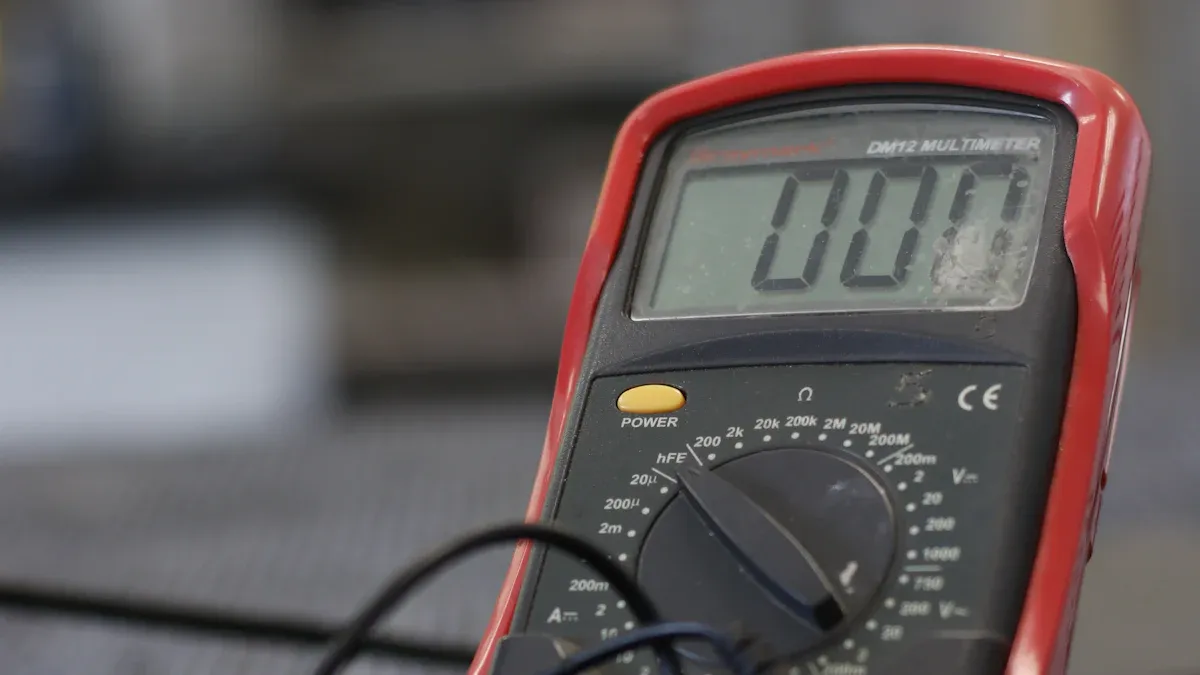
Testing relay sockets with a multimeter helps you find electrical problems quickly. You can follow these steps to check voltage, measure coil resistance, and test contact continuity. Each step gives you important information about the health of your relay socket.
Check Voltage at Pins
You need to check for power at the relay socket before you test relay sockets further. This step shows if the socket receives the right voltage.
- Turn the ignition ON. Make sure the relay is removed from the socket.
- Set your multimeter to DC Volts mode.
- Place the black probe on a good ground point. Use the red probe to test each socket pin.
- Look for these voltage readings:
-
Pin Number Expected Voltage Range Condition / Notes 30 ~12-13V Battery voltage, present at all times 86 >10V Voltage only when ignition ON or engine running 85 0V Should be at ground potential 87 ~12V Only when relay coil is energized - Pin 30 should always show battery voltage. Pin 86 should show voltage when the ignition is ON. Pin 85 should be close to zero volts, showing a good ground. Pin 87 only shows voltage when the relay is activated.
Tip: If you do not see the expected voltage, check for blown fuses, bad wiring, or poor ground connections.
Measure Coil Resistance
Measuring coil resistance helps you know if the relay coil is healthy. You need to do this before you test relay sockets for continuity.
- Remove the relay from the socket.
- Set your multimeter to resistance (Ω) mode. Use the lowest range if you can select it.
- Place one probe on pin 85 and the other on pin 86.
- Wait for the reading to stabilize. The coil's inductance may cause the numbers to jump at first.
- A healthy relay coil usually reads between 50 and 150 ohms. If you see "OL" or "1", the coil is open and broken. If you see a very low number, the coil is shorted.
- Make sure the probes touch clean metal for an accurate reading. Measure at room temperature for best results.
Steps for measuring coil resistance:
- Disconnect the relay.
- Set the multimeter to Ω.
- Probe pins 85 and 86.
- Wait for a steady reading.
- Check for 50-150 ohms.
Note: If the resistance is outside this range, you should replace the relay.
Test Contact Continuity
Testing contact continuity shows if the relay switches power correctly. You need to test relay sockets for continuity between pins 30 and 87.
- Make sure the relay is not energized.
- Set your multimeter to continuity mode. This mode beeps when the circuit is complete.
- Place one probe on pin 30 and the other on pin 87. You should not hear a beep. This means the contacts are open.
- Apply 12V power to pins 85 and 86 to energize the coil. You should hear a click.
- While the coil is powered, test between pins 30 and 87 again. You should hear a beep or see a low resistance reading (less than 1 ohm). This means the contacts are closed.
- Remove power from the coil. The relay should click again, and the beep should stop.
Quick checklist for contact continuity:
- No beep between 30 and 87 when relay is off.
- Beep or low resistance when relay is powered.
- No beep after removing power.
If you hear a beep when the relay is off, or no beep when it is powered, the relay is faulty.
You can use these steps to test relay sockets in most vehicles. Accurate testing helps you find problems and keep your electrical system working well.
Troubleshooting
Common Issues
When you test relay sockets, you might run into some common problems. Knowing these issues helps you avoid mistakes and fix faults faster.
- You might forget to check battery voltage. This can cause the relay to act strangely and hide real problems.
- Testing the relay while it is still plugged in can give you wrong readings because other circuits may affect your results.
- If you mix up the relay pins, you could apply power or ground to the wrong place. This can damage the relay or socket.
- Poor ground contact often leads to inaccurate readings on your multimeter.
- Skipping safety steps, like working near fuel vapors, can be dangerous.
- Sometimes, you may guess the relay location without checking diagrams, which wastes time.
- Replacing relays without confirming they are faulty can lead to more problems.
- Some people avoid using a multimeter because it seems hard, but this only makes troubleshooting take longer.
Tip: Always double-check pin numbers and follow safety steps. This helps you get accurate results and keeps you safe.
Next Steps
If you find a problem while you test relay sockets, you can follow these steps to fix it:
- Inspect the relay socket and all wiring for signs of damage or corrosion.
- Clean the relay terminals and socket contacts. Use contact cleaner or fine sandpaper to remove oxidation.
- Check all wiring connections, especially at the coil and contact terminals. Tighten any loose connections.
- Use your multimeter to test voltage at Pin 30 and Pin 86. Both should read about 12V with the key on.
- Make sure Pin 85 has a good ground. It should read close to 0V.
- Test the fuse linked to the relay. Sometimes, a fuse looks fine but has a tiny crack you cannot see.
- If the relay fails the voltage, resistance, or continuity tests, replace it with a new one that matches the original.
- If the relay passes all tests but the device still does not work, check the wiring and control circuits for hidden faults.
- If a new relay fails soon after installation, look for deeper electrical issues before replacing it again.
If you cannot solve the problem or if the issue is complex, consider reaching out to professional services. Companies like Electrical
Reliability Services and HVM Corp offer expert help with advanced tools and certified technicians.
When you use relay sockets, always think about safety first.
- Take off the battery cable before you begin.
- Work in a place with fresh air and no clutter.
- Make sure the car is in Park or Neutral and the brake is on.
- Be careful not to break any wires or terminals.
After you finish testing, check your work again:
- Listen for a click from the relay and see if terminal 87 has power.
- Check that the relay fits tightly in the socket.
- Look for rust or wires that are not tight.
Doing regular checks helps your car's electrical system stay healthy. It also stops breakdowns and keeps safety parts working. If you are not sure what to do, ask an expert for help.
FAQ
How do you know if a relay socket is bad?
You can check for burned marks, loose pins, or melted plastic. Use your multimeter to test for voltage and continuity. If you see strange readings or the relay does not click, the socket may be faulty.
Can you test a relay socket without removing the relay?
You should remove the relay before testing the socket. This helps you get accurate readings. Testing with the relay in place can give you wrong results because other circuits may affect your measurements.
What does it mean if you get no voltage at pin 30?
No voltage at pin 30 means the socket is not getting power from the battery. Check the fuse, wiring, and battery connections. Fix any loose or broken wires before testing again.
Is it safe to use a test light instead of a multimeter?
A test light can show if voltage is present, but it does not measure exact values. You should use a multimeter for accurate results. Always wear insulated gloves and follow safety steps.
Why does the relay click but the device does not work?
The relay may click, but the contacts inside could be dirty or worn out. Check for continuity between pins 30 and 87 when the relay is powered. Clean the contacts or replace the relay if needed.