


When you choose double throw relays over single throw relays, you gain more control and flexibility. Double throw relays let you switch between two circuits using a single relay, thanks to their three terminals: common, normally open, and normally closed. You can simplify your circuit design and create backup switching for critical systems. This ability to handle two independent circuits at once means you can build more reliable and adaptable solutions for your projects.
Key Takeaways
Double throw relays control two circuits with one device, offering more flexibility than single throw relays.
They simplify circuit design by reducing the number of relays and wiring needed, saving space and cost.
Double throw relays provide backup switching, improving system reliability and safety in critical applications.
These relays allow switching between power sources or devices quickly, making them ideal for automation and power management.
They offer electrical isolation, protecting sensitive control circuits from high voltages and ensuring safer operation.
Double throw relays come in many types and sizes, fitting a wide range of projects from home automation to industrial control.
Using double throw relays can improve energy efficiency by easily turning off unused circuits.
Always match the relay's ratings and features to your project needs to ensure safe and reliable performance.
Relay Types
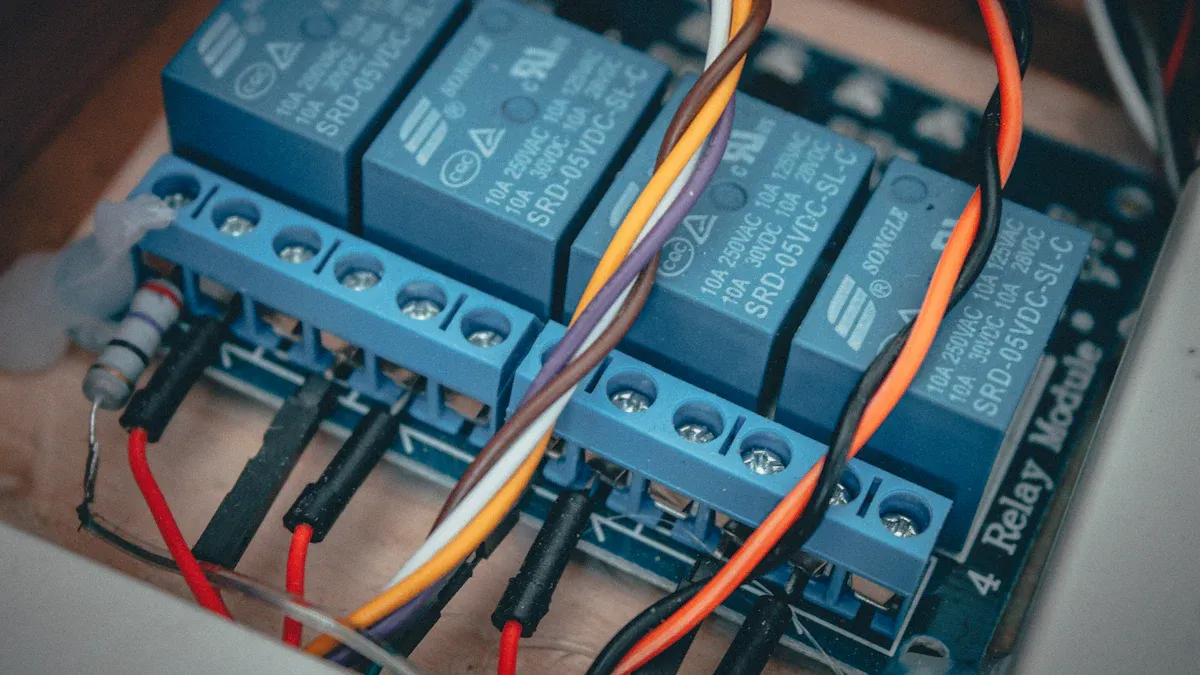
Single Throw Relays
You often use single throw relays when you need basic ON/OFF control in a circuit. These relays work like a simple switch. When you energize the coil, the contacts either close (normally open) or open (normally closed). This action lets you control one circuit at a time.
A single throw relay has these main parts:
Coil (electromagnet)
Armature (moving part)
Contacts (NO or NC)
Spring
Terminals
When you apply current to the coil, it creates a magnetic field. This field pulls the armature, changing the state of the contacts. You can use single pole single throw (SPST) relays for simple tasks, such as turning a light on or off. These relays are reliable for basic switching, but they do not offer much flexibility.
Tip: Always check the coil voltage and contact ratings before using a relay. This helps you avoid damage from too much current or voltage.
Double Throw Relays
Double throw relays give you more options. You can switch between two circuits using just one relay. These relays have three main terminals: common (COM), normally open (NO), and normally closed (NC). When you energize the coil, the common terminal moves from the NC contact to the NO contact. This lets you control two different outputs with one input.
Here is a table that shows some key specifications for double throw relays:
|
Specification |
Description |
|---|---|
|
Contact Configuration |
One common, one NO, one NC terminal (SPDT) |
|
Coil Voltage |
5–48 V DC or AC |
|
Contact Material |
Silver alloy, gold, or other metals for durability |
|
Operating Time |
5–15 milliseconds |
|
Release Time |
2–10 milliseconds |
|
Voltage Ratings |
5 V to 240 V |
|
Current Ratings |
1 A to 30 A |
|
Dielectric Strength |
Withstands high voltage between coil and contacts |
You can use double throw relays for more complex tasks, such as switching between power sources or reversing the direction of a motor. These relays help you build circuits that need backup or failover options.
Key Differences
You might wonder why you should choose double throw relays over single throw relays. The answer lies in their flexibility and control. Here are some important differences:
Number of Circuits Controlled:
Single throw relays control one circuit.
Double throw relays control two circuits with one relay.
Contact Arrangements:
Single throw: Only NO or NC contacts.
Double throw: Both NO and NC contacts, allowing changeover.
Applications:
Use single throw relays for simple ON/OFF tasks.
Use double throw relays for switching between two outputs, providing backup, or controlling more complex systems.
Wiring Flexibility:
Double throw relays let you design circuits with more options for control and safety.
Note: Double throw relays can simplify your design by reducing the number of relays needed for multi-circuit control.
You gain more versatility and reliability when you use double throw relays over single throw relays, especially in projects that require switching between two outputs or providing a backup path.
Features Comparison
Switching Mechanisms
You want to know why double throw relays give you more control than single throw relays. The answer starts with how each relay switches circuits. Both types use a coil and armature to move contacts, but double throw relays add an extra layer of flexibility. When you energize the coil, the armature moves, changing the connection from one contact to another. This lets you switch between two outputs instead of just turning one circuit on or off.
Here is a table that shows how the switching mechanisms differ:
|
Feature |
Single Throw Relay |
Double Throw Relay |
|---|---|---|
|
Contact Configuration |
Either Normally Open (NO) or Normally Closed (NC) contacts |
Both NO and NC contacts in the same relay |
|
Contact Behavior (No Coil Power) |
NO contacts are open; NC contacts are closed |
NC contact closed, NO contact open |
|
Contact Behavior (Coil Energized) |
NO contacts close; NC contacts open |
NO contact closes, NC contact opens (switches power between circuits) |
You can see that double throw relays let you choose which circuit gets power. This switching action makes them ideal for applications where you need to alternate between two devices or provide a backup path.
Tip: Double throw relays can act as single throw relays if you only use one side, but single throw relays cannot switch between two circuits.
Circuit Control
When you design a system, you often need to control more than one circuit. Double throw relays help you do this with fewer components. You can use one relay to manage two separate circuits, which saves space and reduces wiring complexity.
The following table highlights the main differences in circuit control:
|
Feature |
Single Throw Relay |
Double Throw Relay |
|---|---|---|
|
Circuit Control |
Controls one circuit |
Controls two separate circuits |
|
Functional Application |
Simple on/off control |
Switching power between circuits |
|
Wiring Flexibility |
Fixed to NO or NC contacts |
Can be wired as single throw or double throw |
You gain more options with double throw relays. You can switch power between two loads, select between two sources, or create a failover system. This flexibility is why many engineers choose double throw relays for complex projects.
Electrical Isolation
You want your circuits to stay safe and reliable. Both single throw and double throw relays provide electrical isolation between the control side and the load side. This means the signal that activates the relay does not mix with the power going to your devices.
Here are some ways engineers test and confirm electrical isolation in relay systems:
Setting devices to a special test mode to isolate them virtually, so test signals do not affect the real system.
Using simulation flags in communication messages to separate test data from live data.
Mapping and validating control logic to ensure test operations do not interfere with normal operations.
Monitoring outputs during tests to confirm that the relay only responds to the intended signals.
You benefit from this isolation because it protects sensitive control circuits from high voltages or currents in the load. Double throw relays maintain this safety while giving you more control options, making them a smart choice for many applications.
Advantages of Double Throw Relays Over Single Throw Relays
Versatility
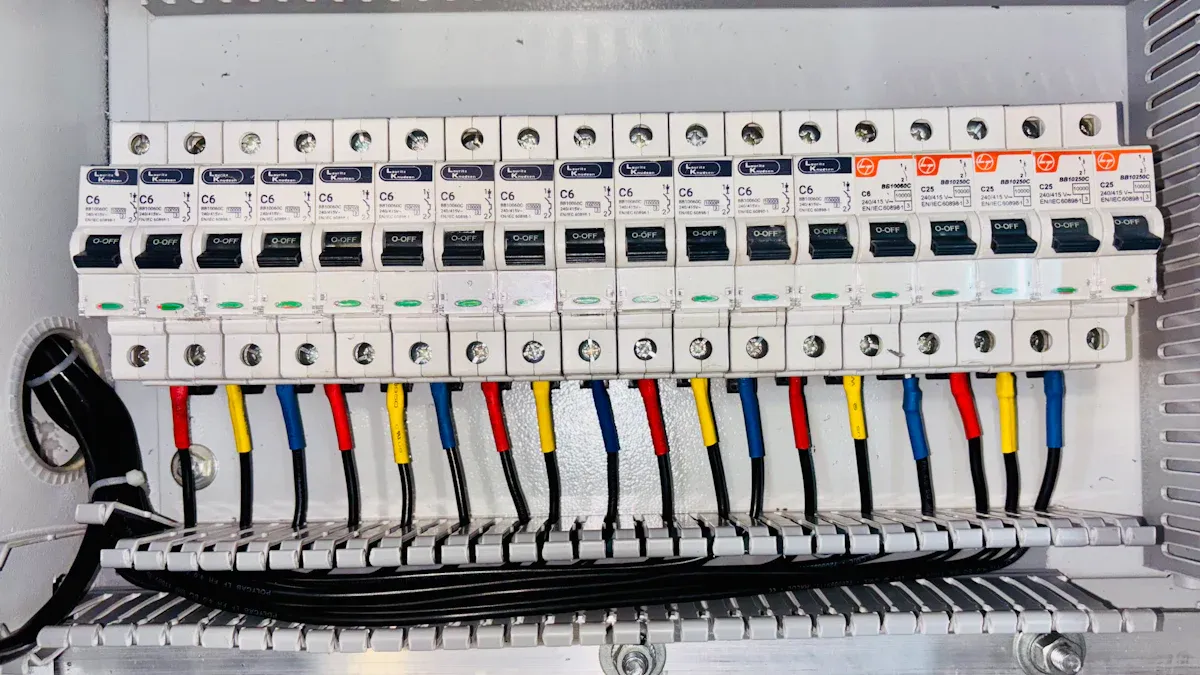
You want your projects to work in many different situations. Double throw relays give you this kind of versatility. You can use one relay to control two separate circuits at the same time. This means you do not need to buy or wire extra relays for each circuit. You can switch between two outputs or even select between two power sources with just one device.
Double throw relays over single throw relays offer more options for your designs. You can use them in audio equipment, industrial machines, cars, and even lighting systems. These relays come in many types, such as panel mount, waterproof, or miniature versions. You can pick the one that fits your project best.
Here is a table that shows why double throw relays are so versatile:
|
Performance Metric / Feature |
Description |
|---|---|
|
Control Capability |
Controls two separate circuits simultaneously, each with two possible connection paths |
|
Contact Movement |
Simultaneous movement of two internal contacts for dual circuit switching |
|
Break-Before-Make Action |
Prevents short circuits by breaking existing connections before making new ones |
|
Detent Mechanism |
Provides tactile feedback and maintains switch position |
|
Application Diversity |
Used in audio equipment, industrial control, telecommunications, motor control, power distribution, lighting control, automotive systems |
|
Variants Available |
Panel mount, PCB mount, high current, miniature, waterproof, multi-position, illuminated, maintained vs. momentary versions |
|
Advantages |
Space efficiency, reliability, customizability, simplified wiring |
You can see that double throw relays over single throw relays give you more ways to solve problems. You can use them in many fields and for many tasks.
Failover Capability
You want your systems to keep working, even if something goes wrong. Double throw relays help you build circuits with backup paths. If one part of your system fails, the relay can switch to another circuit. This is called failover capability.
For example, you can use a double throw relay to switch between a main power source and a backup battery. If the main power fails, the relay moves to the backup. Your devices keep running without interruption. You do not need extra relays or complex wiring to make this happen.
This failover feature makes double throw relays over single throw relays a better choice for safety and reliability. You can trust your system to keep working, even in tough situations.
Tip: Use double throw relays in critical systems where you need backup options, such as emergency lighting or alarm systems.
Circuit Simplification
You want your circuits to be easy to build and maintain. Double throw relays help you simplify your wiring and reduce the number of parts. You can control two circuits with one relay, so you do not need to install multiple single throw relays.
Engineers have used double throw relays to replace several single-function relays in safety systems. In one case, a manufacturer upgraded from many single relays to a multi-function relay with double throw contacts. This change saved 30% in costs and increased production by 40%. The new relay made the circuit easier to understand and maintain. It also made the system more flexible and reliable.
Here is a summary of this engineering case:
|
Upgrade |
Result |
|---|---|
|
Replaced multiple single-function relays with one multi-function relay (with double throw contacts) |
30% cost savings, 40% increase in production, simpler safety circuit, more flexibility, easier maintenance |
You can see that double throw relays over single throw relays make your circuits less crowded and more efficient. You spend less time wiring and troubleshooting. Your projects become easier to manage and expand.
Control Flexibility
You want your circuits to do more than just turn something on or off. Double throw relays give you the power to control how and when your devices operate. This flexibility comes from the way you can wire and use the relay's terminals. With both normally open (NO) and normally closed (NC) contacts, you can decide which circuit gets power when the relay switches. This means you can create more advanced control systems without adding extra relays.
When you use double throw relays, you can:
Switch between two different devices with one relay.
Set up a system where one device turns off as another turns on.
Build circuits that change behavior based on different conditions.
Create backup paths for critical equipment.
You can also use double throw relays to build logic into your circuits. For example, you can combine several relays to make your system act like an AND or OR gate. This lets you design smart control systems for lights, motors, or alarms. You can even use different wiring methods, like break-before-make or make-before-break, to control how fast or slow the switch happens. This helps you avoid short circuits and makes your system safer.
Here is a table that shows how different relay types and wiring options affect control flexibility:
|
Relay Type |
Description |
Terminals |
Control Flexibility Aspect |
|---|---|---|---|
|
DPDT (Double Pole Double Throw) |
Controls two circuits at once, switching each between two outputs |
8 terminals (including coil) |
Lets you make complex changes in your circuit with one relay |
|
Contact Types |
NO, NC, Change-Over |
Varies |
Lets you pick how each circuit behaves when the relay switches |
|
Switching Actions |
Break-before-make, Make-before-break |
N/A |
Lets you control the timing and safety of the switch |
|
Relay Configurations |
SPST, SPDT, DPST, DPDT |
Varies |
Lets you choose the right relay for your control needs |
You can see that double throw relays over single throw relays give you more ways to control your circuits. You can switch between two outputs, carry two signals, or set up special switching actions. This makes your projects more flexible and powerful.
Tip: If you want to design a system that can adapt to different situations, choose double throw relays. You will have more control over how your devices work together.
Use Cases
Home Automation
You want your home to be smart and efficient. Double throw relays help you achieve this by letting you control more than one device with a single switch. You can use them to manage lighting, fans, or even security systems from one central point. This makes your home easier to control and saves you time.
Double throw relays let you switch between two lighting circuits. You can turn on the main lights or switch to mood lighting with the same wall switch.
You can set up a backup system for important devices. If the main power fails, the relay switches to a backup battery, keeping your security system running.
You can control appliances remotely. Smart home systems use double throw relays to connect devices to your phone or voice assistant.
Tip: Using double throw relays in home automation reduces the number of relays you need. This makes your wiring simpler and your system more reliable.
Many home automation systems use double throw relays because they provide electrical isolation. This protects your control circuits from high voltages, making your home safer. You also gain energy efficiency, since you can easily switch off devices when not in use.
Industrial Control
You need reliable and flexible control in factories and industrial settings. Double throw relays play a key role here. They help you automate machines, control motors, and manage complex processes.
You can use double throw relays to reverse the direction of a motor. This is important for conveyor belts or robotic arms.
They allow you to switch between different power sources or control signals, making your system more adaptable.
Industrial automation systems use double throw relays to manage multiple signal paths at once. This simplifies circuit design and reduces the need for extra components.
A table below shows why industries choose double throw relays:
|
Benefit |
Why It Matters in Industry |
|---|---|
|
Motor control |
Easily reverse or stop motors |
|
Signal switching |
Manage multiple signals at once |
|
Reliability |
Fewer relays mean fewer failures |
|
Safety |
Electrical isolation protects equipment |
Major companies like Omron and Siemens use double throw relays in their automation products. The market for these relays keeps growing as factories become smarter and more automated. You see them in smart factories, communication networks, and even in the expansion of 5G infrastructure.
Automotive Systems

You want your car to be safe and dependable. Double throw relays help you control many systems in vehicles. They let you switch between different circuits, which is important for things like headlights, wipers, and power windows.
You can use a double throw relay to switch between high and low beam headlights with one control.
They help manage backup systems. If one circuit fails, the relay switches to another, keeping your car running smoothly.
Automotive systems use these relays to control multiple actions at once, such as turning off the radio when you start the engine.
Double throw relays also provide electrical isolation in cars. This protects sensitive electronics from power surges. You get more reliable performance and fewer breakdowns. Many modern vehicles rely on these relays for both safety and convenience features.
Note: Double throw relays make your car's electrical system more flexible and robust. This is why automakers use them in so many applications.
Power Switching
You want your power switching systems to be fast, reliable, and efficient. Double throw relays give you a clear advantage in these areas. When you use a double throw relay, you can switch between two power sources or two loads with just one device. This makes your design simpler and more flexible.
Many engineers choose double throw relays for power switching because they handle demanding tasks with ease. You can use them in backup power systems, uninterruptible power supplies, or even in high-speed data centers. These relays help you keep your devices running smoothly, even when you need to switch power quickly.
You might wonder why double throw relays work so well for power switching. The answer comes from their technical performance. These relays operate much faster than traditional electromagnetic relays. Some models switch in less than 10 microseconds. This speed is about 1,000 times faster than older relay types. You get almost instant switching, which protects your equipment and keeps your system stable.
Reliability matters in power switching. Double throw relays can last for over 3 billion switching cycles. This long life means you spend less time and money on maintenance. You can trust your system to work for years without problems.
You also save space and energy with double throw relays. Many modern relays have a very small footprint-about 64 square millimeters.
This size is 90% smaller than older relays. You can fit more relays into your control panel or device. Power consumption drops, too. Some double throw relays use less than 0.08 milliwatts. This is a 99% reduction compared to traditional relays. You save energy and reduce heat in your system.
Here is a table that shows how double throw relays perform in power switching:
|
Benchmark Aspect |
Performance Metric / Description |
|---|---|
|
Switching Speed |
Ultra-fast operation: < 10 µs; release time: < 2 µs (1000x faster than conventional EM relays) |
|
Reliability |
Over 3 billion switching cycles (1000x longer lifetime than conventional EM relays) |
|
Size |
64 mm² footprint (8 mm x 8 mm x 1.6 mm QFN package), 90% smaller than conventional EM relays |
|
Power Efficiency |
Power consumption < 0.08 mW, representing 99% reduction compared to EM relays |
|
Linearity (IP3) |
IP3 linearity > +90 dBm, enabling large distortion reduction and improved signal quality |
|
Power Handling |
+33 dBm power handling capability |
|
Data Rate / Frequency |
Supports DC to 20 GHz or 40 Gbps switching speeds, suitable for PCIe Gen 5 and other high-speed digital interfaces |
You can see that double throw relays offer top performance for power switching. You get fast response, high reliability, and energy savings. You also gain the ability to handle high-frequency signals and large amounts of power. This makes double throw relays the smart choice for modern power switching needs.
Tip: If you want to future-proof your power systems, choose double throw relays. You will enjoy better performance and lower costs over time.
You now understand why double throw relays stand out in power switching applications. They help you build systems that are faster, more reliable, and more efficient. You can meet the demands of today's technology with confidence.
Choosing Between Relay Types
Application Needs
When you choose a relay for your project, you want to make sure it fits your specific needs. Picking the right relay type helps your system work better and last longer. You should always start by understanding what your application requires. Here are some important reasons why you need to match the relay to your needs:
Operation Principle: You need to know how the relay works. Electromechanical relays use moving parts and physical contacts. Solid-state relays use electronic parts with no moving pieces. This affects how fast the relay switches and how long it lasts.
Isolation: You want to keep your control circuit safe from high voltages. Electromechanical relays give strong electrical isolation. Solid-state relays use optical or transformer isolation.
Load Types: You must check if your relay can handle the type of load you have. Electromechanical relays work with both AC and DC loads. Solid-state relays often work best with one type.
Switching Speed: If your project needs fast switching, solid-state relays switch much faster than electromechanical ones.
Lifespan and Noise: Solid-state relays last longer because they have no moving parts. They also work silently. Electromechanical relays make a clicking sound when they switch.
Cost and Power: Electromechanical relays usually cost less. Solid-state relays may need extra cooling because they can get hot.
Environmental Conditions: You need to think about where you will use the relay. High temperatures, humidity, or vibration can affect how well the relay works.
Surge Current and Voltage Rating: Always pick a relay with a surge current rating higher than your system's inrush current. Make sure the voltage rating matches or exceeds your load.
Physical Size and Mounting: You want a relay that fits your space and mounting needs.
Contact Configuration: Choose a relay with the right number of contacts for your switching needs.
Tip: Always match the relay's features to your application. This helps you avoid failures and keeps your system safe.
Limitations
You also need to know why each relay type has its own limits. Understanding these limits helps you avoid problems and pick the best relay for your job. Here is a table that shows some common relay types and their main challenges:
|
Relay Type |
Limitations and Performance Challenges |
|---|---|
|
Electromechanical |
Slow switching speed, large size, sensitive to magnetic fields, needs regular maintenance, can wear out over time |
|
Static Relay |
Sensitive to voltage spikes and temperature, needs extra voltage to work, can be affected by electrical noise, complex design |
|
Digital Relay |
Limited memory and processing power, mostly used for protection, can be slow in some cases, needs trained staff |
|
Numerical Relay |
Very fast and precise, but limited by breaker speed, can face cybersecurity risks, complex design, needs careful setup |
You should know why these limits matter. For example, electromechanical relays can handle big surge currents, but their size makes them hard to use in tight spaces. Solid-state relays switch quickly, but they may need heat sinks and cost more. Digital and numerical relays offer advanced features, but they can be complex and need skilled people to set up and maintain.
Note: Always weigh the pros and cons of each relay type. This helps you choose a relay that meets your needs without causing extra problems.
When you understand both your application needs and the limits of each relay type, you make smarter choices. This leads to safer, more reliable, and cost-effective systems.
Common Misconceptions
Always Better?
You might think double throw relays always work better than single throw relays. This idea seems true because double throw relays offer more control and flexibility. However, you need to know why this is not always the case. Double throw relays do not guarantee flawless operation in every situation. Many technical factors affect how well a relay works in real-world systems.
Here are some reasons why double throw relays may not always perform perfectly:
Traditional testing does not show true relay performance. These tests often miss important factors like how the relay connects to different loads or how the source impedance changes.
Impedance relays use phase comparators of complex quantities, not just simple measurements. This makes their behavior harder to predict.
Real-world conditions, such as source impedance, load flow, and fault direction, can change how a relay responds. Simple diagrams do not capture these effects.
Sometimes, relay elements designed to look forward can act in reverse, making relay behavior confusing.
Graphs that show fault position versus true fault resistance give a better picture of relay performance, no matter the system conditions.
Some faults can show negative resistance, which challenges the idea that relays always work as expected.
Different relay types, like mho and quadrilateral, measure impedance in their own ways. You need to analyze each type separately.
Modern power systems require advanced testing with real power system models. This helps you find problems that simple tests miss.
Note: You should not assume double throw relays will always work perfectly. Real-world systems are complex, and many factors can affect relay performance.
Complexity
You may believe that using double throw relays will always make your project simpler. In reality, advanced relay designs can add new layers of complexity. You need to understand why this happens, especially as technology advances.
Advanced relays often include smart features like wireless control, remote monitoring, and programmability. These features require special skills to set up and maintain.
Adding smart functions means you need more research and development. This increases the time and cost to design and build the relay.
Programmable relays can reduce the need for rewiring, but you must learn how to configure them correctly.
As industries like automotive and renewable energy grow, electrical systems become more complicated. You need to keep up with new technology and standards.
Manufacturers must balance performance, durability, energy use, and cost. This balancing act can make relay systems harder to design and manage.
Supply chain issues and tariffs can raise costs and slow down production. Companies may need to find new suppliers or move factories to keep up.
If you work in a small or medium business, you may find it hard to adopt advanced relay technology. High costs and the need for expert knowledge can be big barriers.
You should always weigh the benefits of double throw relays against the added complexity. Sometimes, a simple single throw relay fits your needs better. Knowing why complexity increases helps you make smarter choices for your projects.
Summary
Key Points
You have learned why double throw relays often give you more value than single throw relays. These relays let you control two circuits at the same time. You can use one relay instead of two, which saves space and parts. Double throw relays help you build safer and more reliable systems. You can switch between power sources, reverse polarity, or set up backup circuits with ease.
Here is a table that shows the main advantages and disadvantages:
|
Advantages |
Disadvantages |
|---|---|
|
Controls two circuits simultaneously |
More expensive than simpler relay types |
|
Replaces two SPDT switches, reducing parts |
Manual operation lacks smart features like remote control |
|
Enables polarity reversal and dual-mode switching |
Takes up more space on crowded circuit boards |
|
Compatible with AC and DC systems |
Needs protection components for high-power inductive loads |
|
Mechanical design is simple and reliable |
You can see that double throw relays offer many benefits. They work with both AC and DC circuits. They give you flexibility and reliability. However, you should know that they cost more and take up more space than single throw relays. You may also need extra protection for high-power loads.
Double throw relays also let you control high-power circuits with low-power signals. You can use them in many ways, such as in home automation, cars, and factories. Here is another table that shows more benefits and some limits:
|
Benefits |
Limitations |
|---|---|
|
Controls high-power circuits with low-power signals |
Mechanical wear reduces lifespan due to contact erosion |
|
Available in multiple configurations (like DPDT) |
Contact arcing can damage contacts when switching high currents |
|
Compatible with both AC and DC circuits |
Slower switching speed than solid-state relays |
|
Convenience and flexibility in application |
May need extra protective circuits, adding complexity |
Note: Double throw relays give you more control and options, but you should always consider the space, cost, and protection needs for your project.
You often choose double throw relays over single throw relays because you want more control and reliability. These relays let you manage two circuits, add backup switching, and simplify your designs. You gain flexibility for many projects, from home automation to industrial systems. Before you decide, look at your project's needs. Pick the relay that gives you the best mix of safety, control, and efficiency.
FAQ
Why should you choose a double throw relay for backup systems?
You should choose a double throw relay because it lets you switch to a backup circuit if the main one fails. This gives your system extra reliability and helps prevent downtime.
Why do double throw relays simplify circuit design?
Double throw relays let you control two circuits with one device. You can reduce wiring and parts. This makes your circuit easier to build and maintain.
Why are double throw relays better for switching between power sources?
You can use a double throw relay to switch quickly between two power sources. This helps keep your devices running if one source stops working.
Why do engineers prefer double throw relays in automation?
Engineers prefer double throw relays because they offer more control options. You can automate tasks like switching devices or changing signal paths without adding extra relays.
Why do double throw relays help with energy efficiency?
You can use double throw relays to turn off unused circuits. This saves energy and lowers your electricity costs.
Why do double throw relays provide more flexibility than single throw relays?
Double throw relays give you both normally open and normally closed contacts. You can choose how your circuit behaves in different situations.
Why do double throw relays improve safety in electrical systems?
You can use double throw relays to create backup paths and isolate circuits. This helps protect your equipment and keeps your system safe.
Tip: Always check the relay's ratings before using it in your project. This helps you avoid damage and keeps your system safe.