


Timed relays and relays serve different purposes in electrical systems. Timed relays come equipped with a built-in time delay feature, which allows for precise control over when circuits are activated or deactivated. For instance, in HVAC systems, a timed relay ensures that the fan continues to run for 30 seconds after the compressor has stopped.
These timed relays are widely utilized in various industries for tasks that require a delay, such as in conveyor systems and protective circuits. The demand for timed relays is projected to increase by over 6.2% from 2025 to 2030, highlighting their growing significance in modern applications. In contrast, regular relays operate instantly, making them more suitable for straightforward tasks that do not require any delays.
Key Takeaways
Timing relays have a delay feature to control circuit timing.
Regular relays work right away, good for simple tasks.
Pick the right relay based on what you need it for.
Timing relays are great for saving energy and automating work.
Their use is growing, from $4.15 billion in 2023 to $6.1 billion by 2032.
Think about safety, future growth, and costs when choosing a relay.
Understanding standard relays
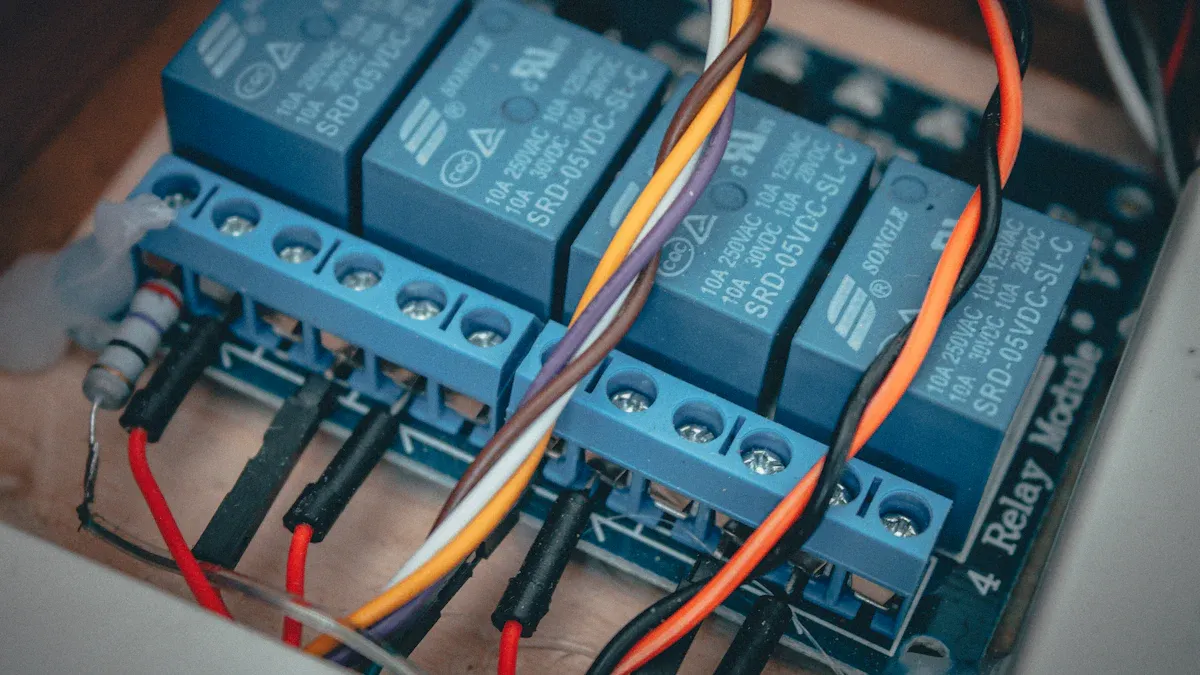
Definition and working principle
A standard relay is like a switch controlled by electricity. It connects a small power circuit to a bigger one. When electricity flows through the relay's coil, it makes a magnetic field. This field moves a lever that opens or closes the circuit. When the electricity stops, the relay goes back to normal.
Relays are useful for controlling big devices, like motors or lights, with small signals. They are simple, reliable, and very important in electrical systems.
Types of standard relays
Standard relays come in different types for specific jobs. Here are some common ones:
|
Relay Type |
What It Does |
Voltage Level |
Used In |
|---|---|---|---|
|
Electromechanical Relays (EMR) |
Sends data |
High Voltage |
Energy & Utilities |
|
Latching Relays |
Powers communication tools |
Low Voltage |
Industrial Automation |
|
Overload Protection Relays |
Protects circuits |
Medium Voltage |
IT & Data Centers |
|
Reed Relays |
Controls things from far away |
N/A |
Telecommunications |
|
Solid-State Relays (SSR) |
Switches signals fast |
N/A |
Transportation |
|
Time Delay Relays |
Adds a delay |
N/A |
N/A |
Electromechanical relays are popular because they work well and last long. Solid-state relays are better for quick switching and tough conditions.
Applications of standard relays
Standard relays are used in many industries. In cars, they control windows, lights, and engines. Factories use them to run machines and motors. Phones and internet systems use relays to send signals. Airplanes need special relays for safe and reliable operations.
The relay market is growing fast. For example, car relays might grow from $16.7 billion in 2025 to $25.0 billion by 2030. This shows how important relays are for cars and factories.

Relays are key to modern technology. They help systems work safely and efficiently.
Exploring timing relays
What are timing relays?

Timing relays control circuits with a set time delay. They don't work instantly like regular relays. Instead, they wait before turning circuits on or off. For example, they can keep a motor running for a few seconds after a switch is turned off. This helps the motor shut down smoothly.
Timing relays work in two main ways. First, there's "on-delay," where the relay waits before turning something on. Second, there's "off-delay," where it waits before turning something off. Imagine a float switch connected to a timing relay. When the float switch closes, the relay turns on right away. When the float switch opens, the relay waits before turning off. This shows how timing relays work.
Types of timing relays
Timing relays come in different types for specific jobs. Here's a simple table:
|
Type |
What It Does |
Used For |
|---|---|---|
|
On-Delay |
Waits before turning something on. |
Motors, lights |
|
Off-Delay |
Turns on right away but waits to turn off. |
Safety systems, machines |
|
One-Shot |
Sends one pulse for a short time. |
Testing tools, automation |
|
Flasher |
Switches on and off repeatedly. |
Signals, lights |
|
Multi-Function |
Does many timing tasks. |
Complex systems, automation |
|
Panel Mounted |
Easy to use on control panels. |
Factories, industries |
|
DIN Rail Mounted |
Fits neatly in control cabinets. |
Automation setups |
|
Plug-In |
Quick to install and replace. |
Safety tools, testing equipment |
Each type has its own use. On-delay relays are great for starting motors slowly. Flasher relays work well for blinking lights.
Where are timing relays used?
Timing relays are important in many industries. They help automate tasks and save energy. Here's a table of common uses:
|
Where They're Used |
What They Do |
|---|---|
|
Factories |
Run machines like conveyor belts and pumps. |
|
HVAC Systems |
Control fans and compressors to save energy. |
|
Lighting |
Turn building and streetlights on and off at the right time. |
|
Safety Systems |
Shut down equipment after a delay to prevent accidents. |
|
Motor Control |
Start and stop motors safely. |
|
Fire Alarms |
Delay alarms to avoid false alerts. |
|
Chemical Processing |
Time mixing and heating steps for better results. |
Timing relays are becoming more popular as industries focus on automation and energy savings. The market for these relays is expected to grow from $4.15 billion in 2023 to $6.1 billion by 2032. This shows how useful they are in modern systems.
Timing relays help make processes safer, faster, and more efficient. Knowing how they work can help you pick the right one for your needs.
Comparing timed relays and relays
Functional differences
Timed relays and standard relays work in different ways. Standard relays act like simple switches. They turn circuits on or off right away when signaled. Timed relays, however, have a built-in timer. This timer lets you delay turning circuits on or off. For example, a timed relay can keep a motor running briefly after the switch is off. This helps the motor stop smoothly.
Here's a quick comparison of their features:
|
Feature |
Timed Relay |
Standard Relay |
|---|---|---|
|
Built-in Timer Function |
Yes |
No |
|
Precision |
High for timing control |
Basic on/off control |
|
Application Areas |
Automation, lighting, etc. |
General circuits |
|
Energy Efficiency |
Saves energy by reducing operation time |
No energy-saving features |
Timed relays are great for tasks needing precise timing, like automation. Standard relays are better for simple jobs, like turning devices on or off.
Operational differences
Timed and standard relays also work differently. Standard relays act instantly. When signaled, they switch the circuit right away. Timed relays add a delay before switching. You can adjust this delay for specific needs, like starting a machine after a safety check.
Both types need to be reliable. Their lifespan is measured by Mean Time Between Failures (MTBF). Good relays can last hundreds of thousands to millions of uses. But things like heat and humidity can affect them:
Heat can stress parts and shorten their life.
Humidity can rust contacts, making them less effective.
Timed relays often have extra features to handle tough conditions. This makes them more durable in challenging environments.
Design and construction differences
The design of timed and standard relays shows their different purposes. Standard relays are simple. They have a coil, a magnetic core, and contacts. This makes them cheap and reliable for basic tasks.
Timed relays are more complex. They use electronic circuits or timers for delays. Some advanced models can do multiple tasks. For example:
A single relay can have both on-delay and off-delay functions.
Multi-function relays can flash, pulse, or time events in order.
Research shows that good relay settings improve safety and automation. For example, studies on 3-phase fault systems show how precise settings help protect systems. This proves timed relays are reliable for complex tasks.
Advantages and applications of timing relays

Benefits in automation and control systems
Timing relays are important for making automation systems better. They help control machines and devices at the right time. This reduces mistakes and makes things work more smoothly. For example, in lighting, timing relays turn lights on and off at set times. This saves electricity and lowers costs.
Here's a table showing how timing relays save energy in lighting:
|
Lighting Type |
Electricity Saved (%) |
Cost Savings (%) |
|---|---|---|
|
HL |
97.92 |
50.05 |
|
CFL |
95.27 |
N/A |
|
LED |
93.98 |
N/A |
|
Astronomical Relay |
49.31 - 50.52 |
N/A |
Using timing relays in automation systems can save energy and money. This makes them very useful in modern setups.
Examples of industrial and commercial uses
Timing relays are used in many industries and businesses. They are great for controlling processes with accuracy. Here are some examples:
Timing relays save energy by running HVAC systems only when needed.
They help in factories and car-making by keeping processes in sync.
Timing relays make safety systems work better, like in elevators and air conditioners.
These uses show how timing relays improve safety, save energy, and make systems run better.
Choosing timing relays over standard relays
When picking between timing and standard relays, think about your needs. Timing relays work well with modern automation tools like PLCs. They are more accurate and reliable.
In 2020, about 384,000 industrial robots were sold, a 12% rise from 2019. This growth in automation needs reliable tools like timing relays for safe and smooth operations.
Governments also support energy-saving tools. Timing relays help by cutting energy use and supporting green practices. New designs like IoT-enabled relays make them even better for the future.
Here's a table comparing timing relays to standard relays:
|
Aspect |
Timing Relays |
Standard Relays |
|---|---|---|
|
Automation Integration |
Works well with PLCs and systems |
Limited capabilities |
|
Reliability |
More accurate and dependable |
Basic reliability |
|
Market Growth |
Growing with automation industries |
Slower growth |
|
Industry 4.0 Use |
Fits smart manufacturing goals |
Less focus on new tech |
Choosing timing relays prepares your systems for modern automation and energy-saving needs.
Picking the best relay for your needs
Important things to think about
Choosing a relay needs careful thought. First, check its safety features. Look for things like encryption and secure bootloaders. These keep your system safe from hackers. Scalability is also important. A good relay should handle many connections without slowing down. This is helpful in big systems.
Make sure the relay follows local rules. This avoids fines and keeps it legal. Think about long-term costs too. Check how long the relay lasts, how much energy it uses, and if it needs repairs. Testing the relay is key. Try it in real situations to see if it works well. Also, pick a trusted brand with good customer support. Lastly, choose a relay that can work with future technology. Relays that can be upgraded are better for modern systems.
Tips for choosing a relay
Knowing the contact material helps you pick the right relay. Here's a simple table:
|
Contact Material |
What It's Good At |
Best Uses |
Problems |
|---|---|---|---|
|
Silver Alloy |
Strong and conducts well |
Everyday relays |
Can stick under heavy loads |
|
Gold Plated |
Doesn't rust |
Low-power tasks |
Costs more, not for heavy loads |
|
Copper |
Cheap and conducts well |
High-power tasks |
Rusts easily, less strong |
Silver alloy is great for most jobs. Gold-plated contacts are best for small currents. Copper works for big currents but needs care.
To pick the right relay, think about your system's needs. For automation, get relays with timing features. For heavy tasks, choose relays with strong materials. Always test the relay to make sure it fits your setup. By doing this, you'll find a relay that works well and improves your system.
Timing relays and regular relays have different jobs in systems. Timing relays are great for tasks needing exact timing, like saving energy or automating machines. Regular relays work instantly, so they are better for simple jobs. Knowing these differences helps you pick the right relay.
New research shows modern relays, like advanced overcurrent relays, work better than older ones. These new designs show why timing relays are important in complex setups. Choosing the right relay can make systems safer and work more efficiently.
FAQ
What's the key difference between timing relays and regular relays?
Timing relays have a built-in delay feature. This lets you control when circuits turn on or off. Regular relays work instantly without any delay. Timing relays are better for tasks needing exact timing.
Can you change the delay time on a timing relay?
Yes, most timing relays let you adjust the delay. You can set it for seconds or minutes based on your needs. This makes them useful for many automation tasks.
Where are timing relays often used?
Timing relays are used in factories, HVAC systems, and lighting setups. They help run conveyor belts, delay fans in air conditioners, and control streetlights.
Are timing relays pricier than regular relays?
Timing relays usually cost more because of their advanced features. But they save energy and improve efficiency, making them worth the investment.
How do you pick the right relay for your system?
Think about what your system needs. Use timing relays for tasks needing delays. Regular relays are good for simple on/off jobs. Check the relay's details to make sure it fits your setup.