


Relays are important in motor control because they let small signals control big motors. Motors can have problems like too much current, sparks at contacts, and starting by mistake. Engineers use relays to fix these problems and keep circuits safe.
- Overload relay circuits stop motors from getting hurt by too much current.
- The right relays can handle sparks, especially when motors use capacitors.
- Plug-in relays are still used a lot in factories because they work well and save money, even with new technology.
Key Takeaways
- Relays help small control signals turn motors on and off. They keep circuits safe from high voltage and current.
- Relays can find problems like overloads and phase loss fast. They stop motors to keep them safe from damage or fire.
- Relays make motor control easier. Low-power switches can run big motors. This makes things safer and saves energy.
- There are different relays for different jobs. Electromechanical relays work for most small motors. Contactors are for big machines. Solid-state relays switch fast and are quiet.
- Picking the right relay saves money, space, and time on repairs. It also helps motors work well and stay safe.
Relay Basics
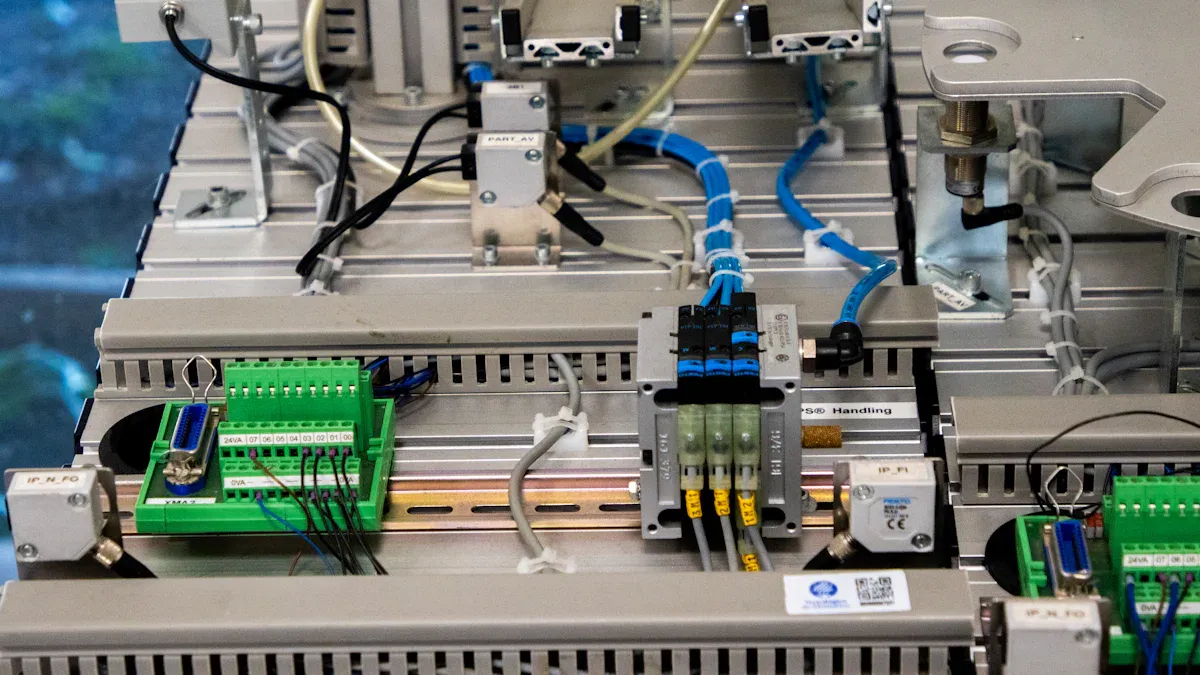
What Is a Relay
A relay is a type of switch that uses electricity to work. It lets a small signal turn a bigger circuit on or off. People use relays to control things like motors with less power. This helps keep the control circuits safe from high voltage and current in motor circuits. The main parts of an electromechanical relay are:
| Component/Section | Description |
|---|---|
| Input Section | This is where the small control signal goes in. |
| Control Section | The coil here gets power when the control signal is used. |
| Output Section | The armature and contacts move to open or close the circuit. |
| Operating Principle | The coil makes a magnetic field when powered. This pulls the armature and moves the contacts. The circuit turns on. When the signal stops, a spring moves the armature back. The contacts open and the circuit turns off. |
This table explains what each relay part does. The input section gets the control signal. The control section uses a coil to make magnetism. The output section has contacts that open or close the circuit. The operating principle tells how the relay switches the circuit.
How Relays Work
A relay lets a small signal control a bigger circuit. The coil inside gets power from the control signal. This makes a magnetic field that moves the armature. The contacts close and let power go to the motor or device. Relays keep the control circuit and power circuit apart. This keeps important parts safe from high voltage spikes. If a surge happens, the relay might break, but the main control stays safe. This setup lets different voltages work together without touching.
- Relay response times are set by the maker. This helps keep motors safe and working well.
- Fast relay action can stop stress on motors by controlling start and stop.
- In safety systems, relays must act fast to protect people and equipment.
- Heat or wear can change how fast a relay works, so testing is needed.
Note: Relays help control motors safely by keeping control and power circuits apart and by acting fast when needed.
Relay Advantages
Safety and Protection
Relays help keep motors and circuits safe. They can find many electrical problems fast. When something goes wrong, like too much current, relays act quickly. They can turn off the motor before it gets damaged. This quick action helps stop fires and keeps equipment safe.
| Fault Type | Description | Relay Type / Protection Method |
|---|---|---|
| Earth Fault | A motor wire touches a grounded part, causing high currents and damage. | Earth fault relays trip to prevent hazards. |
| Winding Failure | Motor windings break down or short out. | Differential protection relays trip on current changes. |
| Overload | Too much current flows, causing overheating. | Overload relays interrupt the circuit. |
| Overcurrent | High current from overload or short circuit. | Overcurrent relays trip to prevent damage. |
| Phase Imbalance | Unequal current or voltage in motor phases. | Phase sequence detection relays trip if imbalance occurs. |
| Phase Loss | One or more phases are lost, risking motor damage. | Phase loss detection relays trip the motor. |
| Voltage Fluctuations | Overvoltage or undervoltage harms the motor. | Voltage relays protect against variations. |
| Reverse Rotation | Motor runs in the wrong direction. | Reverse rotation protection relays trip. |
| Bearing Failures | Mechanical failures cause vibration and heat. | Advanced relays with sensors detect early signs. |
| Overheating | Temperature rises too high. | Thermal overload relays trip on heat rise. |
Relays also help stop electrical fires. They watch the current and voltage all the time. If they find a problem, they turn off the circuit breaker. This stops things from getting too hot and hurting the wires. Some relays let people check them from far away. This helps workers find problems early and keep things safe.
Tip: Relays in motor circuits help meet safety rules. They switch reliably and make it easy to check for problems. This is important for safe use.
Efficient Control
Relays make it easier to control motors. They let a small switch run a big motor. This means you can use a low-power button to start or stop a machine. You do not have to touch high voltage. This makes things safer and lowers the chance of shock.
- Relays help machines run only when needed. This saves energy and makes motors last longer.
- Double throw relays can control two things at once. This means less wiring and fewer parts. It makes the system easier to fix.
- In factories, relays let people control machines from far away. Workers can watch and change motors from one place. This makes work safer and faster.
Relays also make wiring simpler. One relay can do the job of many switches. This saves space and money. It also makes the system easier to build and repair.
Durability and Cost
Relays are strong and not too expensive. Electromechanical relays cost less and work well for most jobs. They can last for hundreds of thousands of uses if used right. Solid-state relays last even longer because they have no moving parts. They can work for millions of cycles but cost more at first.
| Cost Factor | Electromechanical Relays | Solid-State Relays |
|---|---|---|
| Initial Purchase Price | Lower | Higher |
| Operational Lifetime | Low hundreds of thousands of operations | Tens of millions of operations |
| Maintenance, Repair, Operations (MRO) Costs | Higher due to wear and contact issues | Lower due to no contact wear or arcing |
| Price Trend | Stable or increasing | Decreasing, approaching price parity |
| Size and Power Loss | Larger size, higher power loss | Smaller size, lower power loss |
Relays save money in other ways too. They lower wiring and building costs, especially with relay boards. Their simple design makes them easy to change or upgrade. For many motor systems, relays are a good choice. They balance cost, safety, and how well they work.
Motor Operation Benefits
Smooth Start and Stop
Motors need to start and stop in a safe way. If you switch them on or off directly, it can cause big power surges. This can also hurt the motor parts. Special switching devices help fix these problems.
- These devices connect the auxiliary winding in motors. This gives extra power when starting. The auxiliary winding is set at a different angle from the main winding.
- When the motor starts, the device sees high current in the main winding. It closes contacts to send power to the start winding. This helps the motor start without jerking.
- When the motor gets to full speed, the current goes down. The device turns off the start winding. This stops the motor from getting too hot or breaking.
- The switching device can handle big currents. It keeps the main switch and wires safe from damage.
- The start winding only gets power when starting. This keeps it from running too long and getting hurt.
- Some devices reset by gravity or other ways. This makes sure the start winding does not stay on by accident.
This way, motors run smoother and safer. It also helps switches and wires last longer.
| Mechanism | Description |
|---|---|
| Solid-State Switches | Use electronic parts to switch at the right time, lowering stress. |
| Heavy-Duty Contactors | Use strong parts to cut down sparks when switching big currents. |
| Overload Protection | Watch the current and turn off the motor if it gets too hot or uses too much power. |
| Mechanical Shock Guards | Turn off when there is a sudden force, keeping the motor safe. |
| Reset and Test Functions | Let people test and reset the system safely, even in risky places. |
Note: Starting and stopping motors in a controlled way keeps them and the wires safe.
Multi-Speed Control
Some machines need motors to run at different speeds. Special switching devices help pick between set speeds. These devices cannot change speed smoothly, but they can switch between a few speeds.
- The switching device cannot change speed quickly or smoothly.
- It can change which way the motor spins or pick a speed by changing the circuit.
- For more than one speed, it switches between resistors, transformer taps, or power lines.
- Smooth speed changes use electronic parts like transistors or MOSFETs. The switching device only picks direction or rough speed.
- The device works with electronic controllers to change direction, while the controller changes speed.
- The device wears out fast if used for quick switching, so it is not used for fine speed control.
- The motor should stop before changing direction to avoid big power surges.
- Electronic circuits like H-bridges use transistors for smooth speed control. The switching device is too slow for this job.
- The device can switch between forward, brake, and reverse, but not give smooth speed changes.
- For real speed control, electronic parts are needed. The switching device only helps with simple switching.
Switching devices are cheap, reliable, and flexible for basic multi-speed setups. They have limits like slow switching, wearing out, and making noise. They are good for simple jobs but not for tricky or exact speed control. Better systems use electronic controllers for best results.
Relay vs. Alternatives
Relays vs. Contactors
Relays and contactors both help control motors. They are used for different jobs. Contactors are best for big, powerful machines in factories. They can handle large motors and lots of switching. They work well in tough places. Relays are better for smaller jobs. They are used in home systems or for automation. Relays are smaller and cost less. They can be used in more ways.
| Parameter | Contactor | Relay |
|---|---|---|
| Load Capacity | High-current, high-power (industrial motors, heavy machinery) | Lower current, usually below 15 amperes, often single-phase |
| Design and Construction | Large, robust, with arc suppression for frequent switching | Compact, less robust, plastic enclosure, for control and automation |
| Contact Configuration | Usually normally open contacts | Can be normally open or normally closed |
| Durability and Lifespan | Long lifespan, durable under heavy use | Shorter lifespan, contacts wear faster under heavy use |
| Size and Cost | Larger, more expensive | Smaller, more cost-effective |
| Application Scope | Industrial/commercial, large loads, three-phase power | Control systems, automation, low-power, single-phase |
| Maintenance | More maintenance needed | Less maintenance required |
| Electrical Noise | More noise due to higher currents | Less noise, good for sensitive electronics |
Contactors are used for things like conveyors and pumps. They also control big air systems. Relays are used for smaller things. They can turn on lights or small motors at home. Solid-state relays are another choice. They switch very fast and have no moving parts. They last a long time and do not need much care. Solid-state relays are quiet and do not bounce. But they cost more money. Sometimes they need extra cooling.
| Aspect | Mechanical Relays | Solid-State Relays (SSRs) |
|---|---|---|
| Switching Speed | Slower, moving parts | Fast, no moving parts |
| Reliability | Reliable, but contacts wear out | Very reliable, no wear |
| Maintenance | Needs regular checks | Minimal maintenance |
| Noise | Clicking sound | Silent |
| Lifespan | Shorter, wears out | Longer, solid-state design |
| Cost | Lower | Higher |
| Isolation | Galvanic isolation | Electrical isolation |
Note: Pick relays, contactors, or solid-state relays based on power, place, and how often you need to switch.
When to Use a Relay
A relay is best for control systems with low or medium power. It works well in home automation and small machines. Relays are good when you do not have much space. They are also good if you want to save money. Relays are best if you do not need to switch on and off a lot.
- Use a relay for:
-
- Small motors or devices
- Panels that do not have much space
- Jobs that need both types of contacts
- Electronics that need low noise
Contactors are for big motors and heavy machines. Solid-state relays are for fast, quiet, and no-maintenance jobs, but they cost more.
Tip: Always pick the right device for your job. Think about power, speed, space, and money before you choose.
Motor control systems use devices that keep things safe and work well. These devices are used in homes, cars, and small machines.
- They can start, stop, and reverse motors easily.
- Their small size and shape help them fit many uses. Experts say to use these devices for overload, phase loss, and arc-flash safety. They help stop problems and protect people and equipment.
FAQ
What does a relay do in a motor circuit?
A relay acts as a switch. It lets a small control signal turn a motor on or off. This keeps the control circuit safe from high voltage and current.
What types of relays work best for motors?
Electromechanical relays and solid-state relays both work well. Electromechanical relays suit most small motors. Solid-state relays last longer and switch faster, but cost more.
What problems can relays help prevent in motors?
Relays help stop overloads, short circuits, and phase loss. They protect motors from damage by cutting power when trouble happens.
What is the difference between a relay and a contactor?
A relay handles small loads and works in control circuits. A contactor controls large motors and heavy equipment. Contactors are bigger and stronger.
What should someone check before choosing a relay for a motor?
Check the motor's voltage and current. Make sure the relay can handle these values. Look at the relay's size, cost, and how often it will switch.