


A relay delay function makes a relay wait before turning on or off. Think about pressing a light switch, but the light comes on after a short wait. It works like a timer. This delay lets you control when machines start or stop. Timing relays help keep systems safe and work better in many industries.
|
Industry |
How Delay Helps |
Impact on Efficiency |
|---|---|---|
|
Manufacturing |
Equipment starts and stops smoothly |
Fewer problems and more trust in machines |
|
Automotive |
Controls when systems do things |
Cars are safer and work better |
|
Energy |
Delays keep equipment safe |
Power systems work better and break less |
Have you ever wondered how things turn on or off at the right time? Relay delay functions make this happen.
Key Takeaways
Relay delays work like timers. They make devices wait before turning on or off. This helps control when machines start or stop.
Using relay delays makes things safer and more efficient. Many industries use them, like manufacturing and automotive.
You can change the delay time on many relay circuits. This lets you control things in home automation and other uses.
Relay delays help protect equipment. They stop sudden starts and stops. This keeps machines from getting damaged or wearing out fast.
People use relay delays in automatic doors, HVAC systems, and safety alarms. These delays help technology work better every day.
What is a relay delay?
Simple definition
A relay delay is like a smart switch. It waits before turning something on or off. You can set how long it waits. This lets you control when things happen. Time delay relays have a timer inside. They do not act right away. They wait for a set time before switching. Regular relays work as soon as they get a signal. Time delay relays add a pause before they act. This gives you more control.
Here is a table that shows how different relays work:
|
Relay Type |
Timing Mechanism |
|---|---|
|
Standard Relay |
Works right away when it gets a signal. |
|
On-Delay Relay |
Starts timing when power is on; closes after waiting. |
|
Off-Delay Relay |
Starts timing when power is off; stays closed for a while before opening. |
Relay delay functions help things happen at the right time. This makes machines work better. It also keeps systems safe.
Everyday analogy
Think about walking into a room and pressing a button for the fan. The fan does not start right away. It waits a few seconds before spinning. That wait is the relay delay working. You might see this in stores. Fans or lights do not turn on instantly. The delay stops machines from starting and stopping too fast.
Tip: You can find relay delays in automatic doors, heating systems, and some car parts. These delays help things run smoothly. They also stop devices from wearing out too quickly.
Here is a table with common relay delay scenarios:
|
Relay Type |
Functionality |
Common Application |
|---|---|---|
|
Delay on Make (DOM) |
Turns on after waiting when the signal is sent. |
Stops motors from starting too often, like store fans. |
|
Delay on Break (DOB) |
Turns on after waiting when the signal is gone. |
Controls lights with a quick switch. |
Relay delays are everywhere. You may not notice them. They help devices work at the right time. They also protect equipment from breaking.
Why use relay delay?
Benefits
Relay delay gives you many good things. It helps you control when machines turn on or off. You can make sure things happen in the right order. For example, in automation, one machine starts after another. Relay delay makes this simple.
Relay delays help with timed steps and process order.
They work in automation, HVAC, and lighting controls.
You can set a wait time before a circuit opens or closes. This helps stop sudden starts or stops.
Note: Relay delays protect your equipment. They stop machines from turning on or off too fast. This lowers damage and helps devices last longer.
Relay delays also make electrical systems safer. The table below shows how they help:
|
Functionality |
Description |
|---|---|
|
Time delay functionality |
Waits before connecting or disconnecting a circuit for a set time. |
|
Protection control |
Waits before disconnecting during problems, giving time to fix things. |
|
Safety control |
Turns on alarms or safety devices, giving people time to act. |
|
Advantages |
Makes the whole system safer and more reliable. |
Common uses
Relay delays are used in many places. They help control machines and keep things working well. Here are some common uses:
Conveyor belts use relay delays to start and stop in order.
Motor systems use delays so all motors do not start at once.
Lighting systems use relay delays to turn lights on or off after waiting.
You also see relay delays in home automation, heating and cooling, and safety alarms. These delays help save energy, protect equipment, and keep people safe.
How relay delay works
Basic principle
A relay delay acts like a timer for circuits. When you send a signal, the relay does not switch right away. It waits for a set time before it changes. This waiting time is what makes relay delay different.
Here is how a relay delay circuit works:
The relay gets a signal, like voltage or a button press.
The timing part inside the relay starts working.
The timer counts down the delay you set. The relay stays in its first state during this time.
When the delay ends, the relay switches its contacts. This lets electricity flow or stops it.
The relay stays in this new state until the signal goes away or something else happens.
Some relays let you reset the timer before the delay is over.
This process helps you control when things turn on or off. It makes your systems safer and more reliable.
Types of relay delay
There are different types of relay delay circuits in electronics. Each type uses its own way to make the delay. Here is a table that shows some common types and how they work:
|
Type of Delay Circuit |
Description |
|---|---|
|
RC Delay Circuit |
Uses a capacitor and resistor to set the delay. The capacitor charges and discharges to control timing. |
|
555 Timer Circuit |
Uses a special chip to create longer or more precise delays. |
|
Monostable Delay Circuit with Op-Amp |
Produces a single timed pulse when triggered. |
|
Long-Delay Circuit with Two 555 Timers |
Combines two timer chips for even longer delays. |
|
Transistor Delay Circuit |
Uses transistors to manage when the relay turns on or off. |
You might also hear about electromagnetic and electronic relay delays. Electromagnetic relays use coils and moving parts. Sometimes they have a shock absorber to slow down movement. Electronic relays use circuits, like RC or timer chips, to control the delay more exactly.
Timing mechanisms
Timing mechanisms are the main part of relay delay circuits. They decide how long the relay waits before switching. One common way is the RC charge-discharge circuit. Here is how it works:
The RC circuit uses a resistor and a capacitor.
The capacitor charges up when power is on. The resistor slows down how fast it charges.
A bigger capacitor means a longer delay. The resistor also changes how slow or fast the charging is.
The time it takes for the voltage to reach a certain level sets the delay. You can figure this out using the RC time constant.
You can change the delay by using a different resistor or capacitor.
Some timing mechanisms use timer chips, like the 555 timer. These chips give you more control over the delay. They can make longer or more exact timing.
Note: Standard relays switch right away when they get a signal. Time delay relays wait for the set time before switching. This difference helps you pick the right relay for your needs.
Here is a table that shows the difference in response time:
|
Relay Type |
Response Time Description |
|---|---|
|
Standard Relay |
Operates right away when it gets an electrical signal. |
|
Time Delay Relay |
Waits before turning on or off its contacts. |
Relay delay circuits help devices turn on or off at the right time. This keeps your equipment safe and helps everything work well.
Relay delay components
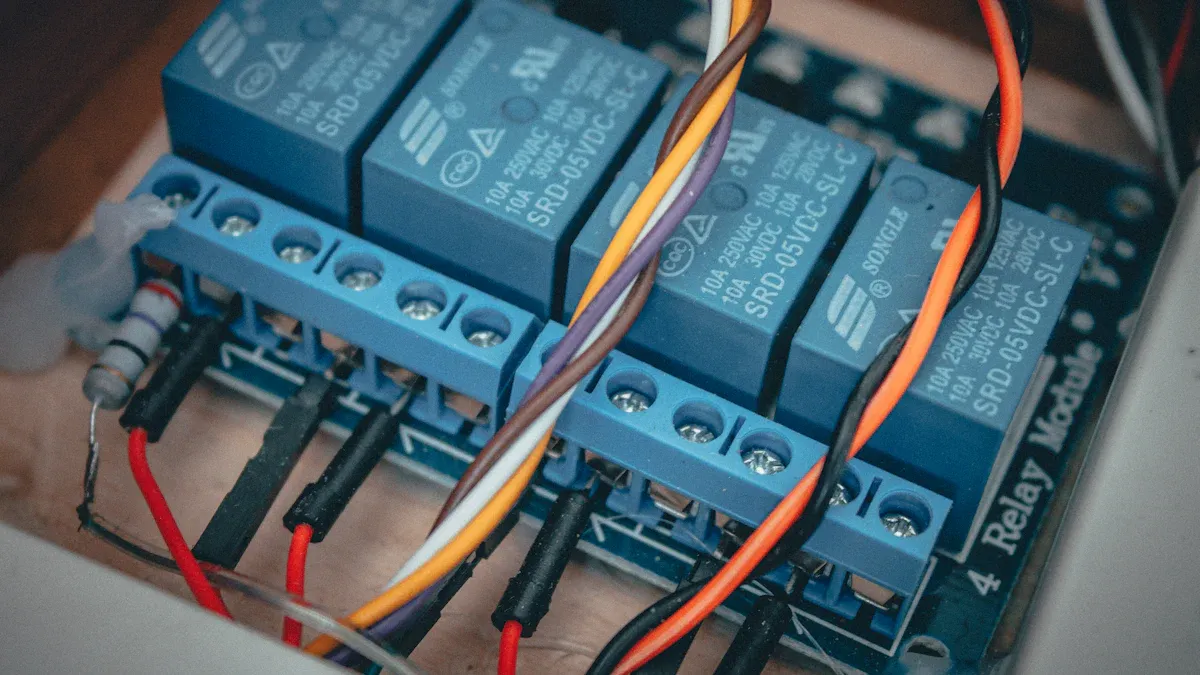
Relay
The relay is the main switch in the relay delay circuit. It controls when electricity goes to your device. The relay listens to signals from the timer circuit. You need to pick a relay that fits your needs. The right relay keeps your system safe and working well.
Here is a table to help you choose the best relay for your project:
|
Factor |
Description |
|---|---|
|
Timing Function |
Pick the right mode for your job, like On-Delay or Off-Delay. |
|
Voltage & Power |
Make sure the relay's voltage matches your power supply. |
|
Contact Configuration |
Choose the contact type that can handle your device. |
|
Timing Range & Accuracy |
Get a relay with the timing and accuracy you want. |
|
Environmental Protection |
Look for protection from dust, water, and shaking. |
|
User Interface |
Find relays with easy dials or screens to set the time. |
Temperature and humidity can change how your relay works. Hot weather may make timing wrong. Cold weather can slow down the relay. Wet air can put water inside the relay and make it act weird.
Timer circuit
The timer circuit decides how long the relay waits before switching. Timer circuits use parts like transistors, capacitors, and diodes. These parts work together to make a delay. You can change the delay to fit what you need. Some timer circuits let you set a delay for turning on. Others let you set a delay for turning off.
Timer circuits are easy and cost less than other timing choices. You do not need a fancy controller for most relay delay jobs.
Power source
Every relay delay circuit needs a power source. The power source gives energy to the relay and the timer circuit. You must match the power source to the relay's voltage and current. If you use the wrong power, your circuit might not work or could break.
Relay delay circuits usually cost less than special controllers.
You can set them up fast for simple timing jobs.
Fancy controllers cost more and need special skills.
Always check your power source and make sure it works well where you use it. Changes in weather can affect how your circuit works.
Setting up relay delay
Simple example
You can set up a basic relay delay circuit at home with just a few parts. Imagine you want your hallway light to turn on a few seconds after you press the switch. Here is how you can do it:
Gather your materials. You will need a MOSFET (like IRF3205), a capacitor, two resistors, and some jumper wires.
Assemble the circuit by following a simple schematic. Connect the MOSFET, capacitor, and resistors as shown in the diagram. Use jumper wires to make the connections.
Test your setup. Add a button to connect the positive rail to the signal input. Attach an LED and a resistor to the output. When you press the button, the LED should light up after a short delay, then fade out.
Tip: After you build the circuit, test it a few times. Try adjusting the capacitor or resistor values to change the delay. This helps you see how timing works in real life.
You can check if your relay delay circuit works by running a calibration test. Activate the circuit and make small changes to the delay. Watch how the light responds. This helps you make sure the delay is accurate.
Troubleshooting tips
Sometimes, relay delay circuits do not work as expected. Here are some steps you can follow to find and fix problems:
Make sure you understand how your relay should work. Check the model and settings.
Look at the power supply. Make sure all connections are tight and there are no loose wires.
Review the relay's settings. Double-check the time delay and pick-up settings.
Inspect the input and output circuits. Make sure everything is connected correctly.
If you still have trouble, check for any event logs or fault records. These can show patterns or problems.
Try simulated tests to see how the relay acts under different conditions.
Keep your relay clean and check for corrosion. Clean contacts help prevent overheating.
Use surge protection to guard against voltage spikes.
Note: Always choose a relay that matches your needs. Regular maintenance, like checking connections and keeping the relay clean, helps your circuit last longer.
Relay delay functions let you choose when devices turn on or off. They help make machines safer and more dependable.
Time delay relays wait before switching, but standard relays do not.
You can set the delay time to match what you need. This is good for home automation and saving energy.
If you know how relay delays work, you can pick the best products for your home or projects.
Here are some ways people use relay delays:
|
Application |
Benefit |
|---|---|
|
Manufacturing plants |
Fewer mistakes and smoother running |
|
HVAC systems |
Cleaner air and less harm to equipment |
|
Safety alarms |
Gives people more time to react |
Look for relay delays in things you use every day. When you learn about them, using technology gets much easier!
FAQ
What is the main purpose of a relay delay?
You use a relay delay to control when a device turns on or off. This helps you protect equipment and make sure things happen in the right order.
Can you adjust the delay time on a relay?
Yes! Many relay delay circuits let you set the delay time. You can turn a dial, change a setting, or swap out a part to get the timing you want.
Where do you see relay delays in everyday life?
You find relay delays in elevators, automatic doors, heating systems, and even some cars. These delays help devices work smoothly and safely.
Do relay delays save energy?
Relay delays can help you save energy. They stop machines from running too long or starting too often. This means less wasted power and longer-lasting equipment.
See also
What is the minimum pull in voltage? Engineer's Guide to Relay Specs
What is the Pull in Voltage of the Relay? Engineer's Guide 2025
What do the pull in voltage and release voltage of a relay mean?
Application of Relays in Solar Power Generation Systems