


Imagine you want to run a big machine with a tiny switch. Relays help you do this in control panels by performing the function of the relay. You use relays to keep equipment safe from problems and too much power. Relays also help you do jobs automatically and make fewer errors. The relay's job is to find strange problems, watch the load, and keep voltage steady. Relays must follow strict safety rules to keep electrical systems safe and working well. If you know how relays work, you can stop damage and keep your system working right.
Key Takeaways
Relays help you use small signals to control big machines. This keeps you safe from dangerous high voltages.
Relays in control panels help do jobs automatically. They lower mistakes and make electrical systems safer.
Relays keep control circuits safe from high-power loads. They give electrical isolation to protect low-power circuits.
Picking the right relay for voltage and current is very important. It helps the system work well and stay safe.
You should check relays often for dust and worn parts. This keeps them working well and helps keep everyone safe.
Relay basics and operation
What is a relay
A relay helps turn a circuit on or off in a control panel. It does not need you to flip a switch by hand. Instead, it uses an electrical signal to work. This lets you control big machines or lights from far away. You do not have to touch the high-power parts. A relay is an electrically operated switch. It has input terminals for the control signal. It also has contact terminals for the circuit you want to control. Relays are used where safety and automation are important.
How relays work
A relay works using an electromagnetic switch. This means a small signal can control a big circuit. Here is what happens:
You put voltage on the relay's coil. The coil gets current and makes a magnetic field.
The magnetic field pulls a lever called the armature toward the coil.
The armature moves and opens or closes the relay's contacts. This turns the circuit on or off.
When you stop the voltage, the magnetic field goes away. A spring pushes the armature back to where it started.
Tip: This keeps you safe because you do not touch high voltages.
Key components
A relay has some main parts:
Coil: This part gets the control signal and makes the magnetic field.
Armature: This lever moves when the magnetic field is made.
Contacts: These metal parts open or close the circuit.
Spring: This pushes the armature back when the coil is off.
Input terminals: You connect the control signal here.
Output contacts: These go to the device or circuit you want to control.
All these parts must work together for the function of the relay. Each part helps with switching, isolating, and protecting your electrical system.
Function of the relay in control panels
Switching circuits
Relays help turn circuits on and off in control panels. This is a main job of the relay. You can use a small signal to control big machines or lights. Relays let you work with high-current circuits without touching dangerous power. In factories, relays control many devices at once. They are important in relay logic and ladder logic circuits. DIN mounted relays are easy to see in these panels. They help automate work and lower mistakes.
Relays turn on motors, pumps, and lights.
They help with relay logic and ladder logic for automation.
DIN mounted relays make setup and fixing easier.
Relays help with automation in many places. In factories, relay modules run machines and robot arms. In smart buildings, relays control lights and HVAC to save energy. In solar power systems, relays connect or disconnect solar panels. In electric cars, relays safely switch high-voltage systems. In smart homes, relays turn on lights and fans.
Electrical isolation
Relays also give electrical isolation. This means they keep the low-power control circuit away from the high-power load circuit. When you send a small signal, the relay uses an electromagnet to move a switch. This opens or closes the contacts in the high-power circuit. You stay safe because the control side never touches the dangerous voltage. This setup keeps you and your equipment safe from electrical problems.
Note: Electrical isolation protects the control system from faults or surges in the power circuit.
Protection and safety
Relays also help with protection and safety. They watch electrical things like voltage, current, and frequency. If something goes wrong, like a short circuit or overload, the relay finds the problem. It sends a signal to a circuit breaker, which shuts off the bad part of the system. This fast action stops damage and keeps the rest working.
Protection relays look for problems.
They tell circuit breakers to trip when needed.
This teamwork keeps the system safe and working well.
You must follow safety rules when using relays in control panels. UL508A certification is needed for panels that run at 1,000V or less. This rule covers boxes, overcurrent protection, switches, and more. Underwriters Laboratories (UL) gives this certification to make sure your panel is safe. Other rules like UL 60947-4-1 and IEC/UL 61810-1 also matter when you design and use relays. These rules help you build safe and strong control panels for any place.
|
Standard |
Covers |
|---|---|
|
UL 60947-4-1 |
Equipment with main contacts for circuits up to 1,000 V a.c. or 1,500 V d.c. |
|
UL 508 |
Old important rule for industrial control panels, now not used. |
|
IEC/UL 61810-1 |
World rule for electromechanical relays, matches IEC. |
Relays in protection systems need to talk fast and well with other devices. The relay is like the "brain" and makes choices based on what it sees. The circuit breaker is like the "muscle" and does what the relay says. This teamwork keeps your electrical system safe and working right.
Types of relays used
Electromechanical relays
Electromechanical relays (EMRs) are found in control panels a lot. These relays use moving parts to open and close circuits. You can trust them for many switching jobs. EMRs work with different voltages and currents. This makes them good for many uses. They also give strong electrical isolation. This protects sensitive parts from harm.
Here are some pros and cons of EMRs:
|
Advantages |
Disadvantages |
|---|---|
|
Reliability: Lasts a long time |
Limited Switching Speed: Slower than solid-state relays |
|
Isolation: Keeps sensitive parts safe |
Mechanical Wear and Tear: Parts get tired over time |
|
Flexibility: Works with many voltages and currents |
Physical Size and Weight: Bigger and heavier than solid-state relays |
|
Ease of Replacement: Easy to swap out |
Acoustic Noise: Makes clicking sounds when working |
|
No Power Consumption: Uses no power when not switching |
Limited Long-Term Reliability: Wears out as it ages |
You might hear a click when an EMR switches. This sound is normal and means the relay is working.
Solid-state relays
Solid-state relays (SSRs) use electronic parts, not moving ones. SSRs switch faster and do not make noise. They last longer because there are no parts to wear out. You can use SSRs where you need quiet or fast switching.
|
Feature |
Solid State Relay (SSR) |
Electromechanical Relay (EMR) |
|---|---|---|
|
Switching Speed |
Microseconds |
Milliseconds |
|
Durability and Lifespan |
Lasts longer, no moving parts |
Mechanical wear limits lifespan |
|
Noise and Interference |
Works silently |
Makes clicking sounds |
|
Electrical Isolation |
Uses optical isolation |
Uses standard isolation |
|
Power Consumption |
Uses less power |
Uses more power |
|
Heat Dissipation |
May need cooling |
Makes little heat |
Tip: SSRs are good in tough places and do not have contact bounce. They can last for millions of cycles.
Time-delay relays
Time-delay relays help control when circuits turn on or off. You use them to set delays for starting or stopping machines. These relays are used in many places:
|
Application Area |
Description |
|---|---|
|
Industrial automation |
Controls when conveyor belts and machines start or stop. |
|
HVAC systems |
Stops compressors from cycling too fast and controls fans. |
|
Lighting control |
Keeps lights on for a set time and helps with emergency lights. |
|
Automotive applications |
Controls wipers and defoggers. |
|
Security systems |
Delays alarms and controls door locks. |
|
Home appliances |
Times washing and cooking cycles. |
|
Power management |
Controls when loads and generators run. |
|
Process control |
Times chemical reactions and water treatment. |
|
Switchboards |
Times when circuit breakers work. |
Time-delay relays help machines run in the right order and for the right time.
Overload and protective relays
Overload and protective relays keep equipment safe. They watch for problems like too much current or overheating. If something goes wrong, these relays break the circuit to stop damage.
|
Role of Overload and Protective Relays |
Description |
|---|---|
|
Prevent overheating and electrical overloading |
Finds and fixes problems, so power interruptions are less. |
|
Extend equipment lifespan |
Watches system to keep machines safe. |
|
Protect motors from damage |
Watches current and breaks the circuit if overloaded. |
Overload relays break the circuit if current gets too high.
You connect them in series with motors to stop overheating.
Note: Picking the right relay helps keep your control panel safe, reliable, and efficient.
Relays for safe and efficient operation
Motor control
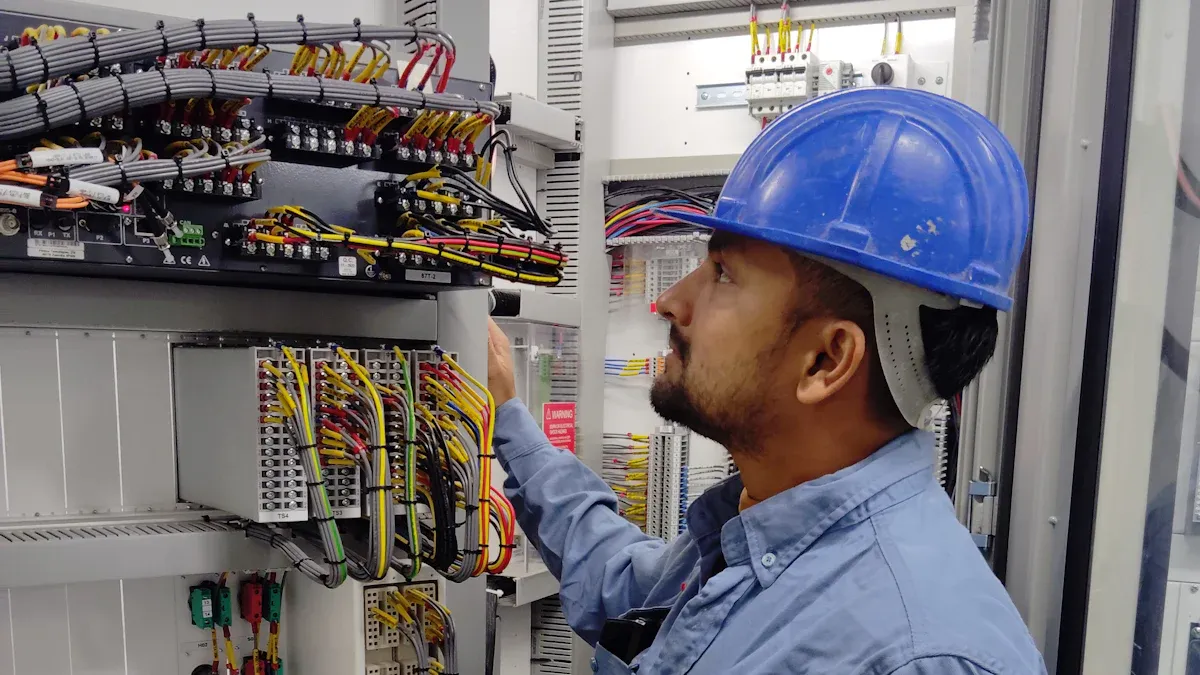
Relays help control motors in control panels. They let you start and stop motors safely. You do not have to touch high voltage. Relays stop too much current and short circuits by turning off bad parts. This keeps people and machines safe. Strong relay panels help motors work well in many places.
Relays turn off broken circuits to stop damage.
This lowers danger for workers and machines.
Good relay panels help motors work in tough places.
Tip: Pick relays with the right voltage and current for your motors.
Emergency shutdown
Relays are important in emergency shutdown systems. They can quickly turn off all power to machines. For simple machines, relays cut power right away. For bigger systems, relays help you shut down safely. Many relays have safety features and approvals for shutdown jobs.
|
Feature |
Description |
|---|---|
|
Approval |
cULus approval |
|
Application |
Tank overfill protection, shutdown controls for refineries and oil/gas storage |
|
Modes |
Energize-to-safe or de-energize-to-safe |
|
Safety Switching |
On/off actuator safety switching |
|
Specific Use |
SIL3 fuel cut-off relay for burner management |
|
Size |
22 mm wide, DIN-rail mountable |
|
Connectors |
Pluggable field connectors for easy removal |
|
Status Indication |
Front status indication |
|
Fuse |
Externally accessible fuse |
|
Temperature Range |
-25°C to +50°C |
Emergency stop circuits turn off machines fast.
Safe shutdowns keep people and equipment safe.
Separate controls help you keep control in emergencies.
Automation examples
Relays help you automate things in control panels. You can use them to start or stop motors and control lights. Relays add safety like overload protection and emergency stops. Some relays have timers and sensors for better control. When you use relays for routine jobs, you do not need to do as much by hand. This lowers mistakes. New relays have tools to find problems fast and cut down on lost time.
Start and stop motors with relays.
Control lights and other things easily.
Timers and sensors give you more control.
Add overload and emergency stop features.
Automate jobs to save time.
Lower mistakes for better results.
Use tools in relays to find problems and fix them fast.
Industrial control panels use relays to help you control machines. You can watch what is happening in real time. This helps you make good choices and keep things running well.
Relays help keep control panels safe and working well. You use relays to turn circuits on and off. They also protect equipment and help with automatic jobs. Picking and taking care of the right relay makes your system last longer and work better.
Relays were first used in old factory machines.
Factories used relay logic for easy and steady control.
Digital systems like PLCs made relays smarter and easier to use.
Today, new relays use green materials and smart features. IoT and AI help relays save more energy and do more jobs. In the future, relays will be even smarter and better for the planet.
FAQ
What does a relay do in a control panel?
A relay helps you use a small signal to control big machines. You can turn things on or off without touching high power. Relays make jobs automatic and keep equipment safe from problems.
How do you know which relay to choose?
Check the voltage and current your device needs. Pick a relay that matches these numbers. Look for safety marks like UL or IEC. Ask your supplier if you are not sure.
Can relays help prevent electrical accidents?
Yes. Relays keep control circuits away from dangerous voltages. They act fast if something goes wrong. Relays can shut down machines quickly to keep you safe.
What is the difference between electromechanical and solid-state relays?
Electromechanical relays have moving parts to switch circuits. Solid-state relays use electronic parts instead. Solid-state relays switch faster and last longer. Electromechanical relays are good for simple jobs.
Do relays need regular maintenance?
You should check relays for dust, loose wires, or worn parts. Clean the contacts and change old relays if needed. Checking relays often helps your control panel work safely.
Complete OEM / ODM Relays Customization Guide for Engineers 2025
Branded vs. Customized Relay: Ultimate Decision Guide 2025
Cut Your Relay Procurement Cost: Strategic Guide for Engineers 2025
Top 10 Common Application Scenarios of Relays