


When you pick an AC or DC solid-state relay, you match it to your power source and what you want to control. If your device runs on AC, you use an AC relay. For DC devices, you choose a DC relay. This choice keeps your system safe and reliable. Solid-state relays switch much faster than mechanical relays and last for millions of cycles. You do not need to worry about complex details-just remember to match the relay to your power type for the best results.
Key Takeaways
- Always use the right solid-state relay for your power source. Use AC relays with AC devices. Use DC relays with DC devices. This keeps things safe and working well.
- Solid-state relays switch on and off very fast. They last longer than mechanical relays. They do not have moving parts. This makes them quieter and stronger.
- Check the relay's voltage and current ratings before using it. Look at the surge current too. This helps stop damage. It also makes sure the relay can handle your device.
- Use zero-crossing AC relays for resistive loads. Use random turn-on relays for inductive loads. For DC loads, protect the relay with diodes. Use heatsinks if the current is high.
- Read the labels, model numbers, and symbols on relays. This helps you know if they are for AC or DC loads. Always follow safety instructions. This keeps your system working well.
What Is a Solid-State Relay?
Simple Definition
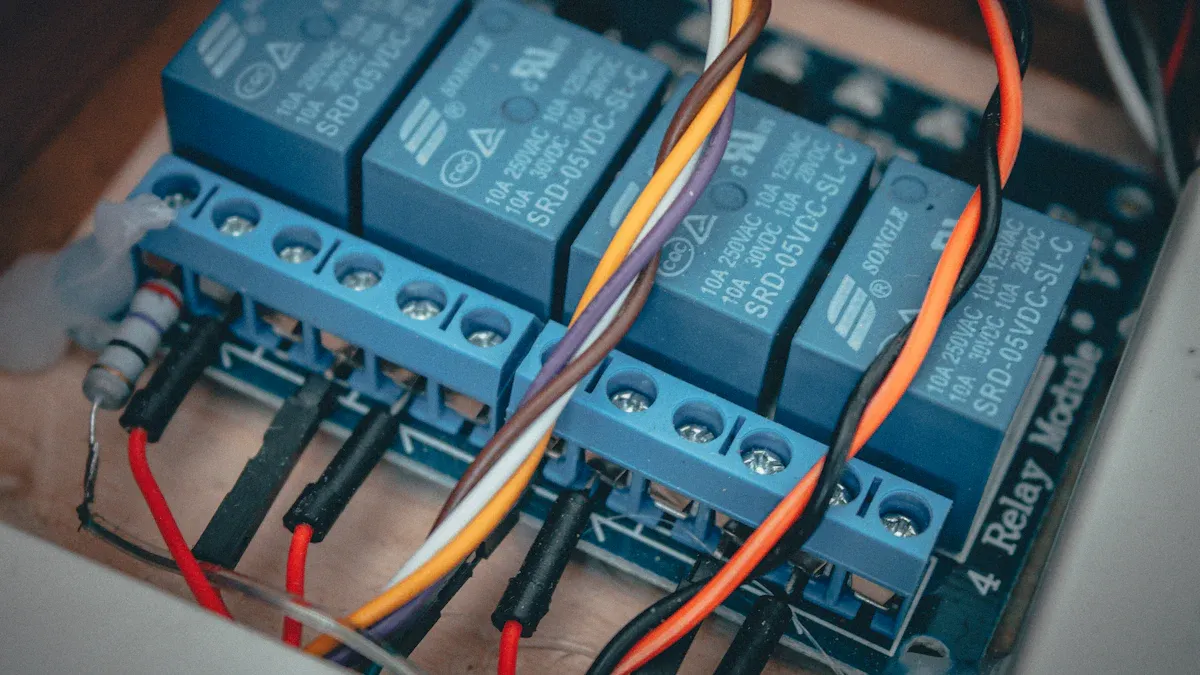
A solid-state relay, or SSR, is a special type of switch. You use it to turn electrical devices on or off without any moving parts. Instead of metal contacts, an SSR uses electronic parts like transistors, triacs, or thyristors. This design makes SSRs much faster and more reliable than old-fashioned mechanical relays. You can find SSRs in many shapes and sizes. Some fit on circuit boards, while others mount in control panels.
Tip: SSRs do not wear out as quickly as mechanical relays because they have no moving parts. This means you get a longer-lasting and quieter switch.
You can choose SSRs for different jobs. Some handle small signals, while others control large machines. For example, SSRs with integrated heat sinks can handle up to 150 amps of current. PCB-mounted SSRs work with up to 3 amps and are great for signal switching. Here is a table that shows some common types:
| SSR Type | Load Current Rating | Typical Use |
|---|---|---|
| Integrated heat sink | Up to 150 A | Control panels, heavy loads |
| Separate heat sink | Up to 90 A | Built into devices |
| Plug-in relay shape | Up to 3 A | I/O for controllers, small devices |
| PCB-mounted | Up to 3 A | Signal switching on circuit boards |
How It Works
When you send a small control signal to an SSR, it uses a light-emitting diode (LED) inside. This LED shines on a sensor, called a phototransistor, which then activates the switching part. This process is called optical isolation. It keeps the control side safe from the high-power side. Some SSRs, like the MOC3041, use a special circuit called zero-crossing detection.
This means the relay switches only when the AC voltage is near zero. This reduces electrical noise and protects your devices. SSRs can switch on or off in just 1–2 milliseconds, much faster than mechanical relays.
You need to manage heat with SSRs. They can get hot during use, so you should keep the metal base below 85°C. Some SSRs come with built-in heat sinks to help with this. SSRs can handle voltages up to 40 V DC or 28 V AC, depending on the model. This makes them useful for many different electrical projects.
AC or DC Solid-State Relay: Key Differences
Internal Components
Inside an AC or DC solid-state relay, you find different parts. Each type has special parts for its job. AC relays use a TRIAC. This part can handle AC power that changes direction. DC relays use MOSFETs. These are transistors that switch direct current fast and well. Here is a table that shows how the main parts compare:
| Aspect | TRIAC-based SSRs | MOSFET-based SSRs |
|---|---|---|
| Internal Components | Triac coupler, main triac, resistance, capacitor | Semiconductor transistors (MOSFETs) |
| Load Type | AC loads | DC loads |
| Current Capacity | Typically below 40 amps | Used for higher currents and DC applications |
| Holding Current Behavior | Has holding current; stays ON until current drops | No holding current; precise ON/OFF control |
| Switching Characteristics | Slower switching due to holding current | Faster switching, more precise control |
TRIACs work well for AC because they turn on and off with the AC wave. MOSFETs are better for DC. They do not need the current to drop to zero to turn off. This gives you faster and more accurate control with DC relays.
Tip: Always check the current rating of your solid-state relay. AC relays with TRIACs usually handle less current than DC relays with MOSFETs.
Switching Principles
How an AC or DC solid-state relay switches power depends on its design. AC relays use TRIACs or back-to-back thyristors. These parts switch the load when the AC voltage crosses zero.
This is called zero-cross switching. It helps lower electrical noise and keeps your devices safe. DC relays use MOSFETs or similar transistors. These can turn on or off at any time. This gives you instant and exact control. DC relays do not wait for the voltage to reach zero, so they switch much faster. Here is a table that shows the main differences in switching:
| Aspect | AC Solid State Relay (SSR) | DC Solid State Relay (SSR) |
|---|---|---|
| Switching Components | Triacs or back-to-back thyristors (SCRs) | Bipolar transistors, MOSFETs, or IGBTs |
| Switching Modes | Zero-cross, random, or peak switching | Transistor-based switching for DC loads |
| Switching Principle | Uses AC waveform; switches at zero crossing | Switches DC loads instantly, no zero crossing |
| Application Suitability | Designed for AC loads | Designed for DC loads |
| Incompatibility | Not suitable for DC | Not suitable for AC |
You cannot use an AC solid-state relay to switch a DC load. The TRIAC inside needs the current to drop to zero. This only happens with AC. If you use it with DC, the relay may stay on and not turn off. DC relays use MOSFETs. They do not need the current to drop to zero. This makes them great for switching DC loads like batteries or solar panels.
Why It Matters
Picking the right AC or DC solid-state relay keeps your system safe. It also helps your equipment work well. If you use the wrong type, you could break your equipment or cause danger. AC relays cannot switch DC loads because the TRIAC will not turn off. DC relays cannot handle AC loads because MOSFETs are not made for AC power that changes direction. When you match the relay to your load, you get:
- Reliable switching every time
- Longer relay life
- Safer operation for you and your devices
Note: Always read the label and check the specifications before you buy a solid-state relay. Make sure it matches your power source and the type of load you want to control.
Now you know the main differences between AC or DC solid-state relay types. This helps you make good choices for your projects and keeps everything working well.
Choosing the Right Relay
Selecting the right solid-state relay for your project helps you keep your devices safe and working well. You can follow these steps to make the best choice.
Check Power Source
Start by looking at your power source. You need to know if you are switching AC or DC power. This step is important because an AC or DC solid-state relay only works with the correct type of power.
- Make sure the relay's rated voltage matches or is higher than your load's voltage. This prevents damage and keeps your system safe.
- Check the relay's surge current rating. Your relay should handle the highest inrush current your device might draw. For example, motors and transformers can pull much more current when they start.
- Some relays have different voltage ratings for the control side and the load side. Always check both sides before you buy.
Tip: If you are not sure about your power source, look at your device's label or manual. You can also ask an electrician for help.
Identify Load Type
Next, you need to know what kind of device you want to control. Different loads need different types of relays.
- Find out if your load is resistive (like heaters or lights) or inductive (like motors or transformers).
- Calculate the average current your load uses. Divide the wattage by the voltage to get this number.
- Think about surge or inrush current. Some devices, like motors, use much more current when they first turn on. Multiply the average current by a factor (for example, 6x for motors, 10x for fluorescent lights, 20x for transformers, 1x for heaters and LEDs).
- For AC loads, choose a relay rated for your mains voltage (like 110-240 VAC). For DC loads, use a relay that matches your voltage and current needs.
Note: Using the wrong relay for your load type can cause the relay to fail or your device to stop working.
Match Relay to Application
Now, you can match the relay to your application. Use this step-by-step guide:
- Identify if you need to switch AC or DC power.
- Check the maximum voltage your load will use, including possible surges.
- Calculate the average load current.
- Determine the surge (inrush) current for your device.
- Choose a relay with ratings that meet or exceed your voltage, average current, and surge current needs.
- For AC loads, use zero-crossing relays for resistive loads and random turn-on relays for inductive loads.
- For DC loads, use protective diodes across the load to protect the relay from leftover currents.
- Add a heatsink if your relay will run hot or if the current is high.
- Follow all wiring and safety instructions, including using fuses and connecting the relay correctly.
Here is a quick table to help you decide:
| Step | What to Do |
|---|---|
| Power Source | AC or DC? |
| Voltage | Match or exceed load voltage |
| Average Current | Calculate (Wattage ÷ Voltage) |
| Surge Current | Multiply average current by device factor |
| Load Type | Resistive or Inductive? |
| Relay Type | Zero-crossing or random turn-on |
| Protection | Use diodes for DC, heatsinks for high current |
| Safety | Use fuses and follow wiring instructions |
⚡ Always double-check the relay's specifications before you buy. Make sure the relay matches your power source, load type, and current needs. This step helps you avoid costly mistakes and keeps your system safe.
You can use these steps for any AC or DC solid-state relay project. Careful selection gives you reliable performance and long-lasting equipment.
Common Uses
AC Relay Applications
AC solid-state relays are used to control big AC devices. You see them in factories, lighting, and HVAC systems. These relays help machines switch on and off fast. Many buildings use AC SSRs for lights and heating or cooling. They help save energy and make smart controls work.
AC SSRs can handle heavy loads and switch quietly. This makes them great for factories and big offices.
Here is a table with some AC relay uses:
| Application Area | Example Devices |
|---|---|
| Manufacturing | Conveyor motors, heaters |
| Lighting | Street lights, building LEDs |
| HVAC | Air conditioners, furnaces |
| Industrial Automation | Pumps, fans |
DC Relay Applications
DC solid-state relays are found in new technology. They are important in solar power, batteries, and charging stations. More people use DC SSRs as clean energy grows. You also find them in cars and phone towers. DC SSRs switch power fast and safely.
- Solar panels use DC SSRs to connect batteries.
- Electric cars use DC SSRs for charging and power.
- Telecom towers use DC SSRs for backup batteries.
DC SSRs help clean energy and smart cars grow.
Real-World Examples
You might use an AC or DC solid-state relay at home or work. For example, you can control a heater or lamp with an AC SSR. If you have solar panels, a DC SSR manages the battery. In factories, AC SSRs control motors and DC SSRs help robots. Factories use these relays to save energy and keep machines running well. Home appliances like washing machines and ovens use SSRs to last longer and work better.
Picking the right relay keeps your devices safe and reliable.
Identifying AC or DC Solid-State Relays
Labels and Markings
You can often tell if a solid-state relay is for AC or DC by looking at its labels and markings. Manufacturers print important information right on the relay case. Look for words like "AC Load" or "DC Load." You might also see voltage ranges, such as "Input: 3-32V DC, Output: 24-380V AC." This tells you the control and load types. Some relays use symbols.
A sine wave symbol means AC. A straight line with dashed lines below it means DC. You may also find the maximum current and voltage ratings. Always check these before you use the relay.
Tip: If you see both AC and DC ratings, the relay may work for both, but this is rare. Most relays are made for one type only.
Model Numbers
Model numbers give you more clues. Many brands use letters and numbers to show the relay type. For example, "SSR-25DA" means a solid-state relay (SSR) with a 25-amp rating. The "DA" at the end often means DC control and AC load. "DD" means DC control and DC load. "AA" means AC control and AC load. Here is a quick table to help you:
| Model Ending | Control Type | Load Type |
|---|---|---|
| DA | DC | AC |
| DD | DC | DC |
| AA | AC | AC |
Always check the datasheet or manual for your relay. Manufacturers sometimes use different codes.
Quick Tips
You can use a simple checklist to identify your relay:
- Check the relay's structure: single channel or dual channel.
- Look for reliability notes, such as how often you plan to use the relay.
- See if the relay offers diagnostics, like lights or test buttons.
- Find the Diagnostic Coverage (DC) rating. A higher percentage means better fault detection.
- Look for standards like ISO 13849 or safety levels (PL, SIL) if your project needs extra safety.
🛠️ Quick Tip: If your relay has a test button or indicator light, you can check if it works before installing it. Some safety relays use external device monitoring (EDM) to reach up to 99% fault detection. This helps keep your system safe.
By reading labels, checking model numbers, and using these tips, you can quickly identify the right solid-state relay for your project.
Picking the right AC or DC solid-state relay is easy if you know your power source and what you want to control. When you choose the relay that fits your needs, it switches quickly, works quietly, and lasts a long time.
This also helps stop problems like getting too hot or breaking your equipment. Use the advice in this guide to help you pick the right relay. The right relay keeps your system safe and working well. If you have any questions or want to share your story, you can leave a comment below!
FAQ
Can you use an AC solid-state relay for DC loads?
No, you cannot use an AC solid-state relay for DC loads. The relay will not turn off because the TRIAC inside needs the current to reach zero, which only happens with AC power.
How do you know if a relay is for AC or DC?
You can check the label or model number on the relay. Look for words like "AC Load" or "DC Load." You may also see symbols: a sine wave for AC or straight lines for DC.
What happens if you use the wrong type of relay?
If you use the wrong relay, your device may not work or could get damaged. For example, an AC relay on DC power may stay stuck on. Always match the relay to your power source.
Do solid-state relays need a heatsink?
Many solid-state relays need a heatsink, especially for high currents. The heatsink helps keep the relay cool and prevents overheating. Always check the relay's instructions for cooling requirements.