


You need to follow clear steps for relay testing. This helps your equipment work well. When you conduct relay testing one step at a time, you check if they protect your power system. The process mimics real electrical problems and different signals. This allows you to see if your relay can handle tough situations and maintain safety.
|
Testing Aspect |
Description |
|---|---|
|
Purpose |
To check how well protective relays work and how accurate they are. |
|
Method |
Mimicking real electrical problems and altering signal conditions. |
|
Outcome |
Ensures relays can protect the power system in various situations, reducing the risk of failures. |
|
Importance |
Helps equipment remain reliable and ensures safety systems function effectively. |
If you use a straightforward process, you can easily test and verify relays.
Key Takeaways
Test relays step by step to keep equipment safe and working well.
Use important tools like a multimeter to check coil resistance and continuity. This helps make sure relays work right.
Put safety first by following rules and wearing safety gear. This helps stop accidents when testing.
Look at relays closely to find damage or loose wires before testing.
Test relays often before installing, after upgrades, and during maintenance. This helps find problems early.
Tools and Safety for Relay Testing
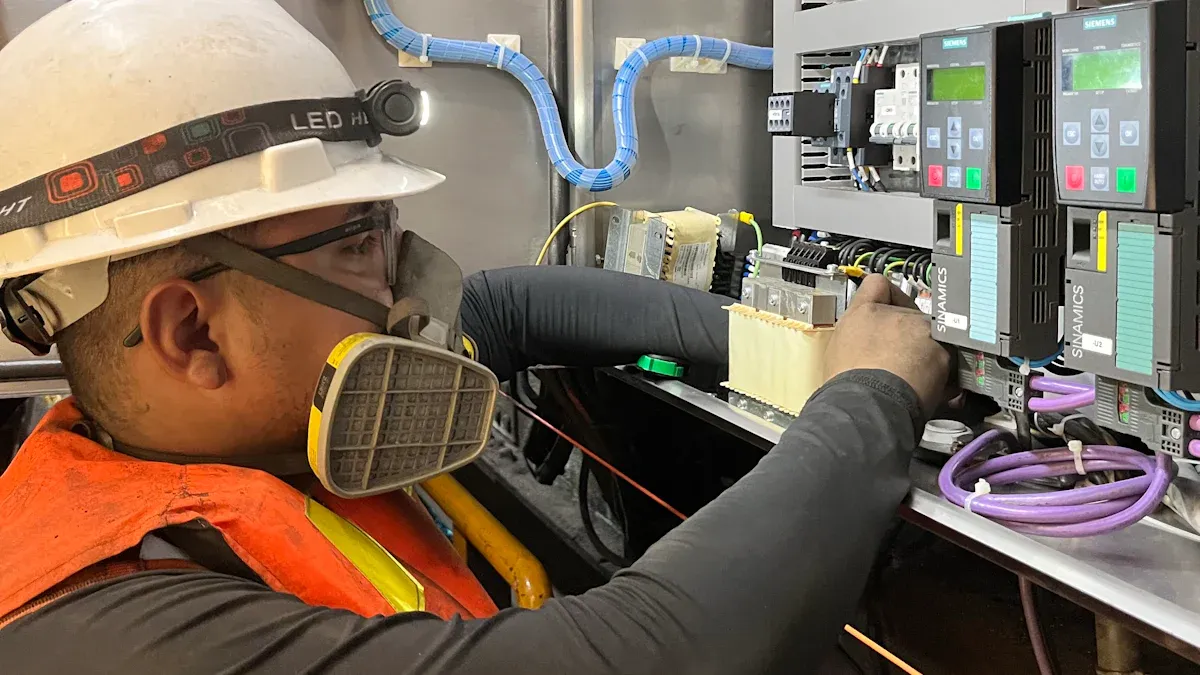
Essential Testing Tools
You need special tools to test relays. A multimeter is very important. When picking a multimeter, check for these things:
DC voltage range helps with control circuits.
Resistance range lets you check the coil.
Continuity testing makes a beep sound if connected.
Diode Test checks if the coil is healthy.
True RMS gives more correct readings.
Safety Category rating (like CAT III 600V) keeps you safe.
It should follow rules like IEC 61010-1.
It must be accurate for voltage and resistance.
Good build quality and a warranty are helpful.
PC connection or data logging helps with more checks.
You need good support and easy-to-find parts.
Wiring diagrams show how relay pins are set up. These diagrams help you see how relays use small signals to control big currents. You can look at sample diagrams to see different relay types. This helps you find problems faster.
Safety Precautions
Staying safe is very important when testing relays. You need to follow safety rules to protect yourself and your tools. The table below lists some important rules and what they cover:
|
Standard |
Description |
|---|---|
|
IEEE C37 series |
Tells how relays should work and how to test them. |
|
IEC 60255 series |
Gives steps for testing relays and built-in test parts. |
|
Test Parameters |
Lists pickup level, time delay, trip time, reset time, and accuracy. |
You also need to watch out for dangers. The table below shows some dangers and how to stay safe:
|
Safety Hazard |
Mitigation Strategy |
|---|---|
|
Electrical shocks |
Wear insulated gloves and the right safety gear. |
|
Arc flashes |
Follow safety steps and wear safety gear. |
|
Lack of risk assessment |
Check for risks before you start testing. |
|
Poor documentation |
Learn your system diagrams and relay settings. |
Tip: Always check your tools and workspace before you start. This helps stop accidents and makes your work better.
Visual Inspection Steps
Checking for Damage
Look at the relay before you test it. Use your eyes and a flashlight. This helps you find problems early. Check for cracks or broken parts. Look for burnt spots or strange colors. Make sure all pins are tight and not loose. If you see any damage, do not use the relay. Bad relays can break equipment or cause danger. Finding problems early can stop bigger issues.
Tip: Check both the top and bottom of the relay. Damage can hide in places you do not expect.
Identifying Relay Pins
You must know what each pin does before testing. Relays have different pin layouts. Use the datasheet to learn about the pins. Look for labels on the relay. You can use a multimeter to check connections. The table below shows relay types and ways to find pins:
|
Relay Type |
Pin Configuration |
Identification Method |
|---|---|---|
|
DPDT |
Pins 1 and 2 (Coil) |
Consult the datasheet |
|
Pins 3 and 4 (COM1 and COM2) |
Use relay labeling |
|
|
Pins 5 and 6 (NO1 and NO2) |
Continuity testing |
|
|
Pins 7 and 8 (NC1 and NC2) |
Understand relay symbol |
|
|
Visual inspection |
Always check the pin layout before you connect anything. This keeps your testing safe and correct.
Relay Testing Procedures
Coil Resistance Test
Start by checking the coil resistance. This helps you know if the relay coil works. Follow these steps:
Use the wiring diagram to find coil terminals.
Make sure the relay is not powered.
Set your multimeter to Ohms (Ω).
Touch the leads to the coil terminals.
Look at the reading. A good coil shows a number that is not zero or "OL" (over limit).
Compare your reading with the values in the table below.
|
Relay Type |
Coil Resistance (Ohms) |
Current (A) |
Power Consumption (W) |
|---|---|---|---|
|
10A 12V DC Relay |
120 |
0.1 |
1.2 |
|
12VDC10A Transparent Relay |
Optimized |
10 |
N/A |
|
Standard Mini 12VDC Relay |
Carefully engineered |
10 |
N/A |
|
12VDC Transparent Relay |
Varies by design |
N/A |
N/A |
Tip: If you see zero or "OL," the coil might be broken. You should get a new relay.
Contact Continuity Test
Check if the relay contacts open and close right. Use the continuity mode on your multimeter. Here is how:
Turn your multimeter to continuity mode. It will beep for a complete circuit.
For a 5-pin relay, touch probes to Pin 30 and Pin 87a. The meter should beep. This means the normally closed connection works.
Touch probes to Pin 30 and Pin 87. The meter should not beep. This means the normally open connection is open.
If you hear a beep between Pin 30 and Pin 87 when the relay is off, the relay is bad.
Connect a 9V battery to coil pins (Pin 86 and Pin 85). Listen for a click. This means the relay works.
With power on, touch probes to Pin 30 and Pin 87. The meter should beep. This means the circuit is closed.
For a 5-pin relay, check Pin 30 and Pin 87a again. The meter should not beep. This means the normally closed circuit is open.
Note: If you do not hear a click or the readings are wrong, the relay may have contact welding, pitting, coil burnout, or mechanical problems.
In-Circuit Relay Testing
You can test relays without taking them out. This saves time and shows how the relay works in real life. Here are some tips:
Use a tool like the Bartol Mag-Probe for easy testing. You do not need to unscrew or desolder anything.
The Mag-Probe helps you know if the problem is electrical or mechanical.
You can use this tool in many places, even tough spots like oil and gas.
Big companies use this tool because it works well in hot or cold places.
|
Testing Method |
Characteristics |
Accuracy Insights |
|---|---|---|
|
In-Circuit Testing |
Tests the device in its real circuit, showing real-time actions. |
May give better accuracy because you see real conditions and how parts work together. |
|
Bench Testing |
Done in a controlled place, often without the whole system. |
May miss things that happen in real life, so accuracy can be lower. |
Tip: In-circuit relay testing often gives better results because you see how the relay works with other parts.
Interpreting Results
You need to know what your multimeter readings mean. Here are signs to look for:
Set your multimeter to continuity test mode.
For normally closed (NC) contacts:
Put probes on NC terminals. The multimeter should beep.
Turn on the relay. The multimeter should stop beeping.
For normally open (NO) contacts:
Put probes on NO terminals. The multimeter should not beep.
Turn on the relay. The multimeter should beep.
If your results are not clear, try these ideas:
|
Strategy |
Description |
|---|---|
|
Continuous Improvement |
Use what you learn from mistakes to make testing better. |
|
Proactive Management |
Work with others and keep good records to help reliability. |
|
Thorough Investigation |
Test again and check notes to see what happened. |
|
Clear Communication |
Share what you find and your answers with your team. |
|
Systematic Approach |
Sort and study problems to make your testing better. |
Callout: Always test again if you see strange results. Good relay testing helps you find problems early and keep your system safe.
Relay Troubleshooting and Failures
Common Issues
Relays can stop working in many ways. This depends on what they control and where they are used. Some relays work with capacitive loads, lamps, or motors. Each type has its own problems. The table below lists some common failures:
|
Type of Load |
Common Failure Description |
|---|---|
|
Capacitive Load |
High inrush current during charging can cause severe contact ablation or welding failures. |
|
Incandescent Lamp |
Inrush current can be up to 15 times the steady-state current, leading to rapid contact corrosion or welding. |
|
Motor Load |
Large surge current at startup can cause arcing and requires robust insulation to withstand overload. |
Other things can also make relays less reliable. You should watch out for these:
Temperature changes can make parts expand or shrink.
High humidity can let water get inside and cause problems.
Electromagnetic interference from other machines can make relays act up.
High altitude means less air, so arcs are harder to stop.
Vibration or shock can make relay contacts move or not work right.
Old relays may not work as they should. They might not trip when needed or trip too easily. If settings are wrong, relays can trip for no reason. Sometimes, relays do not work together well. This can cause big power outages.
Tip: Test your relays often. This helps you find problems before they get worse.
What to Do If a Relay Fails
If a relay stops working, you need a plan. Here are steps to help you fix it:
Learn what the relay should do.
Find out the relay model and its settings.
Check if the relay has good power and tight wires.
Make sure the settings are right for your system.
Look at input and output wires to see if they are connected.
Check records or logs to find patterns.
Use secondary injection testing to see how the relay acts with fake faults.
Look at how the relay works with other relays.
Ask experts or read manuals if you need help.
Write down what you find and how you fix it.
You can also study failed relays to stop future problems. Try short circuit analysis and check time-current curves. Use relay setting math and look at diagrams. These steps help your system work better and last longer. They also make it safer and easier to grow your system.
Note: Careful checks and study help you stop problems from happening again and keep your system safe.
If you test relays step by step, your system works better. Checking relays often helps you find problems early. This can save money on repairs. Good ways to test relays are calibration, checking if they work, and writing down results. Relays last longer if you pick the right one, do not switch them too much, and use surge protection.
|
Recommended Times for Relay Testing |
|---|
|
Before switching on a new substation |
|
After system upgrades or changes |
|
During annual or scheduled maintenance |
|
Following a fault or major event |
Plan regular checks to keep your equipment safe and working well.
FAQ
How often should you test relays?
You should test relays before starting new equipment, after upgrades, during yearly maintenance, and after any major fault. Regular checks help you catch problems early and keep your system safe.
What tools do you need for relay testing?
You need a multimeter, wiring diagrams, and sometimes a Mag-Probe. These tools help you check coil resistance, contact continuity, and relay function. Always use tools that meet safety standards.
Can you test a relay without removing it from the circuit?
Yes, you can use in-circuit testing tools like the Mag-Probe. This method lets you see how the relay works in real conditions. You save time and avoid extra steps.
What does it mean if your relay does not click?
If your relay does not click, the coil may be broken or the relay may not get power. Check the coil resistance and wiring. Replace the relay if you find damage.
See also
How can you identify and reduce relay noise in your circuits
Why are relays commonly used for motor starting and protection?
Which Is Better Plug-in Relay or PCB Relay for Your Project
How to Match Solid-State Relay Parameters to Application Requirements