


To pick the right micro relay size, you should check your project's voltage, current, and switching needs. Always choose a relay that meets or goes above these numbers. Industry studies show that when you match relay size and settings to your project, your system works more reliably and clears faults faster. Add a safety margin to your ratings, and match the coil voltage to your circuit. With these simple steps, you can make safe and smart choices, even if you are new to electronics.
Key Takeaways
- Always make sure your relay's voltage and current ratings fit your project. Add a 20–30% safety margin to protect from surges and help it last longer.
- Check what kind of load you are controlling, like resistive, motor, lamp, or capacitive. Each type changes which relay you need and may need special contact materials or ratings.
- Measure the space on your circuit board. Pick a relay size that fits well but still gives enough power and keeps things safe.
- Match the relay's coil voltage exactly to your control circuit voltage. This helps stop relay failure or damage.
- Think about where your relay will be used. Use sealed relays in wet or dusty places. This helps the relay last longer and keeps your project safe.
Project Requirements
Voltage and Current
You should always start by checking the voltage and current your project needs. Most hobby projects and small industrial setups use micro relays rated for 12 volts. For example, a simple circuit might use a 12V relay with a transformer that supplies 500mA. This means your relay should handle at least 12V and a few hundred milliamps. If you use a relay with a lower rating, it may overheat or fail.
Always match the relay's voltage and current ratings to your circuit. If you are unsure, check your power supply and the devices you want to control.
Tip: Write down the highest voltage and current your project will use. This makes it easier to compare relay options later.
Load Type
The type of load you control affects your relay choice. Loads can be resistive, inductive, or capacitive. Each type behaves differently:
- Resistive loads (like heaters) draw steady current. You can match the relay rating to the load.
- Lamp loads (like bulbs) have high inrush currents. Some bulbs can draw up to 20 times their normal current when turned on.
- Motor loads need special care. Motors draw much more current at startup than when running.
- Capacitive loads (like some power supplies) cause high surges when switched on. This can weld relay contacts.
- Inductive loads (like relays or motors) create voltage spikes when turned off. You need relays with higher voltage ratings and arc suppression.
Always check the load type before picking a relay. Some loads need relays with special contact materials or extra safety features.
Safety Margin
Never choose a relay that just meets your project's needs. Add a safety margin to your voltage and current ratings. For example, if your circuit uses 12V and 500mA, pick a relay rated for at least 15V and 650mA. This extra margin protects your relay from unexpected surges or changes in your project. A good rule is to add 20–30% to your highest expected values. This keeps your project safe and helps your relay last longer.
Micro Relay Size and Fit
Physical Dimensions
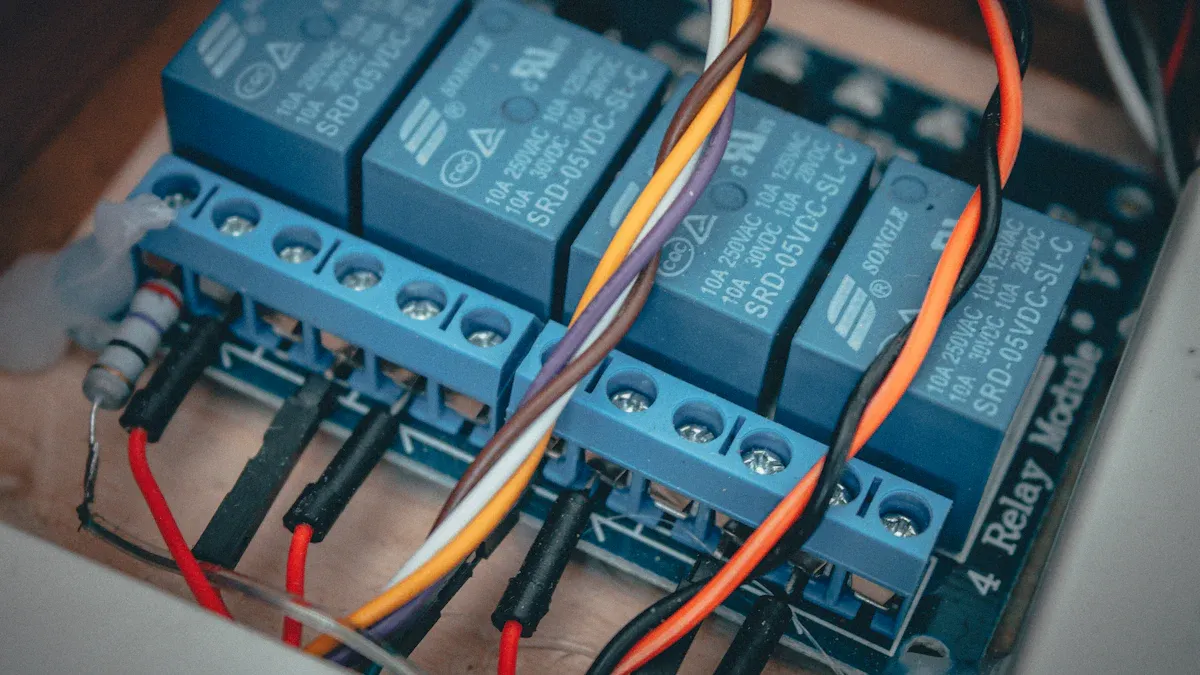
When you select a relay, you need to check its physical size. Micro relays come in many shapes and sizes. Some are as small as 10 x 6 x 5 mm. These tiny relays fit well in tight spaces. You can find the exact measurements in the relay's datasheet. Always measure the space on your board before you choose a relay. If your project has a small enclosure, a large relay will not fit.
Tip: Use a ruler or caliper to check the available space on your PCB before ordering parts.
A table can help you compare common micro relay sizes:
| Relay Type | Typical Size (mm) | Current Capacity |
|---|---|---|
| Ultra-miniature | 10 x 6 x 5 | 2A |
| Standard micro | 15 x 10 x 10 | 5A |
| Larger micro | 20 x 12 x 10 | 10A |
You should always match the micro relay size to your project's needs. Smaller relays save space but may have lower power ratings.
Space Constraints
Space on your PCB is valuable. In modern electronics, you often need to fit many parts into a small area. Choosing a smaller relay helps you save space for other components. When you use a micro relay size with fewer pins and a smaller footprint, you make assembly easier and keep your board neat. Designers often pick ultra-miniature relays for high-density layouts.
These relays work well in tight spots and still handle up to 2A of current. You must balance size with performance. If you pick a relay that is too small, it might not handle the power your project needs. If you pick one that is too large, it may not fit on your board.
Remember: Always check both the electrical and mechanical requirements before you decide on a micro relay size.
Key Relay Specifications
Coil Voltage
You must match the relay's coil voltage to your control circuit voltage. If you use the wrong coil voltage, the relay may not work or could get damaged. Always check your circuit's voltage before you choose a relay. Most micro relays come in common coil voltages like 3V, 5V, 12V, and 24V. Here are some important points to remember:
- The relay coil voltage must exactly match your control circuit voltage.
- Using a relay with a different coil voltage can cause it to overheat or fail.
- The relay's load voltage rating should be higher than the highest voltage in your circuit.
- Both the coil activation current and the contact current rating must meet or exceed your circuit's needs.
Tip: Double-check your control circuit voltage before you buy a relay. This simple step prevents many common problems.
Contact Rating
Contact rating tells you how much voltage and current the relay contacts can safely handle. You should always pick a relay with a contact rating higher than your project's maximum load. If your circuit draws 2A at 12V, choose a relay rated for at least 2.5A or 3A at 12V. This extra capacity helps your relay last longer and keeps your project safe.
| Load Type | Minimum Contact Rating Needed |
|---|---|
| Small LED | 0.5A |
| Motor (small) | 3A |
| Heater | 5A |
Never use a relay with a contact rating lower than your load. This can cause the contacts to stick or burn out.
Number of Contacts
Micro relays come with different numbers of contacts. You will see terms like SPST (Single Pole Single Throw), SPDT (Single Pole Double Throw), and DPDT (Double Pole Double Throw). The right choice depends on how many circuits you want to control.
- SPST: Controls one circuit, simple on/off.
- SPDT: Switches one circuit between two outputs.
- DPDT: Controls two circuits at once.
Pick the contact type that matches your project's needs. If you only need to turn something on or off, SPST works well. For switching between two devices, SPDT is better. For more complex control, use DPDT.
Remember: Always match the relay's coil voltage, contact rating, and contact type to your project for safe and reliable operation.
Durability and Environment

Mechanical Durability
You want your micro relay to work for a long time. Mechanical durability means how many times it can switch before breaking. Most micro relays in electronics can switch millions of times. For example, some miniature relays from ABB and Telemecanique can switch up to 10 million times. Micro switches, like ones from Unionwell, last between 100,000 and 1,000,000 times. The table below shows some common ratings:
| Source | Device Type | Mechanical Durability (cycles) |
|---|---|---|
| ABB Miniature Relay Spec | Miniature Relay | 10,000,000 |
| Telemecanique RXM2AB1BD Relay | Miniature Relay | 10,000,000 |
| Unionwell Guide | SPDT Micro Switch | 100,000 – 1,000,000 |
Tip: Pick a relay with more cycles if your project switches a lot.
Surge Current
Surge current happens when you first turn on a device. Some things, like lamps and motors, use much more current at the start. You need a relay that can handle these big surges. For example, a lamp can use up to 10 times its normal current when you turn it on. Motors can use up to 6 times their normal current at startup. The chart below shows how much surge current different loads can have:
If you do not think about surge current, your relay might stick or break early. Always check both the normal and surge ratings before you choose.
Operating Conditions
Where you use your relay changes how long it lasts and works. High heat can make it wear out faster and hurt the insulation. Cold can make parts brittle and slow the relay down. Humidity can cause rust or even short circuits inside the relay. Dust, chemicals, and shaking can also make the relay not last as long.
- Big temperature changes can make relays wear out faster.
- Humidity can cause rust or electrical problems.
- Dust and chemicals can block or hurt relay parts.
- Shaking can make connections loose.
For tough places, use sealed or strong relays to keep your project safe.
Checking and cleaning your relay often helps it last longer. If you watch the temperature and humidity, you can find problems early and keep your project working well.
Isolation and Configuration
Circuit Isolation
It is important to keep your control circuit and load circuit apart. Micro relays help you do this safely. They have a coil and contacts inside that never touch. When you send power to the relay coil, it moves the contacts.
This lets you turn things on or off without mixing the circuits. High voltage or current stays away from your control electronics. Isolation keeps your microcontroller or logic board safe from spikes or surges. If you use a relay to turn on a motor, the relay blocks dangerous voltage from the control side. This lowers the chance of damage and makes your project safer.
Tip: Always look at the relay's isolation voltage in the datasheet. Pick a relay with an isolation rating above your highest circuit voltage.
Contact Configuration
You need to pick the right contact configuration for your project. The contact type tells you how many circuits you can control and how you switch them. Here are some common choices:
- SPDT (Single Pole Double Throw): This relay has one main terminal and two outputs. One output is Normally Open (NO) and the other is Normally Closed (NC). You can control two circuits with one relay. SPDT relays are good for switching between main and backup power.
- They also work for changing motor direction, switching signals, or making interlock systems.
- DPDT (Double Pole Double Throw): This relay has two sets of SPDT contacts. You can switch two circuits at once and keep them apart.
- DPDT relays help you make more complex control systems. They are used for process control or advanced sequencing.
- Other Types: Some relays have force-guided contacts or extra safety features. Solid state relays are best for fast switching and sensitive loads.
You should pick the relay type that fits your project. Think about how many circuits you need to control. Also think about the voltage,
current, and any special safety rules. The right contact configuration gives you more control and keeps your project safe.
Matching Specs to Needs
Data Sheet Comparison
When you choose a relay, you need to compare your project's needs to the relay's data sheet. The data sheet gives you all the important details about the relay. You should look for these key parameters:
- Coil voltage: This must match your control circuit voltage. If it does not match, the relay may not work or could get damaged.
- Load voltage: This should be higher than the highest voltage your project will use. This keeps switching safe and reliable.
- Current requirements: Check both the coil current (to turn the relay on) and the contact current (the current that flows through the relay when it is on).
- Contact material: Some materials last longer or work better with certain loads. Good contact material helps your relay last longer.
- Operating time: This tells you how fast the relay can switch on or off. Fast switching is important for some projects.
- Life expectancy: This shows how many times the relay can switch before it wears out.
- Maximum switching voltage: This is the highest voltage the relay can handle during switching. If you go over this, the contacts can get damaged.
- Cold switching voltage: This is the highest voltage the relay can handle when it is not switching a load.
- Switch current: This is the most current the relay contacts can carry. Make sure this matches your project's needs.
- Special features: Some relays have extra features like status lights or manual switches.
Tip: Always check the physical micro relay size in the data sheet. Make sure it fits your project's space and matches your power needs.
You can use a table to compare your project's requirements to the relay's data sheet:
| Parameter | Your Project Needs | Relay Data Sheet Value | Meets Needs? |
|---|---|---|---|
| Coil Voltage | 5V | 5V | ✅ |
| Load Voltage | 12V | 24V | ✅ |
| Contact Current | 2A | 3A | ✅ |
| Micro Relay Size | 15 x 10 x 10 mm | 15 x 10 x 10 mm | ✅ |
| Life Expectancy | 100,000 cycles | 1,000,000 cycles | ✅ |
If you see a ❌, you should look for another relay.
Applying Safety Margins
You should never pick a relay that just meets your project's highest voltage or current. Always add a safety margin. This helps your relay last longer and keeps your project safe from sudden surges or changes.
A good rule is to add 20–30% to your highest voltage and current values. For example, if your project uses 10V and 1A, you should choose a relay rated for at least 12V and 1.3A. This extra margin protects your relay from overheating or failing when your project has a power spike. Here is a simple way to calculate your safety margin:
Project Maximum Value x 1.2 = Minimum Relay Rating
So, if your project needs 2A, you should look for a relay rated for at least 2.4A.
Note: Safety margins are important for both electrical ratings and micro relay size. If your relay is too small, it may not handle the heat or current, even if the data sheet says it can.
You should also think about the space on your PCB. If you pick a micro relay size that is too small, it may not handle the power, even with a safety margin. Always balance size and performance.
By comparing your project's needs to the data sheet and adding a safety margin, you make sure your relay works safely and lasts longer. This step helps you avoid common problems and keeps your project running smoothly.
Common Mistakes
Undersized Relays
Some people pick a small relay to save space or money. But if the relay is too small, it can get too hot or stop working. This can break your project and make it unsafe. Always check the relay's voltage and current ratings. These numbers should be higher than what your project needs. This is very important if you use motors or lamps that need more power when starting. If you use a relay with the wrong coil voltage, it might not turn on or could burn out fast.
Tip: Write down the highest voltage and current your project uses. Add 20–30% more before picking your relay.
Ignoring Environment
Many people forget to think about where the relay will be used. If you use an open relay outside or in a factory, water or dust can get inside and break it. Cleaning open relays in wet places often needs strong chemicals. These chemicals can hurt the environment. Sealed relays let you clean with safer methods and keep out water and dirt. Not thinking about the environment can cause bigger problems for people and nature. It can even hurt future generations.
- Open relays in wet places need cleaning with strong chemicals.
- Sealed relays can be cleaned with safer, water-based cleaners.
- Not thinking about the environment can cause more harm and raise ethical issues.
- Good design helps your project and protects the environment.
Overlooking Isolation
If you do not use good circuit isolation, your project may not be safe. One problem can make many relays stop working at the same time. This makes backup systems useless and can be dangerous. It is also harder to find out what is wrong if relays are not isolated. You should always follow the manufacturer's rules for isolation and the environment. This keeps your system safe.
- Bad isolation can make many relays fail together.
- It is easier to check for problems with isolated contacts.
- Not using isolation makes dangerous failures more likely.
Quick Tips to Avoid These Pitfalls
- Make sure relay specs match your project's manual and needs.
- Check the temperature, humidity, dust, and gases where your project is.
- Use the right control signal for your relay type (rectangular for DC, sine for AC).
- Never use relays that are dropped or damaged.
- Set latching relays to the right position before using them.
- Double-check coil polarity for polarized relays.
- Watch for contact protection, coil specs, voltage, and how you install the relay.
- Handle sensitive parts, like 12V timers, carefully.
- Ask the manufacturer for help if you are not sure.
Doing these things helps you avoid mistakes and keeps your project safe and working well.
You can find the right relay for your project by following some easy steps. Start by looking at how much voltage and current your project needs. Think about what kind of load you will control. Then, make sure the relay will fit in your project space. Always look at the relay's specs and think about where you will use it. Use a checklist to help you avoid mistakes:
- Make sure the coil voltage and contact ratings are correct
- See if the relay can handle surge current
- Check that your wiring and load will work with the relay
Always check every rating and read datasheets from good brands. This helps stop problems and keeps your project safe.
FAQ
How do I know if my relay is too small for my project?
If your relay gets hot, makes clicking noises, or stops working, it may be too small. Always check the voltage and current ratings. Pick a relay with at least 20% higher ratings than your project needs.
Can I use any relay coil voltage in my circuit?
No. You must match the relay coil voltage to your control circuit voltage. Using the wrong voltage can damage the relay or make it fail to switch. Always double-check before you buy.
What happens if I ignore surge current?
Ignoring surge current can cause relay contacts to stick or burn. Motors and lamps often have high surge currents. Always check the surge rating in the relay's datasheet.
Do I need a sealed relay for outdoor projects?
Yes, you should use a sealed relay for outdoor or dusty places. Sealed relays keep out water, dust, and dirt. This helps your relay last longer and keeps your project safe.
How can I quickly compare relay options?
Make a table with your project's needs and the relay specs. Example: